Plea bargains keep America’s courts running. Guilt or innocence barely matters
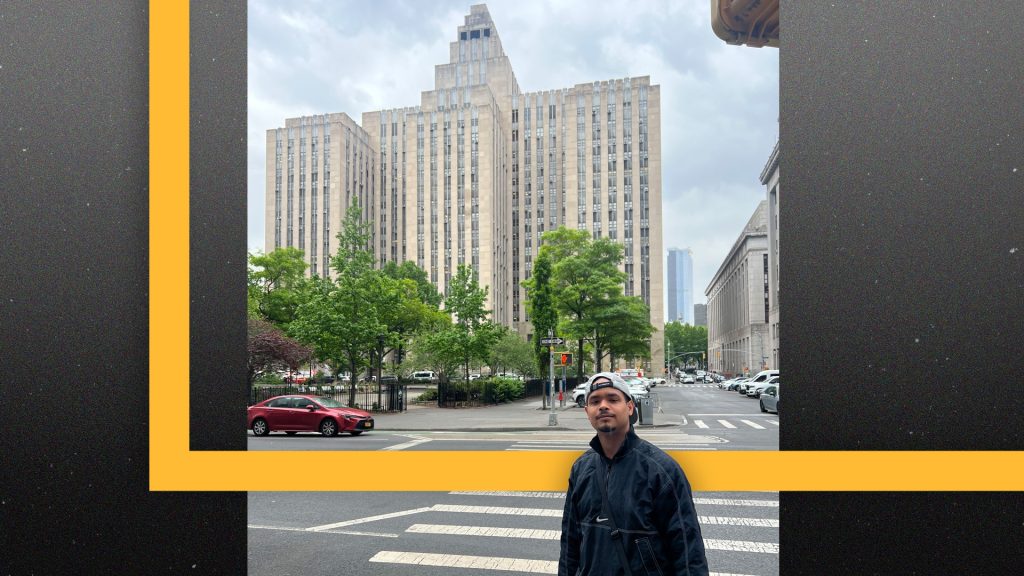
NEW YORK — When Emile Herrera Acosta agreed to plead guilty, he had already been locked up for three months on Rikers Island.
While awaiting his court date at New York’s infamous jail complex, the 23-year-old got COVID-19, endured weeks of medical processing — including blood testing and STD tests — and lived in a cell so cramped that he and another prisoner had to squeeze past each other to reach the toilet.
The conditions took a toll.
“The food was so horrible, I couldn’t go to the bathroom for 16 days,” Acosta told Straight Arrow. “When I finally did, the guys could hear me screaming and said it sounded like I was giving birth.”
Acosta had been arrested after a fight with his cousin’s boyfriend. Because a knife was involved, he was charged with attempted murder. Because his cousin’s child was present, he was also charged with child endangerment. If a jury convicted him, he faced more than 26 years in prison.
But about three months into his time at Rikers, prosecutors offered him a deal: If he pleaded guilty to attempted assault — still a felony, but a significantly less serious offense — Acosta would be sentenced to six months in jail and five years of probation. He would be free in just a few weeks.
By the time he stood before a judge, Acosta was willing to accept any offer, so long as it got him out of Rikers.
“The judge was asking, ‘Do you understand what I’m saying?’” Acosta said recently. “I was just agreeing to whatever they said. I was so nervous, my heart was going crazy.”
“I just needed to be out,” he said.
No jury would ever consider his guilt or innocence. Acosta would never present a defense, or be allowed to mount an appeal. Whether he was guilty as charged was all but irrelevant.
It’s exactly how almost every single criminal case in America ends.
‘A system of pleas, not a system of trials’
The Constitution’s Sixth Amendment guarantees the right to “a public and speedy trial.” But a trial decided by a jury of one’s peers has become vanishingly rare.
Plea bargains like Acosta’s are the engine of America’s criminal justice system. Without them, many legal experts say, the system would simply stall out.
“Frankly, I’m not sure that it is even possible to seat sufficient jurors for every case, and that’s just one piece of a complex system,” Michael Holley, the district attorney of Montgomery County, Texas, a Houston suburb, told Straight Arrow. “… Most prosecutor’s offices in the country are understaffed, and there are not enough defense attorneys to represent clients. I see no means by which you could provide enough lawyers to try every case. And you would need not just lawyers, but trial lawyers. And trial lawyers are fairly rare.”

Today, more than 90% of convictions come from plea bargaining. In large urban areas, that number rises to 97%.
Even in federal court, where far fewer cases are heard, defendants take plea deals in nearly 98% of cases, according to the U.S. Sentencing Commission.
“As the U.S. Supreme Court has noted, the justice system has become a system of pleas, not a system of trials,” Michael Dougherty, the district attorney in Boulder County, Colorado, told Straight Arrow. “Without plea bargains, the system would become completely logjammed in a justice system that already takes way too long. It would take much longer if every case went to trial.”
‘The best offer’
Even if they profess their innocence, defendants often are encouraged — by prosecutors, judges, even their own lawyers — to accept plea deals. They can often count on relatively short sentences without the risk that a jury would throw the book at them. Or they can get out of jail immediately, rather than having to wait weeks, months or years to go to trial. That’s an especially appealing enticement to defendants who cannot afford to post bail or those who don’t have sharp lawyers who might be more likely to win an acquittal.
Legal scholars trace plea bargaining in the United States to the 19th century, a time when police departments were expanding, arrests were increasing and judges’ case loads were swelling.
“But in order for plea bargaining to truly become the criminal justice system, the legal profession would have to accept and internalize it,” William Ortman, a law professor at the University of Georgia, wrote in the Boston University Law Review. “That was not its first reaction.”
“When legal scholars and reformers in the 1920s discovered that bargaining dominated America’s criminal courts, they quickly denounced it as abusive,” Ortman wrote. “By the 1960s, only four decades later, the legal profession had learned to love it.”
Mary Warner, a New Jersey-based defense lawyer, said limited resources and issues such as mass incarceration helped make plea bargaining ubiquitous.
“The plea came about as a way of not having to go to trial,” Warner told Straight Arrow. “Now, criminal defense attorneys need to get evidence and due diligence as quickly as possible in the beginning of the process so they can weigh the first plea that comes in, as that will be the best offer.”
The Supreme Court has largely endorsed plea bargaining as a necessary tool to keep courts running efficiently.
“Done properly, the plea system is a very good system because it opens up the courts to try cases where there are truly factual and legal questions,” Warner said. “If each and every case went to trial, the whole system would crumble under its own weight.”
‘Nothing to do with truth-finding’
For defendants like Acosta, plea deals are offers they can hardly refuse.
He found life in jail untenable, he couldn’t afford the $370,000 bail set by a judge, and waiting for a trial in New York’s chaotic and crowded court system could have kept him behind bars for a seemingly interminable period — even if he was ultimately found not guilty.
“Because the system is so coercive, so many clients have to accept pleas,” Rachael Sutherland, a supervising attorney in a New Mexico public defender’s office, told Straight Arrow. “I don’t really think any plea is ‘fair’ because it is fundamentally coercive, in some capacity.”
“Pleas have nothing to do with truth-finding,” Sutherland added. “Frankly, our system has nothing to do with truth-finding.”
Acosta was charged with attempted murder, but the negotiations between his lawyer and prosecutors had little to do with whether he intended — or even tried — to kill his cousin’s boyfriend. But the elevated charge provided a strong incentive for him to accept a plea deal because he might spend decades in prison if a jury convicted him.
Defense lawyers and others say overcharging — or stacking charges — is a common strategy used by prosecutors to coerce defendants into pleading guilty to lesser charges.
“The stacking of charges has become standard practices to build such a horrifying potential sentence, that even actually innocent people will be intimidated into pleading guilty, rather than face what’s called the ‘trial penalty’ — a very scary long sentence if the defendant should somehow be convicted at trial,” the NAACP said in a resolution titled “Opposition to Stacking Charges,” adopted in 2019.
Prosecutors can use several means to threaten draconian sentences. They might take a single act, such as committing fraud, and file a separate charge for each act, increasing the potential prison sentence exponentially. Or they might merge multiple offenses together to turn what would have been a misdemeanor into a felony, increasing the time a defendant might spend in prison.
By the time most defendants hear about a plea deal, “you haven’t eaten properly, you don’t have full resources of gyms, programs,” Warner said. “When you’re in jail, you have less freedom than when you’re in prison. So here you have someone incarcerated in what is supposed to be a temporary incarceration and all they want is out. Some will take offers that may not exactly be reflective of the degree of their crime.”
“It’s a nice way of saying,” she said, “that the punishment exceeds the crime.”
A life-changing deal

Acosta grew up in the Dominican Republic. His father is an architect and, since 2010, a U.S. citizen. His mother works for the Dominican government.
“My parents in the DR are very well situated,” Acosta said. “I came to America to make my own way.”
His plea bargain changed his life.
He walked out of jail about a month after he went to court to plead guilty. But he would have to serve five years on probation, reporting weekly at first and then every other week. If he didn’t, he could be locked up again.
And, thanks to his guilty plea, he also carried the stigma of a criminal conviction.
His probation officer helped him get a job in Hunts Point, Queens, working for a company that employs formerly incarcerated people. He’s still there, mainly working in refrigeration.
“I take the bus to work six days a week,” Acosta said. “Most everyone has been locked up in prison there. But they treat me well. They give us the lowest paycheck — but you know, I still appreciate the opportunity they’re giving us.”
Acosta completed his probation in March. That allowed him to visit his family in the Dominican Republic for the first time in six years.
But his criminal record still looms large.
As he re-entered the United States from the Dominican Republic, officers from the Department of Homeland Security stopped him for interrogation.
“They had me in a room for three hours,” Acosta said, and questioned him about his criminal history.
“They told me,” he said, “pleading guilty didn’t help me.”
Round out your reading
- Tennessee officials will pay $835,000 for jailing man over Charlie Kirk meme.
- Why the immune system turns on women more often than men.
- More than 340 newspapers block the Wayback Machine. What that means for the future of the internet.
- Why Rep. Cohen filed articles of impeachment against Supreme Court Justice John Roberts.
- We’re building a new Straight Arrow. Help us shape our future by taking our survey.
Ella Rae Greene, Editor In Chief