The AI campaign season is here. Ready to see a MAGA candidate with AOC?
Last Friday, in deep-red Oklahoma, residents may have caught a glimpse of a “lifelong Republican” smiling at them, with a pin on his chest featuring Barack Obama.
A week later in California, viewers saw three men in a sunny backyard, sipping beers and repeating the same phrase as they discovered reasons to support the same Republican mayoral candidate. “I’m not MAGA or anything,” they said.
None of those scenes occurred in reality, but they did appear in content promoting candidates in competitive elections. And none included text identifying the images as having been generated by artificial intelligence.
Recent technological improvements have made it easier and cheaper to create images, ranging in verisimilitude. Some images are immediately recognizable as computer-generated. Some were, arguably, passable as realistic to a casual observer, like the video of the three unidentified men in California.
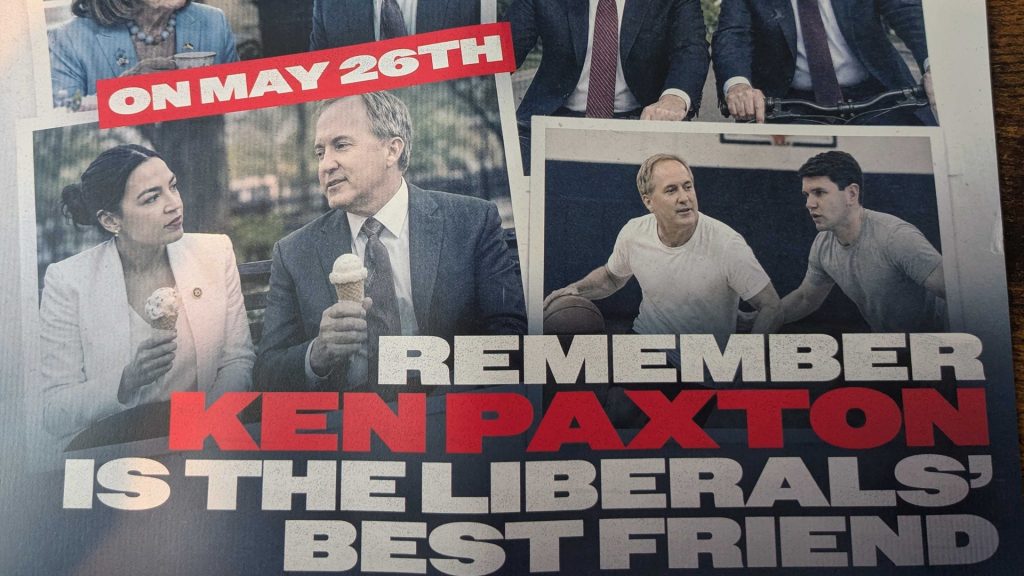
But others, like the ad attacking Oklahoma gubernatorial candidate Charles McCall, appeared photo-realistic. As was a paid mailer sent by Sen. John Cornyn’s campaign this week in Texas, where he is in a run-off against a Trump-backed MAGA challenger.
The mailer shows that challenger, Ken Paxton, cavorting with well-known Democrats: he’s seen eating ice cream with Rep. Alexandria Ocasio-Cortez, riding bicycles with Senate Minority Leader Chuck Schumer, playing basketball with Democratic senate nominee James Talarico, and listening to House Speaker Nancy Pelosi who, for some reason, is holding a teacup.
The Cornyn campaign declined to comment.
Communication experts and lawmakers on both sides of the aisle have warned that, as it becomes easier, cheaper and faster to create real-looking images, the harder it may become for voters to trust what they see or hear.
“I would argue we’re just past the point where AI does generate indistinguishable content,” said Rick Wilson, a longtime admaker and co-founder of the anti-Trump group The Lincoln Project.
“It kind of freaks me out a bit, I’m not going to lie,” Wilson added in an interview with Straight Arrow.
Not only is AI changing the content of ads, but also the speed at which they can be produced, according to Wilson. “The speed of ads was always constrained by finding human talent,” he said. Now, an ad could be made using a prompt like “generate a 45-year-old woman facing economic pressure,” he said.
AI-generated images have been most visible in the Los Angeles mayoral race, where the strongest challenger to the Democratic incumbent is a Republican whose first-time candidacy is being promoted by AI-generated videos that are garnering millions of views online.
One video depicting a multi-ethnic group of women at a pilates studio, all saying they support the Republican candidate, Spencer Pratt, has 1.9 million views on X. The video of the three men has more than 2.2 million views. A Star Wars-themed video has 3 million views. A video showing Pratt as Batman leading a tomato-throwing crowd against a Joker-painted Mayor Karen Bass and regal-looking Gov. Gavin Newsom has more than 5 million views. And that’s just in May.
The effectiveness of using AI in ads can vary. One study last year found that “genAI-created ads consistently outperform both human-and genAI-modified ads, increasing click-through rates by up to 19% in field settings.” That same study also found that “disclosing AI involvement in ad generation significantly reduces advertising effectiveness by up to 31.5%, underscoring trade-offs relevant to evolving AI disclosure policies.”
Currently, there is no mandate requiring campaign ads to “alert the audience, or regulators, to the presence of AI-generated content,” according to a report from the Congressional Research Service from Sept. 2025. The report also noted that the American Association of Political Consultants issued a statement in 2023 condemning “deceptive generative AI content in political campaigns.”
Lawmakers have introduced legislation to address the use of AI in ads, including in 2023 by Rep. Yvette Clarke, D-New York, and last year, by Sen. Amy Klobuchar, D-Minn. Both pieces of legislation were referred to committee and did not come up for a vote.
Whether campaign ads eventually are required to have a disclosure about AI, it still may not prevent the spread of misinformation, according to one expert.
Professor Michelle Nelson, who teaches media literacy and campaign advertising at the University of Illinois Urbana-Champaign, told Straight Arrow that people may remember an image, but, over time, they may forget what disclosures may have come with it.
It is a phenomenon, she said, that researchers call the “sleeper effect,” in which the impact of a negative message increases over time as details mitigating the attack are forgotten.
“Our memory,” Nelson said, “is faulty.”
Ella Rae Greene, Editor In Chief