Google attempts to distance itself from smart glasses backlash with ‘intelligent eyewear’
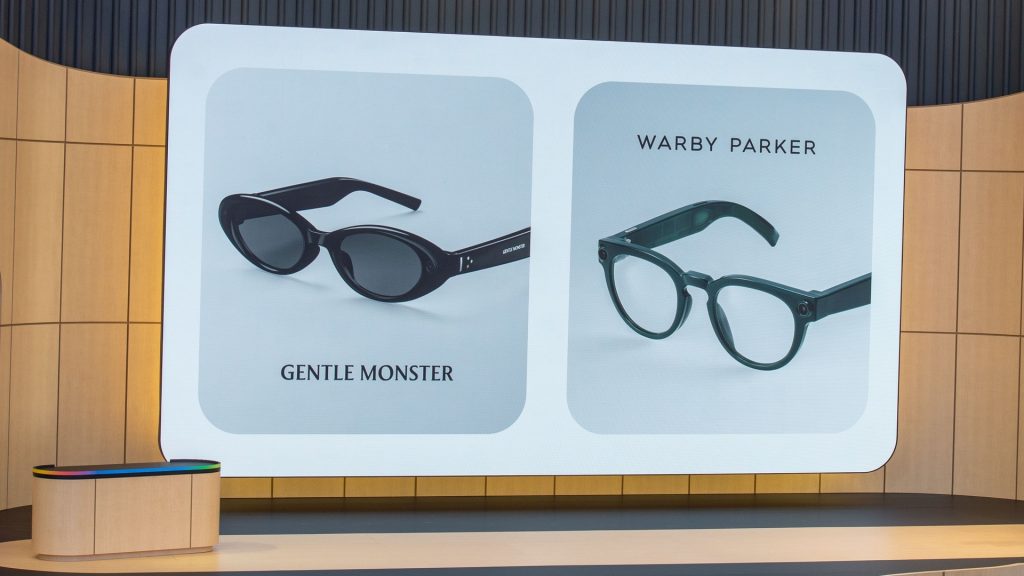
Google has unveiled plans for “intelligent eyewear,” the company’s foray into AI-powered smart glasses. The announcement, made at the Google I/O 2026 conference on Tuesday, comes amid a growing backlash against smart glasses over privacy concerns.
The company is not referring to its products as “smart glasses,” however, as the term has gained notoriety among privacy advocates and government officials.
The first product in Google’s intelligent eyewear line, known as “audio glasses,” will launch in the fall. Google says it will roll out its second product, known as “display glasses,” later.
The audio glasses, developed in partnership with Samsung and eyewear brands Gentle Monster and Warby Parker, let users speak with Google’s AI chatbot Gemini and receive responses through ear speakers in the glasses. The display glasses, also powered by Gemini, will display information such as translations and turn-by-turn directions right in front of the wearer’s eyes.
Intelligent eyewear users will be able to connect the smart glasses to either their iOS or Android devices to manage calls, send texts, play music and take photos and videos. While both models will allow for recording video, a press release from Google only mentions the capability once.
The announcement signals Google’s first attempt to return to the smart glasses space since it introduced “Google Glass” in 2013. The project was pulled in 2015 after pushback from the public, which referred to wearers as “Glassholes” because of the technology’s intrusive nature.
Smart glasses remain in a controversial space, especially in light of plans by Meta to introduce facial recognition into its own product. A memo from last May, first reported by The New York Times, revealed Meta’s plans to introduce facial recognition to its Ray Ban smart glasses at a time when it believed pushback would be minimal.
Meta has promised to implement safeguards, such as only allowing the glasses to identify people the wearer has previously connected with on Meta platforms such as Facebook and Instagram. But privacy advocates remain unconvinced.
The dangers of such capabilities were made apparent in 2024 when two students at Harvard integrated facial recognition into Meta’s smart glasses. The pair were able to instantly learn the identities of anyone they looked at and uncover their names, phone numbers, and home addresses.
Contractors for Meta also recently revealed that they had been tasked with reviewing highly sensitive footage recorded by the company’s smart glasses in order to train its AI. The contractors, based in Nairobi, Kenya, said they witnessed users of smart glasses engaged in everything from sexual acts to using the bathroom.
Meta’s smart glasses are even being referred to online as “pervert glasses” over their use by men to film women without their consent.
On Wednesday, Texas Attorney General Ken Paxton announced an investigation into Meta’s smart glasses over privacy concerns as well as “the capabilities of the glasses to expose Texans’ private data, recordings, and facial geometry.”
Outside of the private sector, government entities such as the Department of Homeland Security are also developing smart glasses for use in immigration enforcement. A group of Democratic senators sent a letter to DHS last week demanding that the project be scrapped given the potential for abuse.
Concerns over smart glasses have led to the development of numerous apps and tools designed to alert users to their presence. Regardless of the concerns, tech companies appear committed to pushing smart glasses forward.
Round out your reading
- They built an Epstein files library, but realized they couldn’t let everyone read them.
- The doctor who claims functional medicine reversed her MS.
- For many Americans, ‘one more round’ no longer serves their lifestyle or budget.
- Trump claimed economic data is ‘rigged.’ Former officials pledge to ‘watch like hawks’ for political manipulation.
- We’re building a new Straight Arrow. Help us shape our future by taking our survey.
Ella Rae Greene, Editor In Chief