Politicians fueling the rising occurrence of Islamophobia
The deadly attack on a San Diego mosque and the subsequent hate crime investigation have led to a discussion on Islamophobia in the U.S. and how certain politicians are adding fuel to the problem.
Groups like the Council on American-Islamic Relations say Islamophobia has reached an all-time high, even higher than it was directly after the 9/11 terror attacks. But these groups are criticizing Republicans for not doing more to stop the anti-Muslim messaging some of its members are putting out.
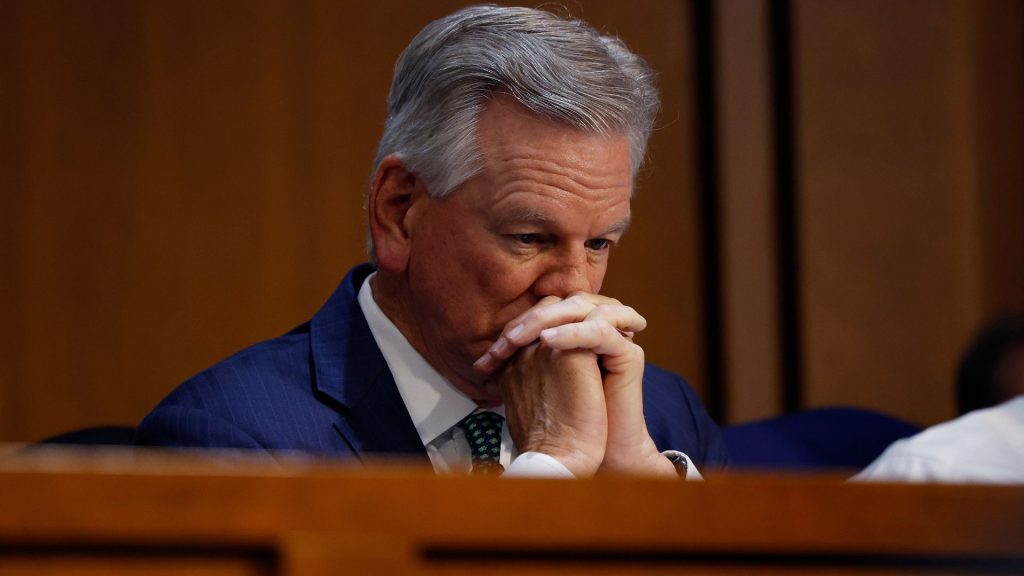
Sen. Tommy Tuberville, R-Ala., has recently attacked Muslim Americans, saying “Islamists are the enemy.” But others have gone further.
What have Republicans said about Muslim Americans?
Since the beginning of the year, nearly half a dozen Republicans, including Tuberville, have stirred controversy regarding comments made against Islam.
Tuberville’s comments came after Zohran Mamdani won his election to mayor of New York City. The senator received pushback after posting a side-by-side image of Mamdani next to the 9/11 terrorist attacks with the caption “The enemy is inside the gates.” However, after reporters asked him whether he had received pushback from his Republican colleagues, he doubled down.
“To be clear, I didn’t ‘suggest’ Islamists are the enemy. I said it plainly,” Tuberville said.
Other Republicans, like Tennessee Rep. Andy Ogles, were direct in their attacks, saying that “Muslims don’t belong in American society.” Rep. Randy Fine, R-Fla., even encouraged more Islamophobia.
“We need more Islamophobia, not less,” NPR reported him saying. “Fear of Islam is rational.”
Fine had previously gotten pushback after saying, “If they force us to choose, the choice between dogs and Muslims is not a difficult one.”
The Islamophobia within the Republican Party goes so deep that 60 Congressional Republicans are in a “Sharia-Free America” caucus. Republicans have also spent millions of dollars on TV ads mentioning Islam negatively, NPR reports.
House Speaker Mike Johnson, R-La., agreed with the fear but made the distinction that it was about Sharia law, not Muslim Americans.
“Look, there’s a lot of energy in the country and a lot of popular sentiment that the demand to impose Sharia law in America is a serious problem — that’s what animates this,” Johnson said. “It is not about people as Muslims.”
Is Sharia law an issue in the US?
Many Republicans bring up Sharia law when they discuss grievances towards Islam. In its most basic description, it’s a conservative religious code derived from the Quran, Islam’s holiest book.
Many nations, like Saudi Arabia, Iran, and Afghanistan, use it as a basis for their own legal systems. But there are no documented cases of Sharia law being used or replacing constitutional law in the U.S.
Instead, there are niche cases in which religious courts are used to settle or arbitrate civil matters, like business disputes. There are also cases when Muslim couples divorce and the man must pay a mahr, or financial payment, to the woman’s family.
Both of these examples are completely legal, and Americans are free to practice Sharia law if they like. But the Constitution’s Establishment Clause also prevents it from being made a state religious doctrine. Any religious law, including Sharia, Christian canon law, or the Jewish Halakha, is also prohibited.
How does rhetoric influence violence?
Research and studies have overwhelmingly found that violent and oppressive rhetoric from lawmakers can make political violence more likely. According to research from the Brookings Institution, anti-Muslim rhetoric on social media platforms like Facebook intensified in 2016, following remarks made by then-candidate Donald Trump. This led supporters to post more anti-Muslim content online, which led to more attention by the media. In the following days, Brookings noted that crimes against Muslims increased by 32%.
According to one study, nations where politicians frequently or habitually employ hate speech recorded a higher volume of domestic terrorist events compared to those where such rhetoric is seldom or never utilized. In countries where politicians rarely used it, those countries only experienced 12.5 domestic terrorist incidents on average between 2000 and 2017. But in countries where politicians used hate speech often or extremely often experienced an average of 107.9 domestic terrorist attacks over the same period.
Researchers say, at the very least, this rhetoric is scaring Americans, especially Muslim Americans.
“If the people who govern your state define you like that, what may come next?” asked Mustafa Akyol, a senior fellow at the Center for Global Liberty and Prosperity at the Cato Institute, a libertarian think tank. “Maybe a legal step against you, or some fanatic who really believes in that can take his machine gun and attack you.”
Round out your reading
- They built an Epstein files library, but realized they couldn’t let everyone read them.
- The doctor who claims functional medicine reversed her MS.
- For many Americans, ‘one more round’ no longer serves their lifestyle or budget.
- Trump claimed economic data is ‘rigged.’ Former officials pledge to ‘watch like hawks’ for political manipulation.
- We’re building a new Straight Arrow. Help us shape our future by taking our survey.
Ella Rae Greene, Editor In Chief