Is nothing sacred? Rising beef prices end a beloved Texas tradition
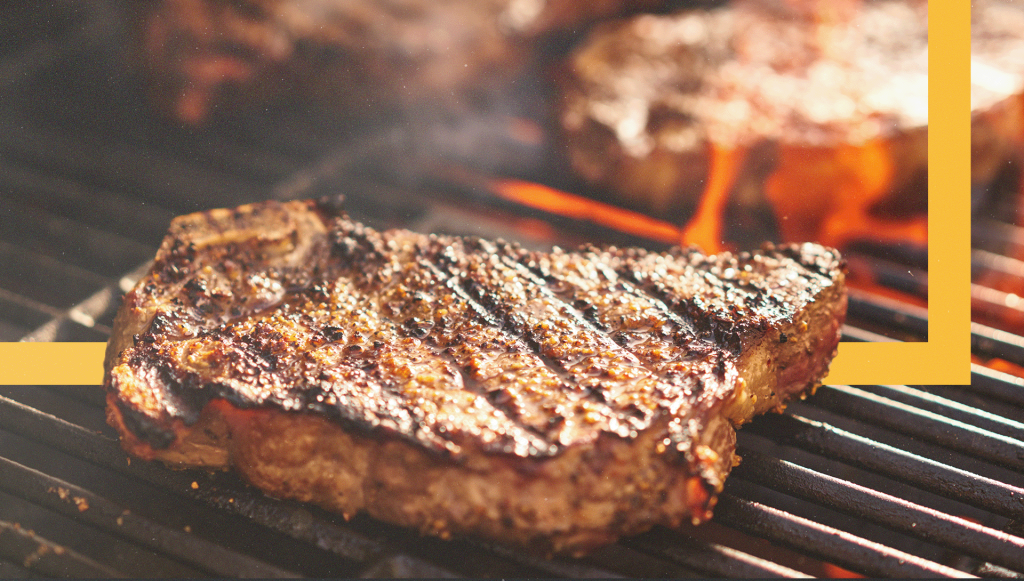
HOUSTON — The death notice arrived digitally: a fade-to-sepia montage loaded onto Instagram over Sarah McLachlan’s mournful goodbye ballad:
“I will remember you…”
Sixteen-ounce ribeyes, crowned with slabs of butter, whirled through the photo carousel posted by Moontower Inn, a neighborhood bar in Houston’s East End.
“…Will you remember me…”
Marisa Campbell couldn’t turn away. She knew she had to make it to the steak wake and pay her respects to a neighborhood mainstay forced to call it quits due to a sharp increase in beef prices.
“When we heard the Sarah song, it was like, ‘We have to go,’” she told Straight Arrow as she stood in line at Moontower Inn on a balmy Thursday evening in early May. “We have to throw it down for one more steak night.”

Bar steak nights have long been a Houston tradition — a ritual that allowed young-and-hungry Houstonians to feel, for one night a week, as though they sat atop the Texas food chain. For much of the 2010s, bars across the city offered a nice slab of meat and a loaded baked potato for under $20 on what traditionally had been slower weeknights. By the 2020s, most of those prices jumped over the $20 mark.
At Moontower, or the now-defunct Front Porch Pub a few miles away, steak night crowds snagged spots on weather-warped picnic tables for the weekly rite. It was never supposed to be fancy, or bust a budget. But as the price of beef climbs ever upward — pushed by a shrinking state herd and an insatiable national hunger for protein — Moontower’s math problem has become unsolvable.
“Charging somebody $35, $40 for a plate here just did not work in our minds,” said Ian Arocha, the bar’s general manager. “It ceases to feel special, and it feels like a slap in the face to your customers.”
So on the first Thursday evening in May, Arocha and his team grilled up one last batch of $24 ribeyes, and sunsetted steak night.
Why are beef prices rising?
Across the nation, the price of beef has steadily climbed for the past several years.
“There’s no longer cheap steak to have a quote-unquote cheap steak night,” said Glynn Tonsor, a meat and livestock economist at Kansas State University.
The market situations driving this issue are complex, with roots in both the supply and demand sides of the curve. And it’s the demand issue, Tonsor said, that is really affecting bars like Moontower.
“The real story here,” he said, “is demand strength. The public has been willing to pay more per pound for beef than we thought they would for two or three years now.”
That hunger has thrived even as the overall cost of living has tested the limits of Americans’ wallets. That, Tonsor said, is thanks to a broad cultural shift in our eating habits in the post-pandemic years, as the price-per-pound for grocery store steaks climbed roughly $5 to $12.73, according to data from the Bureau of Labor Statistics.

America is in what Tonsor called a “pro-protein era,” in which everything from coffee to cheese uses added protein as marketing fuel.
“More people are being intentional on their protein consumption.” And, he said, “some of that is a GLP-1 effect.”
Tonsor works with other professors as well as the U.S. Cattlemen’s Association to publish a popular monthly Meat Demand Monitor. Since July 2024, he said, the survey has asked respondents whether they currently take a GLP-1. His most recent data shows about 14% of adults say yes.
“What we find when we do a deep dive on that group is they have lower calorie intake, but not necessarily lower protein intake,” he said. “So the demand for meat actually hasn’t taken a hit, because people are valuing the protein.”
While demand remains resilient, the supply side is riddled with obstacles. Fertilizer is becoming more expensive, as are gas and diesel.
“All the things that go into producing cattle are more expensive,” said David Anderson, a livestock economist at Texas A&M University. And the Texas herd is shrinking: In 2010, the year before a massive drought, the state was home to 5.1 million beef cows; that number is now 4.1 million, Anderson told Straight Arrow.
These days, cattle increasingly compete for space.
“Land is moving to these higher-value uses, which would suggest a move away from cows to — you name it — solar panels, data centers,” Anderson said. Add to this the loss of another million cows a year that are no longer imported from Mexico due to screw-worm policy restrictions, and the supply chain is out of fat.
“Our reduction in supply would cause higher prices,” Anderson said. “But prices are much higher than we would expect from supply alone. And I think that’s really driven by growing demand for beef.”
Why are Houston bars canceling the weekly steak night tradition?
Campbell made it to Moontower Inn — a place she and her fiancé have frequented for nearly five years — at 7:20 p.m., 20 minutes after the first order of the evening.
She was too late.
Moontower sold out of all 95 steaks by 7:09 — a testament to the loyalty of its customers in a neighborhood where the rough-around edges soften with each passing year as native, low-slung bungalows and shotgun houses lose ground to townhomes that sprout three stories high.

“How do you even take 95 orders in nine minutes?” Phil Cirlos asked as he and his partner Angelica Gomez split their plate of steak and potatoes. They’d arrived about 20 minutes early, at which point Cirlos joked he tuck-and-rolled out of the car as Gomez scoured the area for a hard-won parking spot. He snagged the third space in a line that, by 7 p.m., stretched all the way to the back of Moontower’s signature pavilion.
To Cirlos and Gomez, the death of steak night feels like one more chip away at Houston’s everyman culture.
“Now you’re saving it for a special occasion, and you’re saving up for it,” Gomez said. “It’s not just, ‘Oh, it’s a Thursday night. Let’s go get some steak.’ It’s ‘Let’s plan it. Let’s fit it in the budget.’”
Not cool, said Yolanda Burnett, a few tables over.
“This is Texas,” she said. “We got cows everywhere. What do you mean beef is unaffordable?”
Why high beef costs are hurting local bars more than luxury steakhouses
It’s not that steak has become unaffordable for everyone. Rather, consumers are increasingly feeling the jagged split of a K-shaped economy. On the K’s upper arm, business travelers or dual-income families make up a group that Tonsor says is “doing better than a year ago” and therefore is “not very price sensitive.” On the bottom arm, lower-K buyers — which include millions of American families, as well as smaller businesses like Moontower without significant buying power — are more highly sensitive to market signals like each extra dollar added to a pound of beef.
“The market is buying a higher-quality product away from your local bars,” said Tonsor.
Houston restaurateur Ben Berg, whose Berg Hospitality Group owns more than a dozen restaurants across Texas, said he can manage the crisis through scale and side dishes, even as the high cost of beef is “killing” smaller operations.
“In a steakhouse, we use side dishes,” Berg said. While meat margins are thin, he said a $10 crème brûlée that costs 30 cents to make can keep the lights on. “But for those smaller guys, they just don’t even have those opportunities to add lower-cost items to make up for the high cost of beef.”
Steakhouses can also trade on their swagger.
“We’re selling a kind of ego,” Berg said. “We’re selling that idea that you have arrived in life.”
Moontower exists in a gravel patch of the East End, delightfully devoid of ego. That, along with its strings of Edison lights weaving over the outdoor picnic tables, is where the bar gets its charm.
That charm was on full display on the final steak night. Parents perched babies on tabletops inside the pavilion as groups of friends tethered bundles of happy birthday balloons to tables outside, allowing them to jellyfish in the wind. Dogs huddled and cuddled near their owners’ legs, in hopeful wait of dropped scraps. And a hundred conversations swirled into a collective hum as the sun faded and the moon over Moontower crept into view.
“It’s like a funeral,” Cirlos mused, as he swiped his fork through the loaded mashed potatoes circling his steak. “But with better sides.”
He apologized. Gallows humor.
Round out your reading
- They built an Epstein files library, but realized they couldn’t let everyone read them.
- The doctor who claims functional medicine reversed her MS.
- For many Americans, ‘one more round’ no longer serves their lifestyle or budget.
- Trump claimed economic data is ‘rigged.’ Former officials pledge to ‘watch like hawks’ for political manipulation.
- We’re building a new Straight Arrow. Help us shape our future by taking our survey.
Ella Rae Greene, Editor In Chief