Data centers are a thorny issue for Democrats. Maine shows us why
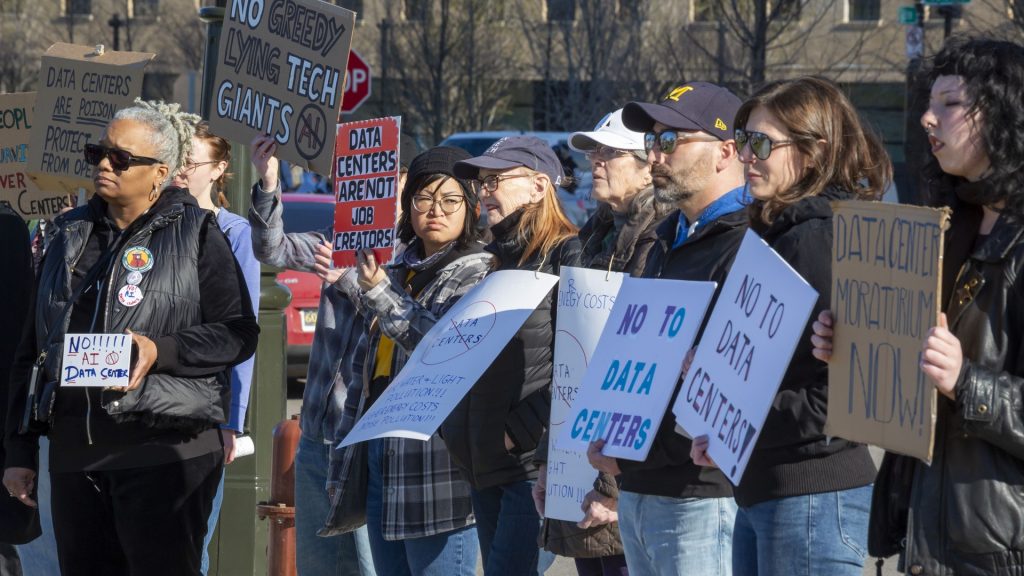
Democrats are split on data centers. As primary election season heats up, the race to develop artificial intelligence is opening a rift between core Democratic constituencies such as unions and environmental groups.
Maine became the first state to pass a moratorium on building new data centers through its Legislature. But in the 11th hour, Gov. Janet Mills vetoed the bill. Four days later, Mills dropped out of the race to be the Democrats’ nominee for the U.S. Senate.
Mills was already down in the polls and losing the fundraising battle to the more left-leaning challenger Graham Platner, a Marine Corps veteran and oyster farmer. The decision to veto the data center moratorium did not lead to Mills dropping out, but it did “perhaps foreshadow” it, according to Andrew Rudalevige, a professor of government at Bowdoin College.
“She could easily have played up signing the bill to the pro-Platner left, but instead went with her notion of centrist locally-centered politics,” Rudalevige said, in an email to Straight Arrow. “It did show the limits of what she was willing to do to campaign in a primary electorate that had already decided to roll the dice on a complete unknown.”
The data center fight is playing out well beyond Maine. Vermont Sen. Bernie Sanders has proposed a national moratorium on data center construction. Supporters of a moratorium often cite concerns about the environmental impact of water use and air pollution, and the potential for increased consumer electricity bills. Opponents argue that full-on moratoriums are too broad and could jeopardize local tax revenue and jobs. Often, those are union jobs, which heightens the tension with a core Democratic constituency.
Backlash to the data center boom
Electricity demand projections show how rapidly the tech industry wants to construct data centers to create and run AI systems.
A forecast from BloombergNEF at the end of 2025 estimated that data centers will need 106 gigawatts of power by 2035. That’s more than twice the all-time peak power demand for the entire state of California.
Most data centers are in the development and construction phase, with proposed projects in nearly all corners of the United States. Data centers’ reliance on gas power plants for electricity and water for cooling computers has triggered backlash from environmental groups. And local communities often oppose projects in their area.
READ MORE: A data center is moving into a small town. Residents say it will ruin their history
Half of Democrats polled in January said data centers are “mostly bad” for the environment, according to the Pew Research Center. In December, 230 environmental groups pushed for a national moratorium on data centers.
“We cannot sit back and allow a handful of billionaire Big Tech oligarchs to make decisions that will reshape our economy, our democracy and the future of humanity,” Sanders said while introducing a national moratorium on data centers co-sponsored by Rep. Alexandria Ocasio-Cortez, D-N.Y.
Moratoriums are intended to be temporary, allowing lawmakers to pass regulations that can put guardrails on data center development and use of resources.
Maine’s moratorium fallout
In Maine, the data center moratorium was opposed by Maine Building Trades, a union representing construction workers across the state, according to the Bangor Daily News.
In an announcement of her veto, Gov. Mills mentioned a specific project in Jay, Maine, a town of fewer than 5,000 people. The closure of a mill in 2023 led to the loss of over 100 jobs, but for the past two years, local officials have worked to bring a $550 million data center project to the site, according to Mills’ office.
READ MORE: It’s not just data centers. Cities are fighting back against detention centers, too
“I believe it necessary and important to examine and plan for the potential impacts of large-scale data centers,” Mills said in a press release, but because of the project in Jay, she was unwilling to support a full moratorium. The Jay project is expected to create 800 construction jobs and 100 permanent positions.
The national picture
The national construction union, North America’s Building Trades Unions (NABTU), has been supportive of data center development. In April, the group representing 3 million workers signed an agreement with Oracle and OpenAI to have union labor build a 1.4-gigawatt data center in Michigan.
NABTU president Sean McGarvey said the agreement is “an important step for our industry and for America’s AI future,” adding that it should become a “national benchmark for how data centers should be built.”
Sanders, who is often viewed as among the most pro-union members of the Senate, has faced pushback from organized labor over his proposed data center moratorium.
United Association of Union Plumbers and Pipefitters General President Mark McManus said Sanders and Ocasio-Cortez “would rather punish the hardworking American workers who build our nation’s infrastructure than work with all stakeholders to craft common sense regulations.”
Both NABTU and the plumbers union endorsed Kamala Harris in 2024.
As the midterm elections come ever-closer, the issue of data centers is becoming more prominent in Americans’ daily livesThe moratorium push started with a city in Missouri, and continues at the local level, with Seattle as the latest example. In total, at least 13 states besides Maine are now considering such legislation.
Round out your reading
- Scientists unearth new evidence on how the Grand Canyon was shaped.
- Why the Army is adding a second fitness test for combat.
- Illegal midwives, growing demand: The fight over home birth in America.
- 40 years after Chernobyl, the U.S. pushes nuclear power once again.
- We’re building a new Straight Arrow. Help us shape our future by taking our survey.
Ella Rae Greene, Editor In Chief