Court rules Texas can require Ten Commandments in classrooms
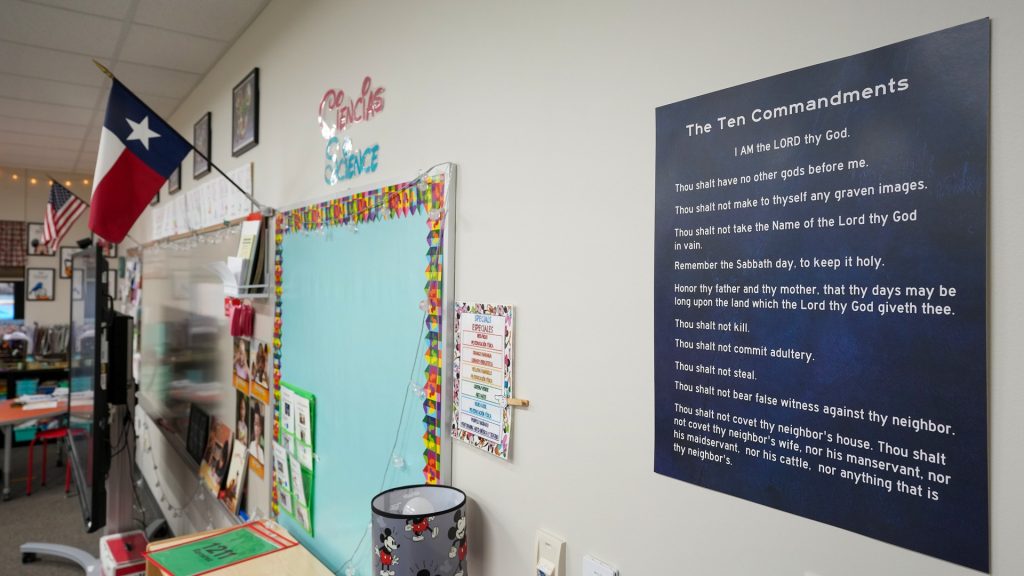
A federal appeals court on Tuesday upheld a Texas law requiring the Ten Commandments be displayed in schools. The U.S. Court of Appeals for the Fifth Circuit said in a narrow 9-8 ruling that the law does not violate the separation of church and state, reversing two lower court decisions.
Opponents have argued that hanging the Ten Commandments in classrooms amounts to religious indoctrination by the government. However, the court disagreed, saying, “No child is made to recite the Commandments, believe them, or affirm their divine origin.”
Conservatives call it a win for bringing religion back into classrooms.
Religion in Texas schools
The ruling is expected to face at least one more legal challenge. The American Civil Liberties Union (ACLU) has signaled it will take the case to the U.S. Supreme Court.
“The First Amendment safeguards the separation of church and state, and the freedom of families to choose how, when and if to provide their children with religious instruction. This decision tramples those rights,” the ACLU said in the statement.
This is not the only mandate that has sparked religious controversy in Texas schools.
In 2024, the state approved optional Bible-infused curriculum for elementary schools. And a proposal set for a vote in June would add Bible stories to required reading lists in Texas classrooms.
Not the only state commanding the Commandments
Texas is not the only state to put the Ten Commandments in schools.
In February, a judge on the same court ruled that it’s too early to determine the constitutionality of a Louisiana law requiring that public schools display the Ten Commandments in their classrooms, allowing it to take effect. Louisiana Attorney General Liz Murrill filed a petition requesting that the full U.S. Court of Appeals for the Fifth Circuit review the case.
But last August, a federal judge in Arkansas blocked a law requiring public classrooms to display the Ten Commandments in four of the state’s 237 school districts. That injunction was made permanent in March.
Ella Rae Greene, Editor In Chief