Should striking workers get paid unemployment? More states eyeing it
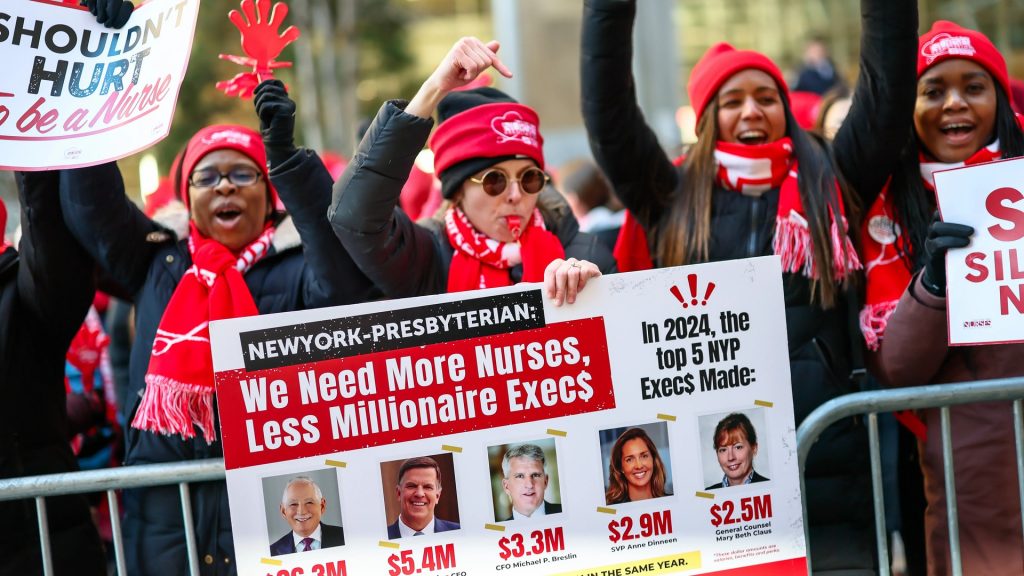
Labor strikes are about pain. Profit loss for the company and wage loss for the worker. But more states are moving to ease some of that harm to striking workers, at the cost of their unemployment funds.
Lawmakers at the state and federal levels are pushing to let workers who go on strike collect unemployment benefits. In states where it’s already allowed, it represents a major boon to unions that would otherwise pay striking workers out of their dues-funded accounts.
New York, New Jersey, Washington and Oregon — all with Democratic governors and Democratic majorities in each legislative chamber — are the only states that allow workers to collect unemployment benefits while marching on picket lines.
Labor groups argue that the measure evens the playing field between employers and workers while keeping money flowing into the local economy at a marginal cost to unemployment funds.
“Providing unemployment benefits to striking workers — and to all workers whose employment is impacted by strikes or lockouts — supports the right to strike and aligns with the purpose of the unemployment insurance (UI) system,” the National Employment Law Project said in a policy paper.
The business community says unemployment for striking workers amounts to paying union members for walking off the job, since the coffers are filled by employers paying state and federal payroll taxes.
“Striking workers are not seeking work; they’re withholding it,” said Stephanie Ferguson Melhorn, executive director of workforce and international labor policy at the U.S. Chamber of Commerce. “That’s a choice, not a layoff.”
More states looking to follow suit
Delaware, Massachusetts, Ohio, Hawaii, Illinois and several others have seen legislation in recent years to join the small group of states allowing UI for striking workers.
In Illinois, lawmakers considered an amended House Bill 2565 in committee on Wednesday. If enacted, it would allow striking workers to collect unemployment two weeks after walking off the job.
“By modernizing these provisions, the bill promotes stability for workers and their families while retaining a balanced and predictable framework for employers in the state,” said Rep. Dave Vella, D-Loves Park, who is also the bill’s sponsor.
Members of the business community say the change would increase union members’ willingness to strike and extend the duration of stoppages. Even though the majority of strikes involve large corporations, opponents said the change would also affect small businesses, which could see higher unemployment taxes.
“The UI trust fund is facing deficits this year, with more funds projected to flow out than flow in. This financial balance is paid for by employers,” said Noah Finley, director of the National Federation of Independent Business Illinois Chapter. “Small businesses should not be left holding the bag for labor disputes at large businesses and corporations.”
The committee voted in favor of the bill.
Too much for California
In 2023, California Gov. Gavin Newsom vetoed legislation that would have given unemployment benefits to striking workers in his state.
In his veto message, Newsom said the state’s unemployment trust fund is outdated and approaching insolvency. Adding the burden of paying strikers could further exhaust the funds that out-of-work residents rely on.
“Now is not the time to increase costs or incur this sizable debt,” Newsom said.
Lawmakers couldn’t muster the votes to override the veto.
Connecticut vetoes
Connecticut Gov. Ned Lamont has vetoed similar legislation multiple times, saying that covering workers who voluntarily walk out would undermine the purpose of unemployment benefits.
“Unemployment Trust Fund exists to provide support to individuals who are out of work through no fault of their own, and its long-term sustainability is critical,” he said in his June 2025 veto message. “Extending benefits to individuals actively participating in labor disputes — even after a period of time — alters the fundamental purpose of the program.”
Federal effort
Rep. Donald Norcross, D-N.J., introduced federal legislation last fall that would implement the practice nationwide.
“Any union worker knows that going on strike is always the last resort,” he said in a statement. “The Empowering Striking Workers Act will make sure no worker is forced to choose between standing up for their rights and putting food on the table.
His bill and identical legislation in the Senate have not moved since their introduction.
Ella Rae Greene, Editor In Chief