Army veteran tasked with prosecuting Nazi death squads awarded Congressional Gold Medal
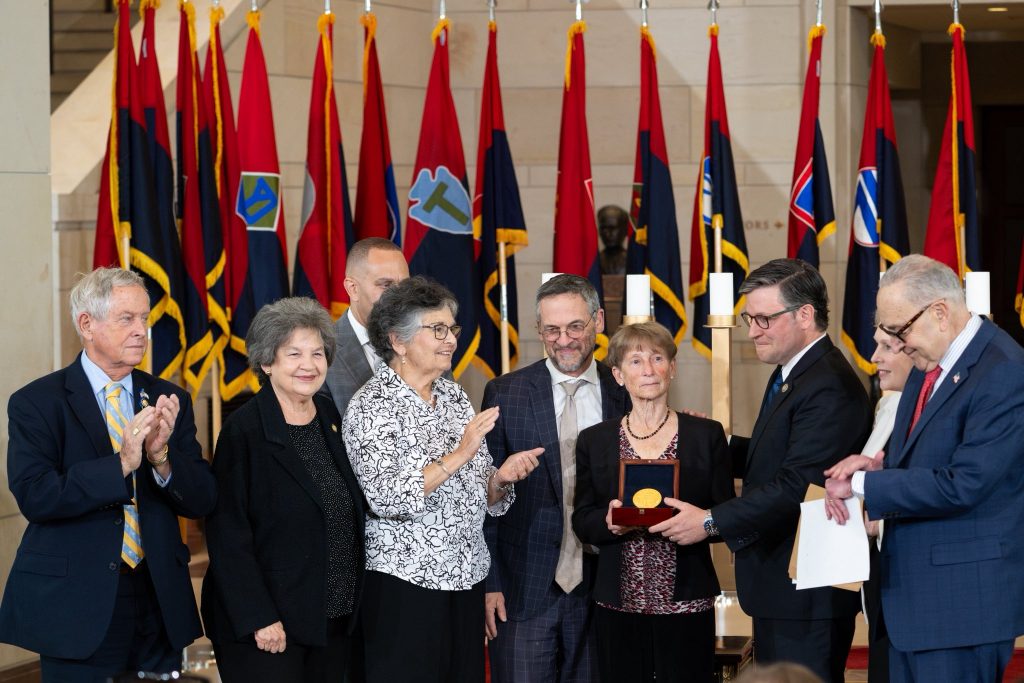
Congress on Tuesday posthumously awarded American prosecutor Benjamin Ferencz with the Congressional Gold Medal, the highest U.S. honor bestowed on civilians, for his work taking on Nazi death squads during the Nuremberg Trials.
Ferencz, who died in 2023 at the age of 103, was just 27 with no previous trial experience when he became chief prosecutor in one of the most significant murder trials in history.
While Congress voted to bestow the medal to Ferencz in 2022, his family members were on hand to posthumously receive the honor this week during the United States Holocaust Memorial Museum’s annual Days of Remembrance commemoration at the U.S. Capitol.
“Mr. Ferencz was a tremendous force for good, a fierce New Yorker with a heart of gold and a backbone of steel, a man who saw the worst of humanity and spent the better part of a century fighting for the best of it,” said Sen. Kirsten Gillibrand, D-N.Y., during the ceremony.
“He came face-to-face with evil, recalling the fact that he had quote, peered ‘into hell,’” Gillibrand continued. “A lesser person might have looked away. But Ben Ferencz looked harder.”

Born in Transylvania in 1920, Ferencz, who was the last surviving prosecutor of the Nuremberg Trials, emigrated with his family to the United States when he was an infant to escape anti-Jewish pogroms.
After graduating from Harvard Law School in 1943, Ferencz enlisted in the U.S. Army and was given the job of anti-aircraft artillery gunner.
“In their typical [Army] brilliance, being a Harvard Law School graduate and an expert on war crimes, they assigned me to clean the latrines in the artillery and do every other filthy thing they could give me,” Ferencz reminisced about the Army’s odd job placement in a 2016 interview with The Washington Post.
The outspoken Ferencz, who barely registered over five feet tall, eventually rose to the rank of sergeant as a member of Gen. George Patton’s Third Army. Action during the Normandy invasion followed, as did breaking through the Maginot and Siegfried lines, crossing the Rhine and bitter fighting in the Battle of the Bulge.
After Ferencz’s honorable discharge in 1945, Gen. Telford Taylor, then the chief prosecutor of the Nuremberg Trials, recruited Ferencz to return to Germany and work with a team of investigators tasked with uncovering the horrors of the Nazi regime.
Tasked with gathering credible evidence of Nazi war crimes for the Army’s War Crimes Branch, Ferencz encountered the depths of human depravity. The Germans maintained meticulous death registries at the camps of Buchenwald, Mauthausen, Flossenbürg and Ebensee. These registries, which Ferencz was ordered to collect, contained the names of millions of victims.
“When I passed the figure of one million, I stopped adding,” he recalled in an interview with the United States Holocaust Memorial Museum. “That was quite enough for me.”
It was there that Ferencz and his colleagues discovered the dossiers of the Nazi mobile death squads, the Einsatzgruppen — roving extermination squads that targeted Jews, Roma, homosexuals and political dissidents in Eastern Europe. In the subsequent trial, the International Military Tribunal determined that nearly two million Jews were murdered by the Einsatzgruppen.
“Death was their tool and life their toy,” Ferencz told the judge during the opening statement of United States of America v. Otto Ohlendorf et. al. “If these men be immune, then law has lost its meaning, and man must live in fear.”
All 22 men prosecuted by Ferencz were convicted. Most were sentenced to death.
Ella Rae Greene, Editor In Chief