In ‘Tehrangeles,’ Iranian Americans back regime change but reject war
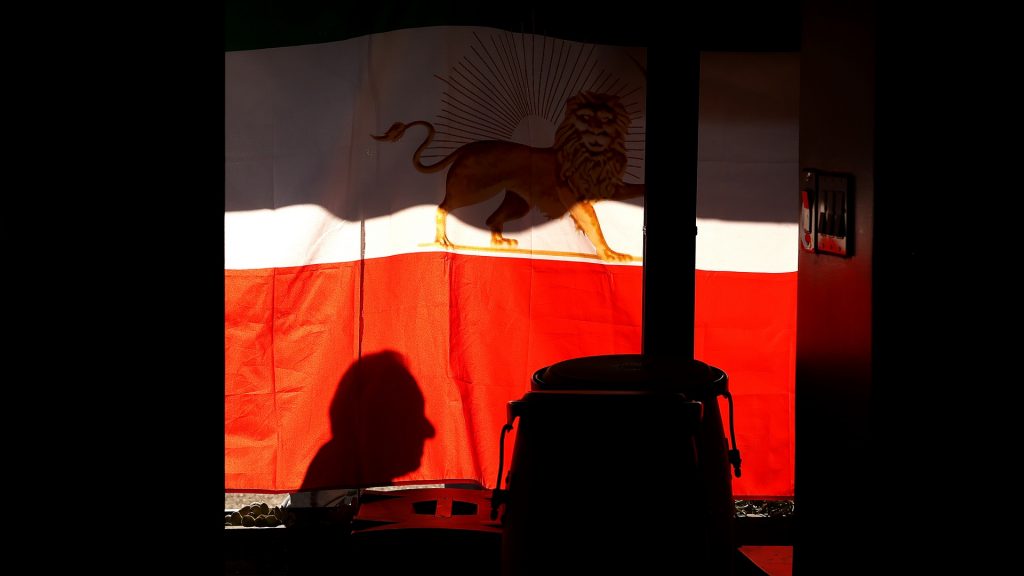
LOS ANGELES — Walk around the intersection of Westwood Boulevard and Wilkins Avenue in Los Angeles, and you’ll see more Iranian flags than Dodgers hats.
It’s the heart of “Tehrangeles,” a portmanteau of LA and Tehran and the largest Iranian diaspora in the world outside Iran.

Straight Arrow News visited Tehrangeles to see how Iranians in America feel about the war in their home country and the recently announced ceasefire.
Those who spoke to SAN expressed their desire for regime change in Iran, 47 years after the Islamic revolution overthrew the U.S.-backed Pahlavi dynasty.
At the same time, they had serious concerns over the way the U.S. has engaged in this conflict, which has caused extensive damage and loss of life but, so far, has failed to topple the oppressive government.
Among them is Roozbeh Farahanipour, who fled to the U.S. from Iran after receiving a death sentence in his home country for being a leader of student protests in 1999.
“If war was the answer, the Middle East would be the freest place in the whole world,” Farahanipour told SAN.

Most people that SAN attempted to speak with refused to comment on what’s happening in their homeland. Many used the same word to explain why they preferred not to do an interview:
“Complicated.”
Ceasefire brings relief
No one who spoke to SAN opposed the ceasefire that was announced Tuesday. But they didn’t all agree on why.
“Of course I am happy with ceasefire,” Mohammad Thafarian, a business owner who’s been in America for 26 years, told SAN.
But he doesn’t believe the ceasefire will hold.
Others were very happy when the U.S. and Iran declared a ceasefire just hours after President Donald Trump threatened that “a whole civilization will die tonight.”
“Even those that were initially pro-war, with the rhetoric changing to an entire civilization going to be wiped out — so many people didn’t go to work that day because it was just unbearable to even be able to breathe,” Sudi Farokhnia, president of the Iranian American Democrats of California, told SAN.

Sheila Rossi was also born in Iran and is now the mayor of South Pasadena, a suburb about 12 miles northeast of downtown Los Angeles. She had similar thoughts about the ceasefire announcement.
“Tuesday morning, they woke up to [Trump’s] tweet talking about the annihilation of a civilization never to return again,” she said. “So, happy to see that basically a threat of nuclear war wasn’t going to happen. Ceasefire is clearly conceptual right now, still tentative, and bombs are going both directions at this point.”
Many approved of the ceasefire because it would pause the loss of life in Iran — even if they want to see the regime out of power.
“There’s always the mixed feelings of all the casualties among the civilians, all of the bridges, infrastructure, all of these things that are getting damaged,” Farokhnia said.
Regime change?
Everyone SAN spoke with in Tehrangeles favored regime change in Iran.
“Of course, I am,” Thafarian said.
“I’m not in support of the Islamic Republic,” said Rossi, who said she once thought she’d be imprisoned while visiting Iran because of the outfit she wore in the airport.
Rossi said she was wearing a hijab with a manteau over a dress that covered to her mid-calf. One of the female guards made her look through her bag for pants, despite there being no law that you have to wear pants.
“There are executions happening in Iran,” Farokhnia added. “There’s uptick in imprisonment. Unfortunately, we see loads of cars are coming from Pakistan, Afghanistan, Iraq, other places to come and help the regime to be able to defend itself.”
The anti-regime attitudes in Los Angeles apparently reflect the prevalent thoughts in Iran. A 2024 survey by Netherlands-based pollsters found that roughly 80% of Iranians inside Iran opposed the regime.
Those sentiments may also explain why Iranians in Los Angeles said they weren’t exactly sad when the news came that initial U.S. air strikes had killed Supreme Leader Ayatollah Ali Khamenei.
“I like that Khamenei got killed,” Farahanipour said. “A world with no Khamenei is a better place to live for everyone, not only for Iranians.”
“Most of us were relieved to know that Khamenei was killed,” Farokhnia said.

Other leaders remained in power.
“The President is the same president,” Farahanipour said. “Head of the judiciary is the same head of the judiciary, and head of the parliament is head of the parliament. I don’t know how you want to call it regime change, but to me, as an activist who fights to overthrow the Islamic Republic my entire life, this is not a regime change.”
Even though Khamenei was killed, he was immediately replaced by his son.
“In Afghanistan, it took 25 years to replace the Taliban with the Taliban,” Farahanipour said. “In Iran, it took seven days to replace Khamenei with Khamenei.”
The people who spoke to SAN have strong ideas about how regime change actually needs to take place.
“The regime change should be done with Iranian people,” Farahanipour said, “not with foreign forces.”
“It has to come from the internal,” Rossi said. “We have a lot of Iranian dissidents within Iran who have been working for years to make the changes.”
Thafarian agreed and said that’s where the U.S. should step in to help.
“If the U.S. was intelligent, or Donald Trump were intelligent, they would support and give the weapons to the Persian people to fight for their right to overthrow the government,” he said. “Then, 60,000 people would not get killed, and then they would overthrow the government and elect the new government by their self.”
Not a ‘holy war’
While some Iranians in LA had no problem with the war, Farahanipour was not one of them.
“I don’t like war at all in my life,” Farahanipour. “I always was an activist, and anti-Islamic Republic activist. I don’t like to see any war.”
Like Farahanipour, Rossi pointed to previous U.S. interventions in the region.
America spent over $145 billion trying to rebuild Afghanistan but that ended with tens of billions in waste and the Taliban back in control.
“I was always opposed to the foreign intervention side of it, because I just didn’t see us as having experience of that working,” Rossi said.

The Trump administration’s rhetoric has also received scrutiny. Defense Secretary Pete Hegseth’s depiction of the conflict as a “holy war” has not played well among Iranian Americans.
“I have to reject this idea of this holy war that supposedly the United States is fighting, because I truly believe in separation of church and state,” Farokhnia said.
“[I am] absolutely concerned about a holy war that looks to, quite frankly, annihilate all Muslims, Jews and apparently Catholics too,” Rossi said. “I don’t think there’s any space or place for having religion be a pretext for going into war.”
Meanwhile, the U.S. has racked up a $16.5 billion bill for the war and counting.
“Nobody thinks Iran is that strong, and the U.S. and Israel, they underestimated Iran,” Thafarian said.
Homeward bound?
After Bashar al-Assad was overthrown in Syria in 2024, hundreds of thousands of displaced Syrians returned to their home country.
Would the same happen if Iran ever had new leadership?
“Of course,” Thafarian said.
“Some would, yes,” Rossi added. “I think there are a lot of people who miss Iran and would love to be able to go back to Iran.”
Thafarian said he would consider returning to Iran, although having his children in the U.S. might complicate that.
Others said they’re firmly planted in the U.S.
“Most of us are so established outside of Iran, while we feel a responsibility towards our friends and family inside Iran who don’t have really a platform to have a voice,” Farokhnia said.
“I was waiting for regime change, and I tried to overthrow the regime to come back to Iran when I decided to become American and become a U.S. citizen,” Farahanipour said. “That was done for me. I said, ‘I’m not going to come back.’”
War also complicates those feelings.
“My biggest fear is losing my entire extended family, and connection to my mother,” Rossi said, adding her mother passed away a few years ago. “If they’re gone, there’s nothing to return to.”
What’s next?
Farokhnia said the old approach to Iran — freezing assets, expelling diplomats, imposing economic assets — failed.
“The only way the civil society in Iran are going to be able to chart their own future is for the regime to be brought to its knees,” she said. “Clearly, the war didn’t do that, so the warmongers didn’t get their way.”
Most of those SAN spoke with pushed for an end to the violence.
“I’d like to see us working towards peaceful solutions,” Rossi said.
“I don’t know who was the winner of this war,” Farahanipour said, “but I know the loser was the Iranian people.”
Ella Rae Greene, Editor In Chief