Congress to debate broad NASA budget cuts as Artemis prepares for splashdown
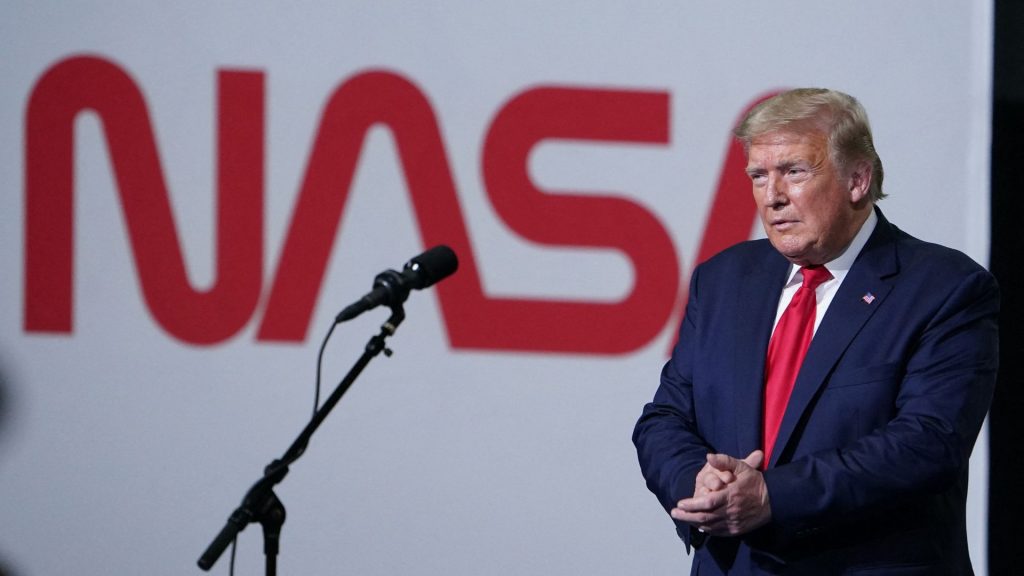
As NASA astronauts prepare for their return from their record-breaking spaceflight mission around the moon, the Trump administration is proposing a large budget cut to the agency that got them up there.
For the second year in a row, the administration has asked Congress to approve a budget with cuts to NASA. The Office of Management and Budget (OMB) asked Congress to approve an $18.8 billion NASA budget, more than $5.5 billion less than last year, according to The Hill.
The proposal cuts $3.4 billion from NASA’s science department, terminating dozens of “low-priority” missions. Programs targeted include a climate partnership and the Mars sample return mission, which costs $10 million annually, OMB reports.
Groups such as the Planetary Society, the world’s largest independent space-interest organization, have criticized the budget cuts.
“This proposal needlessly resurrects an existential threat to U.S. leadership in space science and exploration,” officials wrote in a statement. “This is a critical period for the U.S. space agency to execute on the ambitious plans to lead the world in science, exploration and innovation.”
NASA Administrator Jared Isaacman pushed back on the criticisms, saying the Trump administration is making NASA’s budget “greater than every other space agency across the world.” He also said that the One Big Beautiful Bill Act allocated nearly $10 billion to the space agency for missions to the moon and beyond.
“We are able to launch the Grace Roman Space Telescope at the end of 2026, 100 times the field of view of the Hubble telescope, 1,000 times the scan rate,” he said. “We’re going to launch a nuclear-powered octocopter in 2028 to explore Saturn’s moon of Titan within the budget environment.”
A historic milestone but an uncertain future
While only a test mission, the Artemis II flight took people further away from Earth than ever before. The Orion spacecraft took four astronauts — Reid Wiseman, Christina Koch, Victor Glover, and Canada’s Jeremy Hansen — about 252,756 miles away, looping around the moon, and beating the Apollo 13 mission’s record by more than 4,000 miles.
This was the most dangerous and critical mission for the Artemis mission yet, and issues could still arise during the astronaut’s return. The mission hasn’t hit any critical issues, unless you count a broken toilet as critical.
But this mission is only the first of four crewed Artemis missions, with the next one scheduled for next year. However, it will not be until Artemis IV that astronauts will conduct a moonwalk, expected in 2028.
Isaacman emphasized the Trump administration’s commitment to the mission and to NASA, noting that the proposed budget set aside $8.5 billion for the Artemis program. OMB noted that this fully funds the mission’s lunar landers, space suits, lunar surface systems and transportation.
What are Trump’s requested cuts?
The White House’s total proposed cuts to NASA are $5.6 billion, dropping the budget by about a quarter, from $24.4 billion to $18.8 billion, according to OMB. But the cuts are unevenly spread across the space administration.
The biggest is the science department, which would see 47% of its budget taken away. The OMB said NASA would terminate more than 40 “low-priority missions” because of the cuts. But OMB’s summary of the proposal lists only the Mars sample return program and SERVIR, a program that distributes Earth science data. The Trump administration has not said what other “low-priority missions” it planned to cut.
A major sticking point in the budget cut is funding for the International Space Station, which NASA plans to retire in 2030. The ISS is a joint venture among the U.S., Canada, the European Union and Russia and has served as a crucial staging ground for experiments that propel space exploration.
According to CNN, NASA has previously intended for private companies to build the next generation of space stations. However, at a recent event in Washington, NASA executives, including Isaacman, pointed out that building, launching and maintaining a space station isn’t financially feasible for companies, and NASA might be the sole financier for the program.
“Tourism hasn’t really materialized as a market,” said Dana Weigel, NASA’s International Space Station program manager, CNN reports. “We certainly have had a number of tourist-sponsored missions, but those have been limited and we haven’t seen recurring demand for them.”
What’s at stake?
The Trump administration believes NASA should focus on human spaceflight rather than scientific research, labeling anything else “lower-priority.” The push away from scientific research has worried some. Sudip Parikh, the CEO of the American Association for the Advancement of Science, believes the cuts would be a mistake.
“Having big, big pieces of infrastructure are really important. But, you know, what the most important thing is, when it comes to technology advancement—it’s people, it’s the American people,” she said. It’s making sure that the American people are studying science, are participating in science,” Parikh told Spectrum News.
While it might not look like it on the surface, NASA’s research helps a lot more people than just astronauts. Memory foam, scratch-resistant lenses and even CAT scans have their roots in NASA. The ISS is also a major contributor to cancer research. If Congress approves the budget and NASA can’t afford to build a new space station, it could negatively impact cancer research.
The National Space Society, a nonprofit organization, commended certain cost-saving measures mentioned in the proposal. However, the group criticized the cut in ISS funding, labeling it “unwise and counterproductive.”
“A strong NASA requires both a robust exploration program and a fully funded science portfolio,” the group wrote. “These are not competing priorities — they are mutually reinforcing pillars of U.S. space leadership.”
Ella Rae Greene, Editor In Chief