What to expect at the gas pump following ceasefire in Iran
Oil prices fell Wednesday on news that the United States and Iran agreed to a ceasefire, but Americans will have to wait a few days before changes in the oil market affect prices at the pump. And long-term price decreases are not guaranteed, as the future of the conflict and the status of the Strait of Hormuz remain uncertain.
The ceasefire agreement announced Tuesday evening stated that vessels, including oil tankers, must be allowed to traverse the Strait of Hormuz, a narrow waterway on Iran’s southern coast that has proved to be a critical economic chokepoint. However, Iran said Wednesday that it was halting any oil traffic through the strait after Israel continued attacks on Lebanon.
The international shipping industry — and with it the arteries of the global economy — is caught in the middle. And while the industry sees the ceasefire as a welcome step in the right direction, it leaves many questions unanswered.
“The ceasefire may create transit opportunities, but it does not yet provide full maritime certainty and we need to understand all potential conditions attached,” the Danish shipping company Maersk told Reuters on Wednesday.
The Baltic and International Maritime Council, one of the largest international shipping associations, said it’s advising ships not to attempt exiting the Persian Gulf without prior coordination with the U.S. and Iran, and technical details on the ceasefire hadn’t been made available.
When will gas prices fall?
As tension rose on Tuesday, West Texas Intermediate (WTI) crude oil briefly hit $117 per barrel. By Wednesday morning, oil fell to the low $90 range before ticking up slightly to $95. The main global oil price benchmark, Brent, also fell from over $110 to about $95.
The uncertainty has not disappeared, but the lower oil price should lead to some relief for American consumers at the pump. Prices could start coming down as soon as this weekend, according to Patrick De Haan, head of petroleum analysis at GasBuddy.
The wholesale price gas stations pay to fill their inventory is often more volatile than what they charge customers at the pump, De Haan told Straight Arrow News.
Gas stations have to buy thousands of gallons of gasoline every few days. When the price fluctuates, they have to charge customers a price that earns a return, but they also have to balance competition with other stations that may have resupplied at different times. As a result, De Haan said, “what drivers pay is a slower climb and an even slower descent.”
Gas stations typically operate on thin margins. And stations across the country are still selling gas that they might have bought at the peak price, so they cannot immediately lower what they charge drivers.
“People just think that stations are out there making tons of money, when actually stations have a really, really hard job on timing, and that is why prices go down much more slowly,” De Haan said. But he warned that despite the ceasefire, “the coast is anything but clear” for a full resolution that could return gasoline prices to where they were over a month ago.
Will the Strait of Hormuz open?
For gas prices to drop significantly, the Strait of Hormuz would need to open to normal oil tanker traffic, and so far, that has not happened.
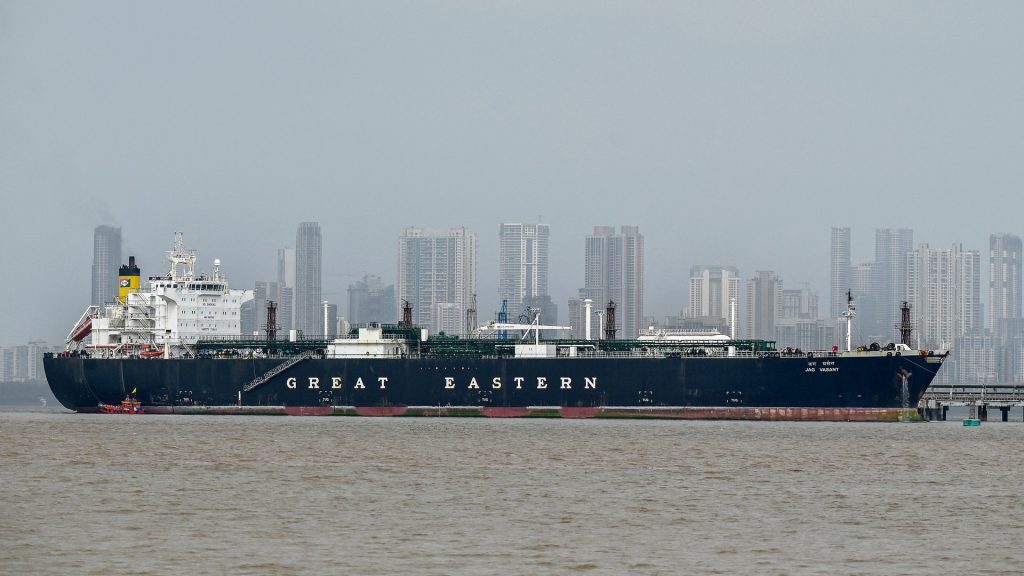
“Extreme volatility persists and the underlying conflict remains unresolved,” Kpler, a data analytics company that specializes in maritime logistics, said in a social media post. There are 426 oil tankers effectively stranded in the Persian Gulf, according to the company’s data.
On Wednesday, a radio message told ships in the Persian Gulf that they needed Iranian permission to proceed through the strait, the Financial Times reported. Fissures quickly appeared in the ceasefire plan.
In response to Israeli attacks on Lebanon, Iran said it would halt passage of oil tankers through the Strait of Hormuz. That announcement came before significant oil tanker traffic had even begun transiting the strait, and shipping organizations have emphasized the need for coordination among all parties.
“The shipping industry is currently awaiting technical details from the US and from Iran,” said Jakob Larsen, chief safety and security officer at the Baltic and International Maritime Council. “There is still too much uncertainty regarding the practical implementation of the ceasefire, and any setback in negotiations could lead to a resumption of hostilities.”
The maritime council also told SAN that oil exports would take extra time to recover due to shuttered production and damaged infrastructure.
How could shipping fees work?
Another layer of uncertainty comes from the prospect of new fees shippers may have to pay to transit the strait.
A spokesperson for Iran’s oil and gas association, which works closely with the state, also told the Financial Times that Iran would require payment of $1 per barrel of oil via cryptocurrency transactions so that the revenue would not be subject to sanctions. Meanwhile, President Donald Trump said the U.S. would explore a “joint venture” with Iran to charge fees in order to traverse the strait.
The prospect of fees is likely to become a point of tension among other Gulf states. A government official in Oman, which lies on the southern side of the Strait of Hormuz, came out against the fees, saying they are not allowed under international trade agreements.
A spokesperson for the International Chamber of Shipping told SAN that the organization is concerned that fees “risk contravening the fundamental right to freedom of navigation and innocent passage under international law.”
“An immediate restoration of unimpeded navigation is essential, and we urge states to work closely with the shipping industry to ensure safe, orderly transit,” the ICS spokesperson said, adding that it was difficult to put a timeline on when traffic would return to normal levels, and the shipping industry needs “clear and credible guarantees for the safety and security of seafarers.”
Ella Rae Greene, Editor In Chief