Low snowpack, early melt triggers alarm bells for farmers, drought managers
SALT LAKE CITY — In a typical year, the Snowbird parking lot on a late March morning is among the best places to watch skiers descend one of the Wasatch Front’s iconic backcountry lines: the South face of Mount Superior.
Not this year.
At 9:30 a.m. on Saturday morning, not a single skier dotted the terrain. Instead, two waterfalls streamed through the chutes.
In the parking lot, skiers heading up to the resort donned snow pants, but left many jackets behind. They’d be forced off the mountain by 2 p.m. due to rapidly deteriorating conditions: The snow was melting too quickly to safely keep the mountain open.
This lack of snow affects more than just skiers. Utah relies on snowpack for 95% of its water throughout the year. For everyone from the parks managers maintaining soccer fields to the farmers planning their crops, rapid snowmelt this early in the season is setting off alarm bells.
Historic on multiple fronts
Unbiased. Straight Facts.TM
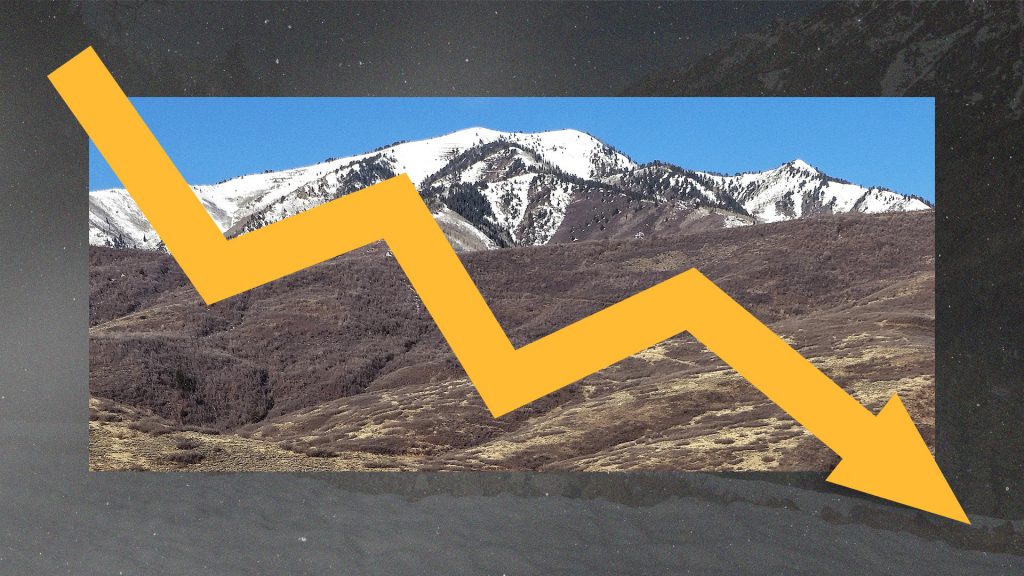
Approximately 60% of the Upper Colorado River Basin’s 2026 snowpack — 5.4 inches — melted between March 9 and March 31.

The western United States, specifically the Upper Colorado River Basin, is wrapping up one of its worst snow seasons on record. The 2026 snowpack was lower than almost any other point on record, and it peaked nearly three weeks before usual due to a record heat wave.
“There’s virtually nothing left in the Southwest, we’ve already lost about two-thirds of the Sierra Nevada snowpack from what was about at one point, about two-thirds of average,” said Brad Rippey, a meteorologist with the U.S. Department of Agriculture office of the chief economist. “There’s not a whole lot of snow left to come down.”
While this winter included some major storm cycles, the way the water fell became a larger issue for those managing the resource.
“We got some good precipitation in October, but after that, we didn’t get a lot of precipitation, and when we did, it was so warm that it fell as rain instead of snow,” said Laura Haskell, the drought coordinator for the Utah Division of Water Resources. “That makes a big difference, because we use the snowpack as basically a giant reservoir that then comes down and will fill up our lakes and our reservoirs.”
When the water is not stored in mountain snow banks, natural resource managers have to make difficult decisions earlier in the season about how to store existing water while taking a gamble on what’s to come.
“Early in the season, especially, you can’t hold on to every drop of water that runs off because you have to leave room in case you have a situation like what happened at the Oroville Reservoir a number of years ago in California, where it literally overflows and starts damaging the spillway,” Rippey told Straight Arrow News. “You have to leave some room for future storms if they’re going to happen. So some of that water just simply has to be released to the ocean, and it’s just gone.”
Exactly how dry is the West?
Experts track the snowpack using the snow water equivalent, a metric that determines how much ground the snow would cover if it were to melt immediately. As of March 31, the Upper Colorado River Basin held the equivalent of 3.5 inches of water, down from a March 9 peak of 8.9 inches.
That’s significantly less water at a significantly earlier time than usual: The median peak is 16 inches on April 6.

While the low snowpack already concerned drought coordinators, March’s unprecedented three-week heat wave accelerated the melt.
“You’re using that water immediately, instead of storing it in a bank — in a snow bank, literally,” Rippey said. “When it comes early, it tends to mess up that natural order of things, and you can’t use the water in the summer, during the growing season, when you need it for agriculture and so many other purposes.”
Farm faucets run dry
As the growing season begins for Western farmers and ranchers, they look at mountain runoff, not just soil moisture, to plan their year.
“A lot of water rights for the farmers and producers are based on surface water. And that’s what we really see on a low snowpack year. There isn’t surface water. So they could see 20% of what their water right is,” Haskell said. “So they may do one crop, they may do part of their field. But that’s what they have to work with.”
March’s extended heat wave across the West is already raising concerns for Rippey, who is monitoring farms with crops already in the ground. Prolonged exposure to temperatures in the high 90s and 100s can kill plants during their reproductive phase, significantly reducing crop yield. Arizona, which is responsible for 90% of all the vegetables grown with Colorado River water between November and April, has seen six times as many 100-degree days this March compared with a typical year.
Surface water and drought conditions also greatly impact the open space used for livestock ranching across much of the West.
When streams peak early in the season, Rippey said rivers and creeks risk going dry, leaving ranchers to search for supplemental feed and water for their herds.
The costs associated with bringing in additional feed are often higher during drought periods, because of increased demand and potentially lower supply, according to the National Centers for Environmental Information (NCEI). If those costs become too high, ranchers can either reduce their herds or increase prices for consumers.
Drought is the second costliest type of weather disaster in the United States, only surpassed by hurricanes. It carries an average price tag of $10 billion per incident, according to NCEI data.
In 2015, California’s lowest-snowpack year on record, the state was short about 8.7 million acre-feet of water. Researchers at UC Davis estimated the resulting drought caused $1.8 billion in direct cost damages and more than 10,000 seasonal jobs lost in the state alone.
A 2022 survey found nearly three-quarters of farmers across Western states reported reduced yields as a result of drought conditions, and about 42% said they planned to change what they planted because of the lack of water. One third of respondents said they had planned to destroy orchards and multi-year crops.
Western drought conditions were widely reduced or eliminated the following year, as 2023 saw one of the strongest snowpack years on record. But another two years of average snowpack, followed by this historically low one, means farmers and the managers controlling their water are once again making tough decisions.
“As long as people conserve and are smart, we have enough to last this year,” Haskell said. “It’s what’s going to happen down the road.”
Reservoirs of concern
While the snowpack numbers are concerning to many data watchers, the reservoir levels tell a different story for now. Multi-year reservoirs — those that do not fully empty every summer — are at average or above average levels across the West.
In California alone, the reservoir system is holding approximately 120% of the average water for this time of year, Rippey said.
“There is a little bit of a buffer in California, which is a huge agricultural state for specialty crops and also for some rice and cotton in the San Joaquin Valley. But at the same time, there’s not going to be a whole lot of water coming down out of the Sierra Nevada,” Rippey said.
Only 5 inches of snow remains in the Sierras, down from the seasonal norm of 25 to 30 inches.

A similar situation is playing out in Utah, where reservoirs currently hold about 4% more water than average. But there is little meaningful precipitation left in the forecast.
And the people most affected are smaller groups that rely on reservoirs that refill every winter and tap out by the end of the year.
“That’s a statewide average that we’re doing OK, but those small, single-year reservoirs, they just won’t fill up,” Haskell said.
As a result, some irrigation companies managing water for local and agricultural use across the state are already planning to limit customers’ water use. Some may wait to turn on the taps, while others may cut water off earlier than normal. Areas with more complex water rights may experience both situations.
Many municipalities have already instituted drought restrictions, like limits on how frequently you can water your front lawn or whether restaurants can serve tap water without your request. That’s just the start for a region that will sink further into drought over the course of the summer, according to the National Oceanic and Atmospheric Administration (NOAA)’s latest seasonal outlook.

A drying basin
More than 57% of the 11-state Western region is currently experiencing some kind of drought. While recreationalists and ranchers alike wait to see if this year’s trickle of water off the mountains gives way to more stable snowpack in coming years, they also have fire season on their mind in the near term.
“It doesn’t take long to dry out some of those ranges and hillsides,” Rippey said. “You have to worry about rangeland and grassland fires that can just flash through hundreds of thousands of acres in a matter of hours or days.”
This is nothing new.
“It’s a longer season. It’s drier longer, warmer longer,” Haskell said. “Usually, the snowpack will smoosh down all the vegetation and make it really flat. And where we didn’t have that, the vegetation is still tall and more susceptible to fire starts.”
As a whole, the Colorado River Basin is hurting for water. At the end of February, it held about 17 million acre-feet of water, about 52% of the historic average for the region. While smaller local reservoirs could recover in a season, major reservoirs like Lake Powell and Lake Mead will need more time.
“It would take a sea change,” Rippey said. “You would have to bring in a decade of good years.”
Back in the Snowbird parking lot, skiers in beach chairs reminisce about how the day felt just like Memorial Day in 2023. Maybe next year, they’ll ski well into May. They’re hoping for a decade of good years.
Ella Rae Greene, Editor In Chief