States move to close college departments with poor grads
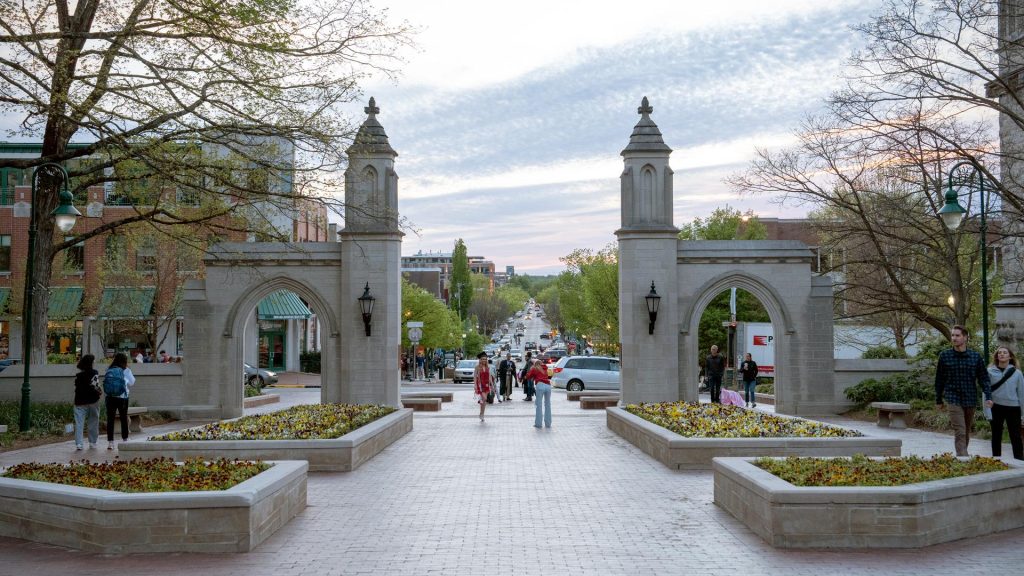
Students go to college for many reasons, including the potential to land a higher-paying job once they’ve finished their education. Now, the Trump administration and several states are moving on legislation and policies to ensure those schools help students land those jobs.
However, it may come at a cost to students who prefer studying subjects that put them at a higher risk of ending up in a profession that doesn’t necessarily lead to big bucks.
State laws
Earlier this month, Indiana passed a law directing public colleges and universities to end all academic programs that produce “low-earning” graduates.
In essence, Indiana Senate Bill 199 directs those schools to end programs that produce graduates who earn less than typical high school graduates.
“The goal is to make sure that any learner who puts in the time and the money, earns a certificate, earns a credential, earns a degree, is going to have a high positive return on that time and that money,” Mark Schneider, a nonresident senior fellow at the American Enterprise Institute, told Straight Arrow News.
The law will take effect on July 1.
“It’s intuitive that anyone who’s considering a post-secondary degree would want to earn more than someone who has gone to high school but has no college experience,” Michael Itzkowitz, president of The Higher Education Insights Group, told SAN. “Students and parents ultimately want this to pay off.”
Meanwhile, in New Hampshire, House Bill 1774 would bar any state aid from going to what they consider low-income college programs and is currently scheduled for a public hearing at the end of this month.
There are similar bills in the legislatures of West Virginia and Nebraska.
Federal rules
All of that legislation comes on the heels of an announcement from the federal Department of Education in January. That announcement essentially implements the same rules as the Indiana bill nationwide.
The change will potentially cut off federal student aid to programs that fail to provide the required financial returns.
“After more than 15 years of regulatory uncertainty under the previous three Administrations, we’ve developed an accountability framework that institutions can work with, students will benefit from, and taxpayers can rightfully expect to improve outcomes,” Under Secretary of Education Nicholas Kent said in the announcement.
Indiana’s new law, along with several other proposals, will follow the guidelines set out in that release for how this will work. Four years after graduating, if a student’s median earnings are lower than the median wages of certain workers with only a high school degree, they will be considered low wage.
While the Trump administration is implementing this, it’s nothing new.

Under former President George W. Bush, Secretary of Education Margaret Spellings declared a national crisis in higher education. Among other things, she emphasized that colleges should measure how students perform after graduation.
That continued under future administrations, including former President Barack Obama’s, which created an online tool to track post-graduation earnings, among other things.
“This did expand with the creation of the college scorecard,” Itzkowitz said. “That was the project that I was director of a number of years back. And essentially this was the largest release of higher education data ever.”
How it’s measured
This plan obviously relies on a significant amount of data. So, where’s that data coming from?
Mostly from the Department of Education. They match the tax records of students who’ve received a federal grant or loan and use that to see how much those graduates are making within a few years after graduation.
As for what high school graduates are earning, that data can come from a variety of places including the IRS and “unemployment insurance wage data” according to Schneider.
“There are a variety of ways of doing it,” Schneider said. “But again, the most important thing is that we want to make sure that if you spend money, time, energy that is your own, or the American taxpayer, state taxpayer, it has to have a payoff, a positive return on the investment.”
Concerns
There are some very clear majors and areas of study where this is not going to be a problem. Engineers, computer programmers, science programs, and business management are among the many fields that have nothing to worry about.
“We’re dealing with a government that is actively trying to define education in terms of economic benefits, which is completely antithetical to education,” Thomas Koehnline, a senior in the Department of Folklore and Ethnomusicology at Indiana University, told the Indiana Daily Student.

His department is being merged with the anthropology department, but he still believes it could all be cut under these new rules. A degree from Indiana University’s music category earns a median wage of just over $42,000.
For the most part, it is the liberal arts majors that seem most likely to have issues.
“It can be a little difficult to make money in music, communications, things like that, journalism,” Schneider said.
The lowest earning college majors include performing arts along with pharmacy, religion, social services and general education.

While college may not be necessary to star in the next Marvel film (even though Natalie Portman went to Harvard), some of those other majors are ones many would consider critical to society.
“States have to make that decision, and they have the legal authority, and I actually believe the moral responsibility to discuss low wage programs and whether or not the state needs them,” Schneider said. “And if the state decides it needs them, then how to fund them in a way that’s fair to the universities, to the colleges, and, more importantly, to the learners.”
Itzkowitz didn’t seem concerned even when it came to those programs after he and his team did an in-depth analysis.
“There’s 36,000 undergraduate programs in total that we were looking at,” he said. “And what we saw is that — this is called a ‘Do No Harm’ law, and essentially, this will do no or very little harm to institutions that primarily focus on associate or bachelor’s degree. Only 2% of those programs would fail to meet that threshold.”
That’s partially because the average salary of a high school graduate is just under $43,000 per year, or $20 per hour.
“It’s really a low bar,” Itzkowitz said.
He believes the ones who will most be impacted by this are institutions other than four-year universities.
“A lot of institutions that are focusing on shorter term certificate programs are at much higher risk,” Itkowitz said. “While these programs, when they work well, can provide one of the fastest paths to socioeconomic mobility, they’re also some of the riskiest programs that are offered in higher education today. About a third of those programs show that the majority of students are failing to earn more than the typical high school graduate.”
Moving forward, experts SAN spoke with believe more states may act like Indiana.
“I know that universities are not going to be happy with this, but I think the state legislatures are the guardians of taxpayer money,” Schneider said. “So I think we need to look to the states to decide how to allocate their money.”
Ella Rae Greene, Editor In Chief