Robert Mueller, ex-FBI director and special counsel in Trump-Russia probe, dies
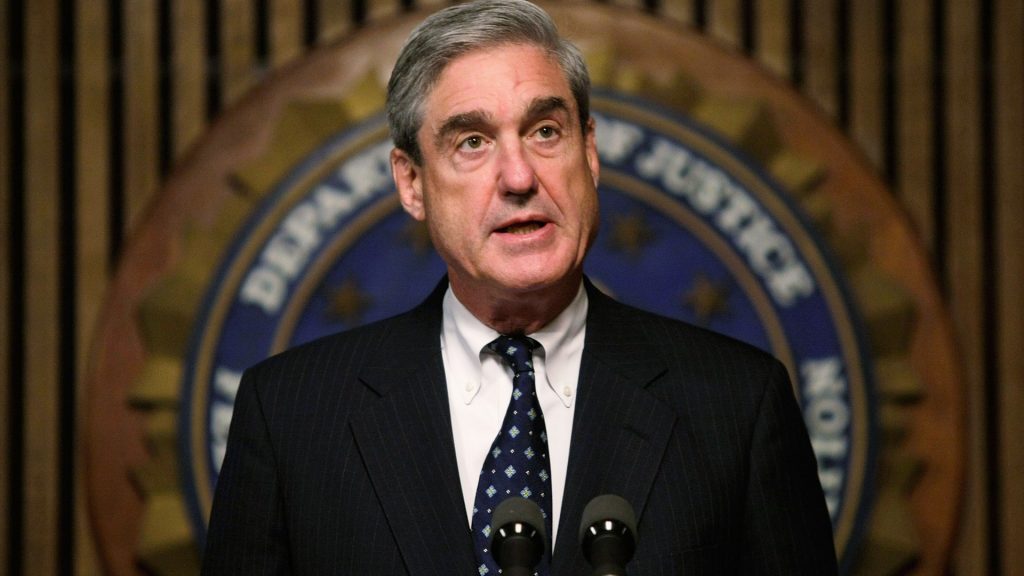
Robert Mueller, the former FBI director who served as special counsel in the investigation into whether President Donald Trump’s campaign coordinated with Russia in the 2016 presidential election, has died, according to a statement released by his family members.
“With deep sadness, we are sharing the news that Bob passed away” on Friday, the statement said, according to The Associated Press. “His family asks that their privacy be respected.”
The family did not say what caused 81-year-old Mueller’s death. Last year, they said he was diagnosed with Parkinson’s disease in 2021.
Mueller started the position just one week before the Sept. 11, 2001, attacks. He would go on to become the second-longest-serving director in FBI history, after J. Edgar Hoover.
Once he left the FBI, Mueller spent several years in private practice before being asked by then-Deputy Attorney General Rod Rosenstein to be special counsel in the Trump-Russia probe.
That investigation, which the president branded a “witch hunt,” ended with charges against 34 people and three companies. While the 448-page document released in April 2019, commonly called the “Mueller report,” showed there was contact between the Trump campaign and Russia, it did not allege the president committed a crime in that instance. Nor did Mueller charge Trump with obstruction, despite the report showing evidence of it.
Mueller previously noted the report also did not necessarily “exonerate” the president.
“If we had confidence after a thorough investigation of the facts that the president clearly did not commit obstruction of justice, we would so state. Based on the facts and the applicable legal standards, we are unable to reach that judgment,” Mueller said in the report.
Responding to the news of Mueller’s death on Truth Social, Trump said: “Good, I’m glad he’s dead.”
“He can no longer hurt innocent people!” Trump wrote.
In contrast, former President Barack Obama had high praise for Mueller, calling him “one of the finest directors in the history of the FBI, transforming the bureau after 9/11 and saving countless lives.”
“It was his relentless commitment to the rule of law and his unwavering belief in our bedrock values that made him one of the most respected public servants of our time,” Obama said. “Michelle and I send our condolences to Bob’s family, and everyone who knew and admired him.”
Mueller’s tenure at the FBI
Mueller was nominated to lead the FBI by Republican President George W. Bush. During his time there, the FBI was given new surveillance powers in response to 9/11 and fears about terrorism and national security. The FBI moved 2,000 in its criminal programs to national security.
As FBI director, “I had expected to focus on areas familiar to me as a prosecutor: drug cases, white-collar criminal cases and violent crime,” Mueller said to a group of lawyers in October 2012, according to the AP. However, he had to shift his focus to “long-term, strategic change.”
“We had to enhance our intelligence capabilities and upgrade our technology,” Mueller said at the time. “We had to build upon strong partnerships and forge new friendships, both here at home and abroad.”
While he was FBI director, Mueller said the FBI would not use abusive techniques to question suspects — though that policy would not be “effectively communicated” for almost two years, the AP wrote. In the weeks after 9/11, the FBI rounded up more than 1,200 people who ended up not being a part of Al-Qaeda.
Mueller’s counterterrorism agents revealed that there was torture and abuse at CIA secret “black sites” and Abu Ghraib prison in Iraq, The New York Times wrote, and in October 2002, FBI agents at Guantánamo Bay in Cuba opened a running file, later labeled “War Crimes.”
Then, in 2004, Mueller and former deputy U.S. Attorney General James Comey learned that Bush let the National Security Agency eavesdrop on Americans without search warrants, collect electronic records of telephone calls, emails and addresses through a secret program called “Stellar Wind.” The NSA would then give this data to the FBI.
Both Mueller and Comey told the U.S. attorney general at the time, John Ashcroft, that the program shouldn’t be reauthorized, but Bush still did.
Mueller, in response, wrote a letter of resignation, saying he would step down if Bush didn’t withdraw from Stellarwind. After a solo meeting with Bush in the White House, the former president ultimately agreed to scale back the program — though the Times notes that this process took years.
Comey, speaking in 2005 to an audience at the NSA about what Mueller did, said: “It takes far more than a sharp legal mind to say ‘no’ when it matters most,” he said. “It takes moral character. It takes an ability to see the future. It takes an appreciation of the damage that will flow from an unjustified ‘yes.’”
It was a fraught time, with Mueller saying at the end of his directorship that there were days “when we were under attack by the media and being clobbered by Congress; when the attorney general was not at all happy with me.”
To his agents, the New York Times wrote, Mueller “could be brusque and unforgiving.” Still, agents apparently liked him and even gave him the nickname “Bobby Three Sticks.”
Although Congress limited FBI directors to 10-year terms, it approved it when President Barack Obama asked Mueller to stay for two more years.
“Under his watch, the FBI joined forces with our intelligence, military and Homeland Security professionals to break up Al Qaeda cells, disrupt their activities and thwart their plots,” Obama said about Mueller, The New York Times reported.
When the Justice Department in 2017 said Mueller would be special counsel for the Trump 2016 campaign investigation, it was only eight days after the president fired Comey, the FBI director at the time.
Trump, when he heard about Mueller’s appointment, said it would be “the end of my presidency.”
Because of the report, Mueller butt heads with Attorney General William Barr, who publicly disagreed with the findings in the report. Democrats, though, were also left disappointed by Mueller’s congressional testimony on the matter.
Mueller’s early life
Mueller was born on Aug. 7, 1944, in Manhattan, to Alice and Robert Swan Mueller Jr., a Navy officer during World War II who later was an executive at DuPont, a chemical company.
In 1966, he graduated from Princeton University with a degree in politics and got a master’s degree in international relations from New York University in 1967.
When a close friend of his at Princeton died in the Vietnam War, Mueller joined the Marine Corps. On MSNBC podcast “The Oath with Chuck Rosenberg” Mueller described the lessons he learned from his time in the Marines. Three pillars he lived by, Mueller said, were “teamwork, sacrifice and discipline.”
“I’ve ended up being able to spend some time in the government and private practice as well as in various institutions, and I’ve come to believe that it really does not matter which way you choose to serve,” he said. “And the only thing that we ask is that you work for your country for your community. Each person must determine in what way they can best serve others in a way that will leave them believing that their time has been time well spent.”
Mueller is survived by his wife, Ann Cabell Standish, and their two daughters, Cynthia and Melissa, as well as three grandchildren.
Ella Rae Greene, Editor In Chief