Is everyone born in the US a citizen? Supreme Court to decide
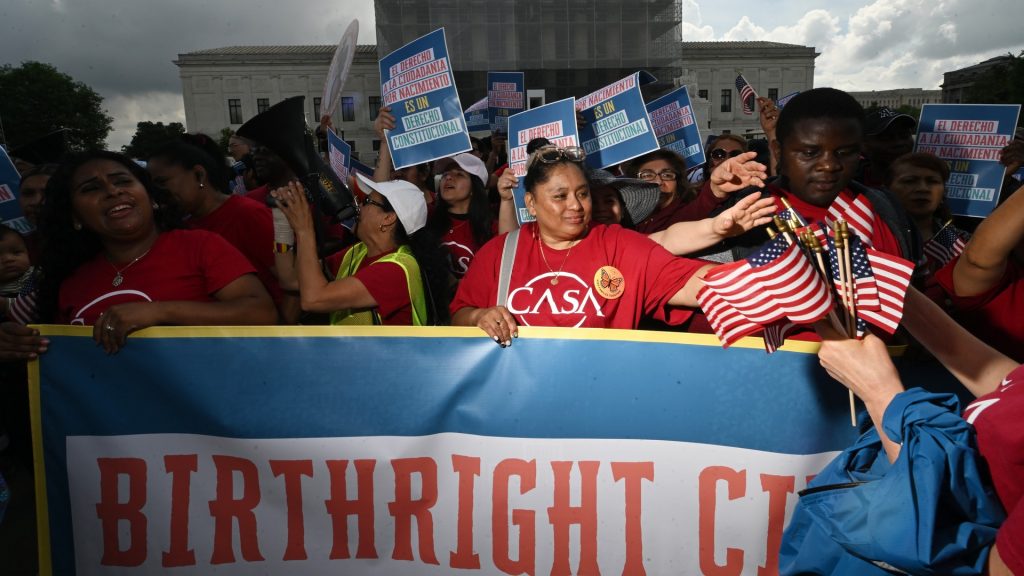
A case headed to the Supreme Court early next month could redefine what it means to be an American citizen.
At the center of the case is birthright citizenship, the longstanding constitutional principle that grants U.S. citizenship to anyone born on American soil, regardless of their parents’ origins or immigration status.
The 14th Amendment, adopted after the Civil War, says that “all persons born or naturalized in the United States, and subject to the jurisdiction thereof,” are American citizens.
But when President Donald Trump returned to office last year, he signed an executive order that sought to end automatic citizenship for babies born to parents who are in the U.S. unlawfully.
“This is a profoundly important case not only concerning the nature of American citizenship, but also the boundaries — yet again — of presidential power,” Zachary Shemtob, executive editor of SCOTUS Blog, told Straight Arrow News.
The Trump administration argues the birthright citizenship clause has been interpreted too broadly and should not apply to every child born in the U.S., regardless of circumstances. But opponents warn the consequences could be sweeping and dire.
“If the court were to agree with the administration, it would signal open season on questioning the citizenship of millions of Americans, which is already a corrosive force in our country,” Cody Wofsy, deputy director of the Immigrants’ Rights Project at the American Civil Liberties Union, told SAN. “It would be cataclysmic.”
Legal scholars say the ruling could reaffirm a longstanding understanding of citizenship in the U.S. — or dramatically alter it.
“[I]f the Court rules in favor of the Trump executive order, we will interpret the 14th Amendment in a radical new way, and the consequences will be extensive and explosive,” Daniel Greenberg, a senior legal fellow in the Robert A. Levy Center for Constitutional Studies at the Cato Institute, a libertarian think tank, told SAN.
What the case is about
The Supreme Court will decide whether a president can effectively limit a constitutional guarantee through his unilateral executive action.
The Trump administration argues the 14th Amendment was originally intended to grant citizenship primarily to formerly enslaved people. Therefore, the administration says, it does not necessarily apply to children born to unauthorized immigrants or visitors.
But critics of Trump’s executive order say the amendment’s text is clear, a position they say is supported by more than a century of legal precedent.
“Those seeking to protect citizenship are relying upon the plain words of the Constitution,” Anthony P. Ashton, senior associate general counsel of the NAACP, told SAN. “They are arguing that ‘all persons … born in the United States’ means exactly what it says. ‘All’ means all. They also are relying on the history of how the 14th Amendment came to be written and the way that language has been interpreted for more than a century. Those seeking to deprive future U.S.-born infants of citizenship are twisting the language in a way that courts have never found to be correct.”
Oral arguments before the Supreme Court are scheduled for April 1 in the case of Trump v. Barbara, which consolidates multiple lawsuits into a class action challenging the president’s executive order.
Lower courts, including a federal trial judge in New Hampshire and the 9th U.S. Circuit Court of Appeals, ruled that Trump’s order violated the 14th Amendment.
How the Supreme Court rules could depend on which of two previous cases concerning birthright citizenship it relies on.
One is U.S. v. Wong Kim Ark from 1898, in which the Supreme Court affirmed that a child born in the U.S. to noncitizens is indeed a citizen. The ruling established the modern understanding of the birthright citizenship clause in the 14th Amendment.
The other case, Elk v. Wilkins from 1884, denied citizenship to a Native American man.
Andrew Arthur, a former immigration judge and a fellow at the Center for Immigration Studies, which advocates for immigration restrictions, said the Supreme Court could reach any of three conclusions.
“It’s either going to confirm its conclusion in United States v. Wong Kim Ark, which says everyone who was born in the U.S. who is not the child of a foreign diplomat or is born to foreign parents in a section of the United States that’s under foreign occupation is a U.S. citizen,” Arthur told SAN. “Or, it’s going to find that the second clause of the 14th Amendment is vague, and for that reason, Congress can pass a statute that interprets it, and therefore modifies the holding in United States v. Wong Kim Ark. The third choice is that the second clause in the 14th Amendment is vague, and that the executive branch can interpret it.”
Potential impacts
The NAACP’s Ashton said any decision other than one upholding the birthright citizenship clause could create havoc.
“The Supreme Court would be creating an underclass of certain persons born in this country,” he said. “It would be a return to Dred Scott days, when persons who were born here and lived here all their lives were not legally entitled to the rights of citizens, not because of any act committed by that person, but because of their heritage. Furthermore, it would make the citizenship rights of persons born in this country subject to whim of whomever happened to be president at the time.”
If the court rules in Trump’s favor, birth certificates alone may no longer be sufficient proof of citizenship, and parents could be required to verify their own legal status. Legal experts say this could leave many children in legal limbo.
“The most imminent would be subjecting them to arrest and deportation to a country they’ve never known,” the ACLU’s Wofsy said. “They’d lose access to passports, Social Security numbers through the ordinary process, all kinds of programs, and as they grow up living under the threat of deportation, they’d lose out on access to higher education, various types of employment and military service, the ability to vote, and to be part of a jury.”
State and local governments could face many logistical and costly challenges verifying nationalities and legal statuses for every birth.
But if the court sides with the families, the current understanding of birthright citizenship would remain intact, as it has for many years.
“The 14th Amendment would continue to operate exactly as it was intended to and always has,” Ashton said. “Each new person born in America would be a citizen of the United States and have the same citizenship rights that every person born in the U.S., with very limited exceptions, has had under the 14th Amendment since its enactment.”
Ella Rae Greene, Editor In Chief