Pentagon shoots down CBP drone; Anthropic rejects AI ultimatum
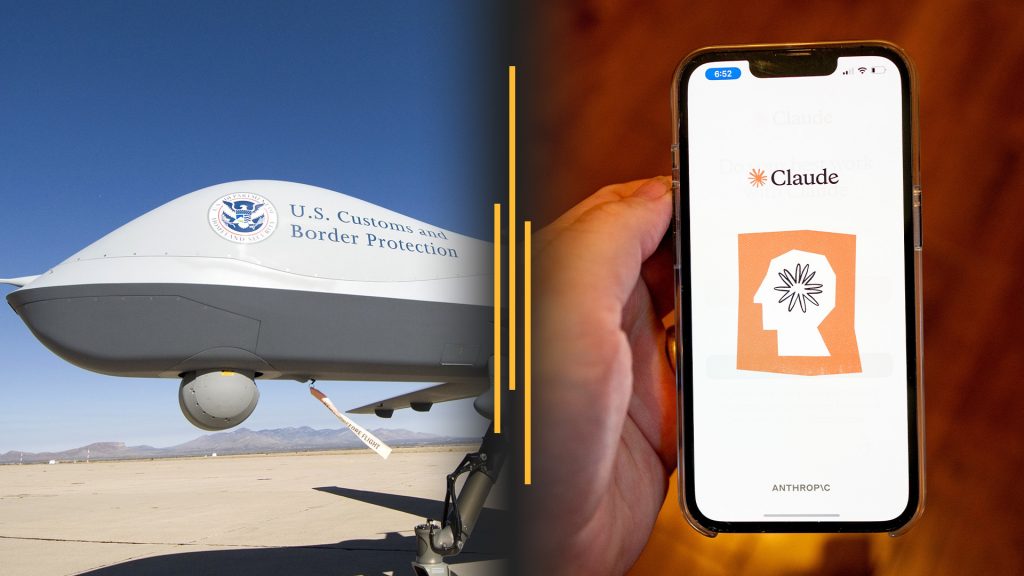
The U.S. military shoots down a drone over Texas belonging to Border Patrol. Now, lawmakers are demanding a federal investigation.
Plus, Anthropic rejects a Pentagon ultimatum over access to its AI model. The company’s CEO says its safeguards are non-negotiable.
And a speedboat confrontation with Cuban authorities turns deadly, with at least one American dead.
These stories and more highlight your Unbiased Updates for Friday, February 27, 2026.
US military shoots down CBP drone calling it a ‘seemingly threatening drone’
The federal government is promising better communication after the U.S. military shot down a drone that turned out to belong to Customs and Border Protection (CBP). The incident happened on Thursday over Fort Hancock, about 50 miles southeast of El Paso, Texas.
In a joint statement, the Defense Department, FAA and CBP said the military targeted what it called a “seemingly threatening” drone.
But it wasn’t until congressional Democrats spoke out that it became clear: the drone was actually operated by CBP.
Democrats accused the Trump administration of “incompetence,” saying a lack of coordination led to the shootdown.
They also criticized the administration for sidestepping a bipartisan bill designed to train drone operators and improve communication between the Pentagon, FAA and Homeland Security.
The incident comes just two weeks after a separate laser response near Fort Bliss, where sources told NBC News the target turned out to be party balloons.
In that case, CBP did not notify the FAA, triggering a temporary closure of El Paso airspace and flight cancellations.
Now, Sen. Tammy Duckworth, the ranking member on the Senate aviation subcommittee, is calling for an independent investigation.
In a post on X, she said, “It’s this kind of failure to communicate between DOD and FAA that led to the tragic loss of life above DCA.”
She’s referring to the January 2025 midair collision between an airliner and a military helicopter near Reagan National Airport that killed 67 people.
The NTSB later found that the FAA and the Army had failed to share safety data on repeated close calls in that airspace and had not addressed the risks.
Anthropic won’t agree to Pentagon’s demands saying threats ‘do not change our position’ on AI
Anthropic’s CEO says his company will not give the Pentagon unrestricted access to its AI model, Claude.
Defense Secretary Pete Hegseth had given the company a Friday deadline to grant access or face consequences.
Those consequences included canceling anthropic’s $200 million DOD contract, labeling the company a “supply chain risk,” and even invoking the Defense Production Act.
In a statement, CEO Dario Amodei called that approach “inherently contradictory.”
“One labels us a security risk; the other labels Claude as essential to national security,” he wrote. “These threats do not change our position. We cannot, in good conscience, accede to their request.”

Amodei says Anthropic will not drop its safeguards.
The company is seeking assurances that Claude would not be used for fully autonomous weapons or mass domestic surveillance.
The Pentagon has not agreed to those terms, though it notes that spying on Americans is illegal.
Talks are continuing.
But according to Axios, the Pentagon on Wednesday asked Boeing and Lockheed Martin to detail how much they rely on Claude. It’s a move seen as a first step toward formally designating anthropic as a supply chain risk.
US confirms citizen among four dead in Cuba shootout
New details have been released in the deadly shootout off Cuba. Officials say at least one of the people killed was an American.
Cuba’s interior ministry says ten people were on board a Florida-registered speedboat near the island’s north coast.
Havana says its forces approached the boat and those on board opened fire, wounding a Cuban patrol commander.
Four people were killed. Six were wounded and detained.
U.S. officials confirm at least one of the dead is an American.
Some of the others may be lawful permanent U.S. residents, including one person with a K-1 fiancé visa.
Cuba called it a “terrorist” infiltration attempt, saying weapons recovered included assault rifles, handguns and Molotov cocktails.
Secretary of State Marco Rubio says the U.S. is working to independently verify what happened, and is for now relying on information from Cuban authorities.
Cuba’s deputy foreign minister says two people on the boat were on prior lists shared with U.S. officials in 2023 and 2025, allegedly linked to violent or terrorist acts.
DOJ reviews missing Epstein files after FBI interview summaries tied to Trump not released
The Justice Department said it is reviewing whether FBI files containing allegations against President Donald Trump were improperly withheld from its massive Epstein document release. The issue concerns missing FBI interview summaries related to a woman who decades ago accused both Jeffrey Epstein and Trump of sexual assault.
Trump has denied any wrongdoing.
When the DOJ released millions of pages under the Epstein files transparency act, an index showed that the FBI interviewed the woman four times in 2019. Only one of those interview summaries was made public. The other three interview summaries were not included in the public release.

The Justice Department now says it’s reviewing whether anything was improperly tagged or withheld.
A spokesperson said, “Should any document be found to have been improperly tagged in the review process and is responsive to the act, the department will, of course, publish it, consistent with the law.”
The woman alleged Epstein introduced her to Trump in the 1980s and that Trump assaulted her. No public evidence has corroborated the claim, and Trump has repeatedly denied wrongdoing.
Senate Minority Leader Chuck Schumer has accused the department of deliberately omitting the information.
“Let me be blunt,” Schumer said. “There is a massive cover-up going on in the justice department to protect Donald Trump and people associated with Jeffrey Epstein.”
Schumer said Senate Democrats will review unredacted files in the coming days and are demanding the preservation of all internal records related to the release.
The Justice Department insists it complied with the law.
ICE detains Columbia University student
A Columbia University student detained by federal agents is now back home after a day of outrage, protests and political pressure. Elmina Aghayeva was taken into custody early Thursday morning after Homeland Security agents entered a Columbia-owned residence hall.
University officials said immigration agents misrepresented themselves by claiming they were searching for a missing person to gain entry.
Manhattan borough president Brad Hoylman-Sigal said in a post on X that ICE agents posed as New York Police Department officers using fake badges and a phony missing-child bulletin, calling the civil rights implications “staggering.”
The Department of Homeland Security confirmed that ICE arrested Aghayeva, a student from Azerbaijan, outside this university’s residential building, stating that her student visa was terminated in 2016 and that she has no pending appeals.
While in custody, Aghayeva posted a photo from the back of what appeared to be an ICE vehicle, writing, “DHS illegally arrested me. Please help.”
Her lawyer filed an emergency petition in federal court
By mid-afternoon, New York City Mayor Zohran Mamdani said she would be released after speaking with Trump.
Aghayeva later posted on Instagram: “I’m so grateful for everyone one of you. I just got out a while ago. I am safe and okay… I am in complete shock, and I need a little bit of time to process everything.”
The incident led to protests on campus and reignited tensions following last year’s high-profile ICE arrest of Columbia student Mahmoud Khalil.
Columbia said it is reviewing its policies and has reminded staff that a judicial warrant, not an administrative warrant, is required for access to private university housing.
Study finds Stone Age markings followed consistent, intentional patterns
Some say writing is a lost art in the age of computers. But how did we learn to write in the first place? The answer may date back 40,000 years.
Researchers in Germany have been studying about 250 Stone Age artifacts — rocks, stones and carved figurines — all etched with repeating symbols. The markings include lines, crosses and other simple signs.
-

Landesmuseum Württemberg / Hendrik Zwietasch, CC BY 4.0 via Saarland University -

Universität Tübingen / Hildegard Jensen, CC-BY-SA 4.0 via Saarland University -

Staatliche Museen zu Berlin, Vorderasiatisches Museum / Olaf M. Tesmer, CC-BY-SA 4.0 via Saarland University -

Staatliche Museen zu Berlin, Vorderasiatisches Museum / Olaf M. Tesmer, CC-BY-SA 4.0 via Saarland University
Scholars now believe they weren’t random.
They might have recorded hunting counts or observed lunar cycles, creating an early sign system with genuine structure and significance. One scientist said there’s a clear logic to the symbols — a pattern that suggests intentional communication.
Researchers add that the complexity of these marks is comparable to proto-cuneiform, the earliest known writing system, which emerged in Mesopotamia more than 5,000 years ago.
In other words, humans may have been laying the groundwork for writing tens of thousands of years earlier than we thought.
More from Straight Arrow News:

Correlation isn’t causation: What headlines often get wrong about health science
News headlines often compress complex science into a simple storyline: If two things are happening at the same time, one must be causing the other. Tylenol causes autism. Ultra-processed foods cause cancer. Social media causes depression.
But in science, that’s only the starting point.
When two trends move in tandem, researchers call that a correlation. It does not mean one directly causes the other. Proving causation — that one factor independently produces a specific outcome — requires far more rigorous evidence. Read the full story now>
Ella Rae Greene, Editor In Chief