What’s at stake as Supreme Court considers Louisiana voting rights case
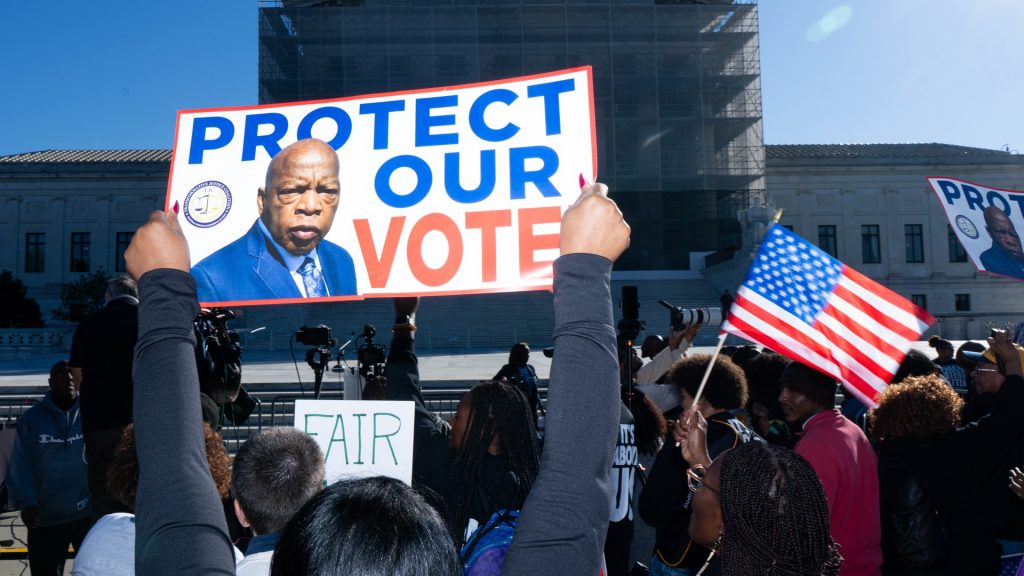
Along the Mississippi River north of Baton Rouge, cutting across Interstate 49, lies the congressional district at the center of one of the nation’s most consequential battles over voting rights.
The Supreme Court is poised to decide soon whether intentionally drawing a congressional district with a majority of Black residents, who would be expected to elect a Black representative to Congress, is constitutional. A group of white plaintiffs sued the state of Louisiana, claiming the district was created through racial gerrymandering and, therefore, violates the Equal Protection Clause.
The case, Louisiana v. Callais, could shape future efforts to address historic underrepresentation of minorities — and could affect the outcome of the 2026 midterm elections.
“This such an important case because the court may seriously weaken, or strike altogether, a key provision of the Voting Rights Act,” SCOTUS Blog editor Zachary Shemtob told Straight Arrow News. “This, in turn, would prevent states from considering race when carving out congressional districts, even as a remedy to the finding of racial discrimination.”
If the court issues its ruling soon, some states might redraw their maps before the midterms.
“That timing could determine whether multiple districts are reshaped — or erased — before voters ever cast a ballot,” wrote Caroline Pirrone, Liana Keesing, and Michael McNulty for Issue One, which describes itself as a “crosspartisan political reform group.”
The decision will mark the court’s next chapter in where it lands on voting rules and rights in the United States. It could reshape — or dismantle — Section 2 of the Voting Rights Act.
The case
When Louisiana lawmakers created a second majority-Black congressional district in 2024, a group of white voters sued, saying the state cannot legally draw a district based on its racial makeup.
A three-judge panel in U.S. District Court sided with the white voters, throwing out the state’s new congressional map on the grounds that it was racially gerrymandered, or carved up to suit certain parties. The state and a group of Black voters appealed to the Supreme Court.
The justices are being asked to balance two legal and constitutional imperatives.
Section 2 of the Voting Rights Act — the seminal civil rights legislation from 1965 — requires states to provide realistic opportunities to historically marginalized groups, such as Black citizens, to elect candidates of their choosing. Would limiting use of that section in redistricting disenfranchise Black voters not only in this Louisiana congressional district, but in others, as well?
But by favoring Black citizens, did the state violate the Equal Protection Clause of the 14th Amendment, which bars the government from treating citizens differently?
“The Court will be poised to address long-held precedent about how lawmakers must balance constitutional and VRA protections when enacting maps,” the Legal Defense Fund, an affiliate of the NAACP, wrote, “and it will be poised to determine the ongoing scope of the VRA in Louisiana and nationwide.”
The Supreme Court has twice heard arguments in the case. The first time, in 2024, the case applied only to Louisiana. Now it has implications for the nation.
Potential impacts
If the court rules in favor of the white plaintiffs, it could sharply limit the way jurisdictions draw voting districts. But some experts say this could chill other racially conscious remedies. More than 60 years after passage of the Voting Rights Act, voting experts say Section 2 is under threat, as is the act itself.
“It’s an important voting rights case because of the possibilities … that this case will undermine Section 2 are of great concern,” Rob Weiner, director of the Voting Rights Project at the Lawyers’ Committee for Civil Rights Under Law, told SAN. The Lawyers’ Committee filed an amicus brief on the case on behalf of several organizations.
“We used to have Section 5 (in the Voting Rights Act),” Weiner continued. “Section 5 said that if a state or local government wanted to change their voting procedures, and they had a history with discrimination, they had to get prior approval from the Department of Justice or from the district court. The Supreme Court struck that down in 2013.”
With Section 5 stricken, Section 2 is all that remains for racially conscious remedies, Weiner said.
“If the court cuts back on Section 2, that is the most significant remaining remedy for voting rights violations, if not the only one,” Weiner said. “I think people are concerned that having chopped down the statue before, that the court will chop it down again.”
Section 2, he said, “is sort of the centerpiece, and that’s the one everyone is concerned about.”
The concerns are speculative until the justices issue an opinion, which could come as early as next week or as late as June, when the court’s current term ends.
“It could be a very significant case,” Weiner said. “It could be a very confusing case. Or it could be a more modest setback. It’s not likely to be insignificant. It will do something that probably affects our ability to bring cases. But we don’t know how much.”
“They could have a narrow ruling, in favor of the plaintiffs, that leaves intact some, or most, of the Section 2 framework,” Weiner added. “Or they could have a broad ruling that dismantles Section 2 in considering race as a remedy… if they say that, then that would make section 2 cases a lot more difficult because it is hard to remedy a racial problem, without considering race. It’s not impossible. There are ways in some circumstances to do it. And there are other bases for which we can bring our lawsuits. But it would make it harder.”
Ella Rae Greene, Editor In Chief