Police overtime, riot agent cleanups: The price tag of having DHS operations in a city
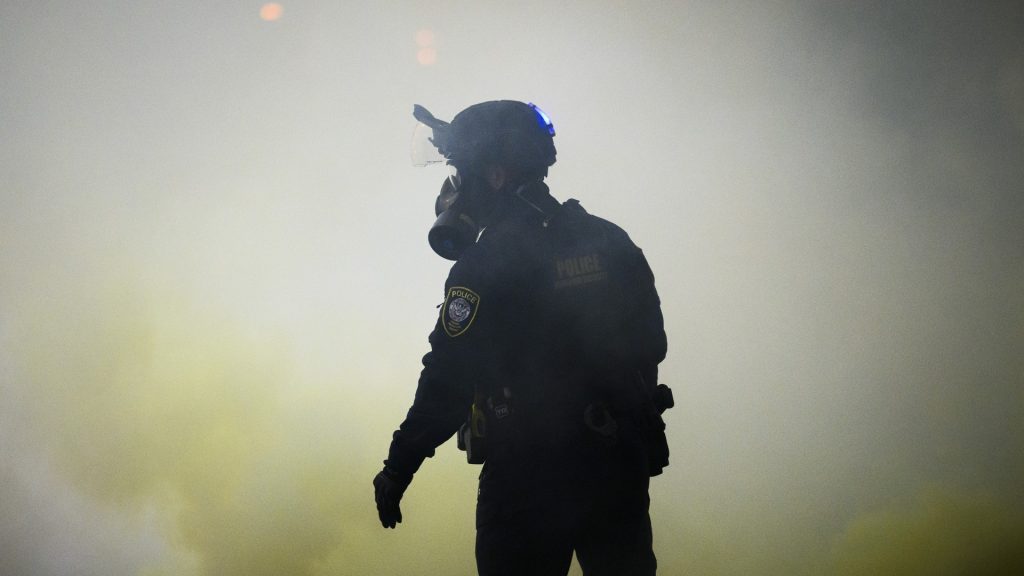
As federal immigration officers continue paring down targeted operations in Minnesota, cities are saying the Department of Homeland Security’s deployments are costing them thousands of dollars.
Minneapolis and Portland reported needing to spend an excess of $6 million, collectively, as they shared that DHS racked up costs for police overtime and for street cleanup necessary for tear and hexachloroethane (HC) gas residue left on streets and buildings. They aren’t alone in tackling high costs, as the Chicago Tribune and Minnesota-based North Star Policy Action estimated DHS shelled out $18 million for every week of Operation Metro Surge and $59 million for Operation Midway Blitz.
“The amount varies with activity at the facility, but since June 2025, Environmental Services has received numerous community complaints through its pollution prevention hotlines,” senior communications representative Andy Kiemen told Straight Arrow News.
In Portland, Kiemen wrote that his department conducts routine inspections around U.S. Immigration and Customs Enforcement’s facility to determine if agents deployed riot control chemicals like tear and HC gas, and if they are affecting the city’s stormwater system.
Unbiased. Straight Facts.TM
DHS’s deployments in Minneapolis and Portland cost the two cities more than $6 million collectively in overtime and environmental cleanup.
For the federal government, North Star Policy Action Executive Director Jake Schwitzer said costs will come out of taxpayers’ pockets, but could have an inverse effect on small businesses that feed and house the agents. He added that the financial costs don’t outweigh the violence seen.
“The human cost is immense and must remain at the forefront of public concern,” Schwitzer said. “Nevertheless, there is also a clear and significant economic cost that can no longer be ignored.”
Estimates came as small businesses said they faced their own economic struggles, leaving once-bustling neighborhoods as ghost towns and owners with the decision to stay open or close for good. University of Pennsylvania Wharton School professor Exequiel “Zeke” Hernandez previously told Straight Arrow News that local officials need to talk about the economic tolls of targeted immigration actions as much as they do about moral and legal ones.
“But they’re not articulating clearly, ‘here are the quantifiable ways in which our economy is suffering,” he said.
Tear, hexachloroethane gas costs Portland at least $20K
Kiemen wrote that the city has spent at least $18,879 since June 2025 on environmental remediation and staffing to address tear and hexachloroethane gas residue. He said the cleanup is limited to the ICE facility at 4310 S Macadam Ave in the city’s downtown neighborhood.
“When it is safe to do so, Environmental Services’ Spill Protection & Community Response (SPCR) investigates the area around the ICE facility (4310 S Macadam Ave) at least once per week to determine if riot control agents (RCAs), including tear gas and pepper spray, are impacting the City’s stormwater system,” he wrote.
Clean up for his department has cost $10,099 from June 2025 to Feb. 11 in labor, and an estimated $8,780 for a single-day contractor, which performed street vacuuming on Jan. 27.
A federal judge has blocked ICE and other federal law enforcement from using chemical munitions outside the federal building since Feb. 3, according to the American Civil Liberties Union of Oregon. The civil rights group sued the Trump administration in November over allegations that federal agents are illegally retaliating against protesters outside of the ICE facility.
The city said in July that it received reports about federal agents using chemical munitions at the facility, which included pepper balls, pepper spray and HC smoke. They added that protesters have also used over-the-counter pepper spray, fireworks, flares and bear mace.
To clean up tear gas residue, Core Environmental Solutions, an environmental remediation company, recommends having a specialized team trained to accurately identify residue, which can appear as a fine off-white powder. Any clothing that the chemical touched must be removed and sealed into a plastic bag. For many surfaces, it can be cleared by vacuuming with a HEPA filter and washing with a water and baking soda solution, or a water and vinegar solution.
“Chemicals from tear gas can settle into soil and waterways, potentially affecting plant and animal life,” the company says. “For instance, aquatic ecosystems may be particularly vulnerable, as contaminants can disrupt the balance of delicate habitats.”
Hexachloroethane is more complex. It is typically a colorless gas that can cause illnesses if consumed or inhaled, according to the National Oceanic and Atmospheric Administration. If heated, it can be toxic, but the main hazard is its environmental impact.
According to the National Institutes of Health, HC can kill fish and cause long-term effects if released in water. If spilled, the chemical must be cleaned using vermiculite, dry sand or earth, then transported to containers.
Kieman wrote that Portland uses catch basins and street cleanings to stop chemical munitions from entering the sewer system and river.
Operation Metro Surge cost Minneapolis at least $6M
Minneapolis, which became the city to watch during DHS’ enforcement operations, released a report on Feb. 13 that stated the plan cost the city $6 million in payroll, police overtime and equipment expenses. The city’s estimates did not cover the entire 10 weeks, instead, it covered expenses from Jan. 7 through Feb. 1.
The bulk of the expenses came from the Minneapolis Police Department, with about $5.29 million used for overtime and standby pay. The department had an overtime budget of $2.3 million.
“The City of Minneapolis projects weekly expenses of $1.5 million, including staff and non-labor costs,” according to the report. “If Operation Metro Surge continues, the City is expected to incur $5.9 million more in staff time and operational expenses by March 1, 2026, as we continue to respond to Operation Metro Surge. If this level of spending is maintained, it would bring the total cost to the City to $11.9 million by March 1.”
Beyond costs the city is responsible for, it estimated Operation Metro Surge to cost a total $203.1 million in losses for business revenues, household incomes, hospitality revenues and wages, and unrealized construction.
DHS could see multi-million bill from Chicago, Minneapolis deployments
Schwitzer calculated average salaries for ICE and Customs and Border Protection agents to estimate that each week of Operation Metro Surge cost DHS $9 million. The calculation did not account for overtime or bonuses. For lodging and feeding agents, he said that costs about $4.5 million each week.
He continued that detention costs about $1.6 million a week.
“This analysis does not consider costs associated with renting vehicles, damage to those vehicles, the use of tear gas or other munitions, or the use of helicopters, again suggesting that the true cost of daily activities is higher,” he wrote.
Estimates are lower for Chicago’s Operation Midway Blitz, which had significantly fewer federal agents compared to Minneapolis. The Chicago Tribune published estimates in January based on court filings, databases and public records.
The newspaper reported that Operation Midway Blitz cost DHS $39.8 million and the National Guard $19.4 million. Most of the costs came from detention, followed by extra staff salaries.
Detention calculations were based on the Department of Homeland Security’s previous statements that it arrested more than 4,500 people. A person spends an average of 44 days in detention and costs about $152 per day to support. Former DHS Assistant Spokesperson Tricia McLaughlin told the Chicago Tribune that “the cost of American lives saved is uncalculatable.”
The post Police overtime, riot agent cleanups: The price tag of having DHS operations in a city appeared first on Straight Arrow News.
Ella Rae Greene, Editor In Chief