At Munich Security Conference, Europe questions its reliance on America
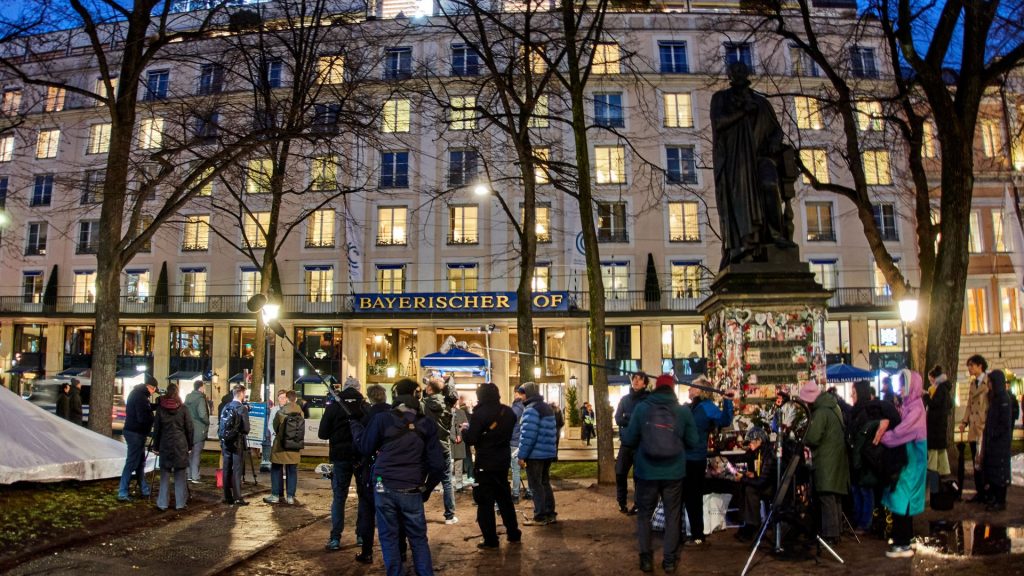
MUNICH, Germany — Black BMWs and Audis rolled up to Munich’s Hotel Bayerischer Hof, their tinted windows concealing presidents, prime ministers and military commanders. From nearby rooftops, snipers scanned the streets below, where police sealed off blocks throughout Old Town. This was the scene in the Bavarian capital last Friday, the opening day of the annual Munich Security Conference.
Every year since 1963, the world’s most powerful heads of state, defense ministers and political actors have gathered at this grand Art Deco hotel to discuss the weight of war and peace and the fate of nations.
In previous years, the conference often struck an optimistic tone, stressing the importance of cooperation among nations. This year’s framing carried a darker message.
Titled “Under Destruction,” the 2026 Munich Security Report warned of a global order entering an era of “wrecking ball politics,” led by President Donald Trump.
“Ironically,” the report said, “the president of the United States — the country that did more than any other to shape the post-1945 international order — is now the most prominent of the demolition men.”
The report reflects the growing concern, expressed frequently during the three-day conference, that political instability in the United States threatens to disrupt longstanding global alliances that have guaranteed relative peace in the West for decades. Delegates to the conference said that internal chaos in the U.S. — caused by aggressive immigration enforcement, by using courts to seek retribution against the president’s enemies, by applying unpredictable and punitive tariffs on imported goods — could result in insecurity around the world.
“European heads of state are concerned about the democratic health of the United States and the independence of its judiciary, in particular the Justice Department, where the norm of independence post-Watergate seems to have been shattered,” Cathryn Clüver Ashbrook, the former director of the German Council on Foreign Relations, told Straight Arrow News.
At the same time, many leaders said that what they consider erratic behavior by Trump has demonstrated that they have depended on the U.S. too much for too long.
“Europe has the chance to lead the middle powers,” Ngozi Okonjo-Iweala, director-general of the World Trade Organization, said during a panel discussion. “So many countries are overly dependent on the U.S.”
In the grand hotel’s hallways, a man’s baseball hat embraced that tone. It read, “MAKE EUROPE GREAT AGAIN.”
Blaming Trump
The complaints lodged against Trump in Munich were familiar.
At home, he has issued a record number of executive orders, some of them involving matters over which a president has no authority. He has unilaterally imposed large tariffs on foreign imports, prompting a Supreme Court battle over their legality. He has imposed penalties on universities, corporations and law firms because of what he perceives as their “wokeness.” He has asserted control over government agencies that Congress created to be independent. And he has sent troops into major cities, over the objections of local and state leaders.
Abroad, Trump has distanced the U.S. from NATO and pulled out of treaties and organizations such as the World Health Organization, the United Nations Human Rights Council and UNESCO. He has wavered in his support for Ukraine in its effort to repel the Russian invasion. He has sent the military into Venezuela to seize that country’s leader, possibly in violation of the U.N. Charter and international law. He has threatened to acquire Greenland from Denmark — by force, if necessary.
It is an extraordinary moment in history, with many who attended the security conference saying they don’t know what to expect next from the U.S.
“Credibility and trust is a fundamental currency in international diplomacy,” said Ashbrook, the former German foreign relations official. “And if you begin to erode that, as we’ve seen on the United States side … that makes middle powers weary. And that is the kind of insecurity, that is the prime order of business now for middle powers to figure out how they manage the insecurity that’s emanating from great powers, structurally.”
Kicking off the conference, German Chancellor Friedrich Merz declared that the rules-based order “no longer exists.”
“Our freedom,” Merz said, “is not guaranteed.”
Two American stories
This year’s Munich Security Conference featured more American delegates than ever before. They brought conflicting versions about how the U.S. views itself in the world and its relationships with other nations, especially those in Europe.
Secretary of State Marco Rubio delivered the main speech for the Trump administration, reiterating the president’s view that tensions between America and Europe are caused by the continent’s cultural slide.
“We do not want allies to rationalize the broken status quo rather than reckon with what is necessary to fix it,” Rubio said, “for we in America have no interest in being polite and orderly caretakers of the West’s managed decline.”
He said that Europe, like the U.S., faces “civilizational erasure” if it doesn’t secure its borders to prevent mass migration. The remarks echoed criticisms that Trump leveled at American allies last month during the World Economic Forum in Davos, Switzerland.
But Rubio said the U.S. and Europe share a destiny.
“America is charting a path of a new century of prosperity and … we want to do it together with you, our cherished allies and our oldest friends,” he said.
Still, Rubio’s speech stood in stark contrast to then-Vice President Kamala Harris’ in 2024, when she declared, “Our sacred commitment to NATO remains ironclad.”
Others close to Trump were less diplomatic than Rubio.
“Who gives a s— who owns Greenland? I don’t,” said Sen. Lindsey Graham, R-S.C., a longtime Trump ally. “So the point is Greenland is going to be more fortified because Donald Trump, once he feels like it’s his brand or his buy-in, is going to go big.”
Other Americans — mostly Democrats, including potential presidential candidates — offered a very different story about the U.S. and how its political turmoil is affecting the world.
“We want to tell a larger story that what is happening is, indeed, very grave,” said Rep. Alexandria Ocasio-Cortez, D-N.Y., a progressive who is seen as a potential candidate for higher office. “We have to recognize we’re in a new day and a new time. But that does not mean that a majority of Americans are ready to walk away from a rules-based order and that we’re ready to walk away from a commitment to democracy.”
Ocasio-Cortez, who has a liberal fan base in European political circles, alluded to international discontent with Trump.
“What we are seeking is a return to rules-based order, that eliminates the hypocrisies … [whether it is] kidnapping a foreign head of state, whether it is threatening our allies to colonize Greenland, whether it is looking the other way in a genocide,” she said. “Hypocrisies are vulnerabilities and they threaten democracies globally.”
California Gov. Gavin Newsom, who has said he is considering a presidential run in 2028, dropped any pretense of subtlety.
“I hope, if there’s anything else I can communicate today: Donald Trump is temporary,” Newsom said. “He’ll be gone in three years.”
Europe steps up
Many European leaders described Trump’s presidency as a wake-up call, as well as an opportunity to expand their global influence.
“This will bring Europe into a really powerful role,” German Vice Chancellor Lars Klingbeil said. “It’s just us deciding if we want to go into this role or not.”
“We have to become stronger when it comes to trade deals,” Klingbeil, who is also the country’s finance minister, added. “We need to reform the institutions. We need to face the situation as it is.”
Sen. Thom Tillis, R-N.C., who is leaving office after the 2026 elections, welcomed the show of strength: “Quite honestly, I think we’ve lost that spirit of coop-etition that comes from having a multilateral bloc that comes at a more level playing field when the U.S. decides to make moves like this. … I’m not the least bit threatened by a multilateral response to the U.S.”
But that response may also include an assertion of military strength by American allies, some of whom have historically deferred to the U.S. on defending against global threats.
Germany, for instance, is undergoing its largest military buildup since World War II, in part to respond to worries that Russian aggression toward Europe will not stop in Ukraine.
This rearmament is “important and vital” as the U.S. commitment to Europe seems to waver, Ashbrook, the German political analyst, told SAN. “The fact that Europe now has to negotiate with an ally that’s changing in terms of its fealty and dedication to the anchor alliance, and it has to resolve all the effects of a land war [in Ukraine], including bringing it to sustainable peace, makes this the most urgent moment in new European history.”
The middle powers need to be more clear about their strengths and weaknesses so they can “withstand the calculated erraticism from the White House,” she said.
“Now truly is an opportunity for Germany to take up a leadership mantle and be that reliable power — as long as it’s capable of putting its economic house in order — doubling down on Europe, and figuring out who its reliable international partners are,” Ashbrook said. “There is enormous opportunity for Germany, actually, because it is a trusted broker. But that doesn’t say that there’s not an emotional loss felt vis-à-vis the United States. We must stay optimistic — and get moving.”
The post At Munich Security Conference, Europe questions its reliance on America appeared first on Straight Arrow News.
Ella Rae Greene, Editor In Chief