Feds take over after Western states fail to strike Colorado River deal
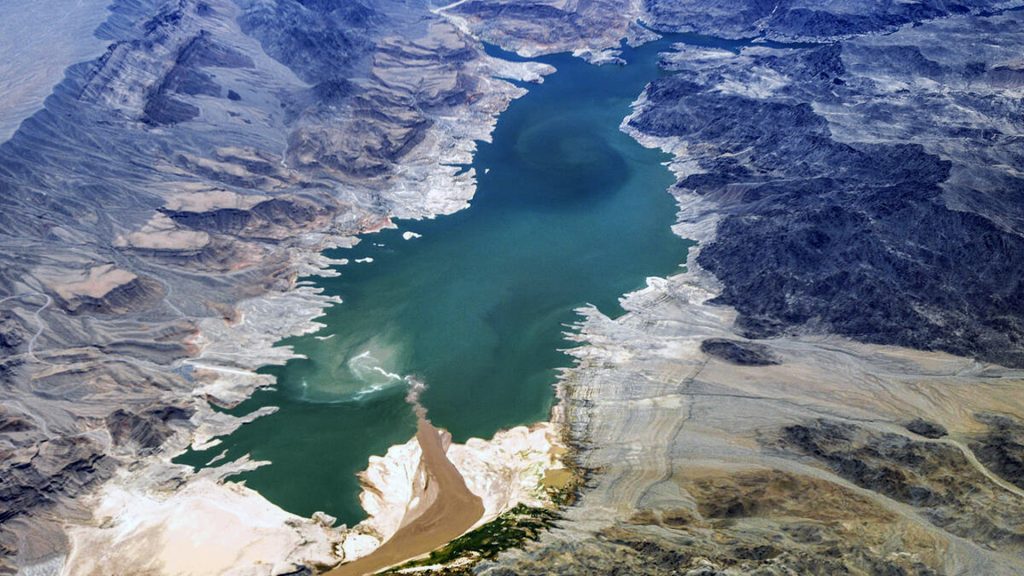
The final deadline for the seven states in the Colorado River Basin to negotiate a new 20-year agreement for how to manage the water supply for years to come is here. The states, once again, have not reached a deal, and after two extensions in November and December, the federal government is done resetting the clock.
The federal government will now step in to determine, at least for a time, how water gets divided among the states and parties signed onto the Colorado River Compact.
What is the Colorado River Compact?
The Colorado River Compact is an agreement, originally signed in 1922, between the Upper Basin states of Colorado, Wyoming, Utah and New Mexico, and the Lower Basin states of Arizona, Nevada and California, that described how they would equitably divide rights to water from the Colorado River.
Since the 1960s, an additional operating agreement has been in effect between the seven states that implemented usage restrictions to ensure all states had access to water as the West grew.
The current operating agreement determines how the Colorado River can be used through 2026. Major population and economic growth, particularly within the Lower Basin, has changed how much water states are willing to give up in the event of a drought.
“It’s important for people to understand that many times, in many years, we get 90% or 100% of the snow pack that we’ve historically gotten,” Tom Buschatzke, director of the Arizona Department of Water Resources told Straight Arrow News. “We get 60% or 70% runoff, not 90% or the 85% of the runoff from that snow that we used to get. That is because of the warming trend.”
As less water flows through the Colorado River, the Upper and Lower Basin can’t agree on who should bear the brunt of water reductions.
Has the federal government laid out a plan?
In January, the Bureau of Reclamation released a draft of five potential options to manage the Colorado River Basin after 2026. At the time, the bureau described the plans as “No Action,” “Basic Coordination,” “Enhanced Coordination,” “Maximum Operational Flexibility” and “Supply Driven.”
A no-action plan would allow large reservoirs like Lake Mead and Lake Powell to fall below critical levels in low water years, which could jeopardize hydroelectric operations at facilities like the Hoover Dam.
A basic coordination plan takes this into account, preserving a smaller amount of water in Lake Mead to ensure there is enough water to “protect critically low elevations.” Areas below Lake Mead would get less water than promised to maintain reservoir levels.
Arizona would be hit the hardest by both plans, taking on around three-quarters of the required cuts. That’s because the Central Arizona Project – which carries Arizona’s portion of the Colorado River water supply across the state – has the most junior river rights and is always the first to see cuts, Buschatzke said.
The “enhanced coordination” alternative attempts to protect critical resources and distribute water storage between Lake Mead and Lake Powell. It also attempts to more evenly distribute water shortages across Arizona, California, Nevada and Mexico, with California taking on a majority (nearly 50%) of the cuts. It also introduces mandatory conservation plans for Upper Basin states.
The “maximum operational flexibility” alternative takes a proactive approach to conserving water across the Upper and Lower Basin states. It would create several surplus pools along the river system to keep Lake Powell above critical levels. It offers a more flexible approach to implementing cuts during shortage years and requires the Upper Basin to release more water to limit impacts in the Lower Basin.
The final alternative, a “supply-driven” alternative, would take a data-driven approach. It would release water from Lake Powell based on a 3-year rolling average of river flows, not what was happening in that particular year. The plan would do the same for Lake Mead in terms of releasing water to the Lower Basin states. Arizona would take on 80% of cuts during a small shortage, but if the river were running particularly low, the cuts would be distributed more equally between the lower basin.
-

Page, Arizona, The water reservoir behind the Glen Canyon Dam is only 27 percent full. White rock around the lake is the ‘bathtub ring,’ which shows how dramatically the water has dropped. (Photo by: Jim West/UCG/Universal Images Group via Getty Images) -

Two of the four intake towers sit in the reservoir of Lake Mead at the Hoover Dam in Boulder City, Nevada on June 8, 2024. (Photo by JIM WATSON/AFP via Getty Images)
What are the implications of potential federal plans?
The federal plans were all developed without much input from the stakeholders: the seven basin states, dozens of tribes and Mexico, which also has junior rights to the Colorado River.
Even without an operating agreement, the original Colorado River Compact requires a certain amount of water to flow from the Upper Basin to the Lower Basin over a 10-year period. While that threshold has never been reached, consecutive low snowpack years, like what Colorado and Utah are currently experiencing, could drop river flows below the mark. Then, more mandatory cuts could come into play.
“The likelihood of litigation is very high,” Buschatzke said.
Arizona’s legislature approved $3 million for the state to fight potential mandated water cuts under a federal plan. Another bill just passed the state House and is working its way through the Senate adds another $1 million.
Potential lawsuits will likely center around which stakeholders must cut water usage. The Upper Basin argues it doesn’t have the water flow to commit to major cuts. The Lower Basin says it already cut enough.
What comes next?
The federal government has until Oct. 1 to determine how much water it needs to release from Lake Powell and Lake Mead for next year. That’s when it will become clear how short, if at all, the Lower Basin will be on water.
The uncertainty that comes with not being able to plan for the future could be detrimental, particularly for Arizona, which faces the widest range of possible outcomes.
“The uncertainty that will occur will hurt us economically,” Buschatzke said. “It will create a huge challenge for the farmers, who often have multi-year contracts to sell their crops.”
He said around 90% of all the vegetables — produce like lettuce, broccoli, and other crops — are grown with Colorado River water in Arizona between November and April.
“There will be economic impacts, and the uncertainty may hurt our economy from a growth perspective as well,” Buschatzke said.
There is a potential five-year deal on the table that could help the seven basin states avoid litigation and potential Supreme Court cases. It helps set guidelines for the short-term management for the river, but it doesn’t help with long-term planning for city managers and businesses.
The post Feds take over after Western states fail to strike Colorado River deal appeared first on Straight Arrow News.
Ella Rae Greene, Editor In Chief