The most expensive Olympic medals ever produced are already falling apart
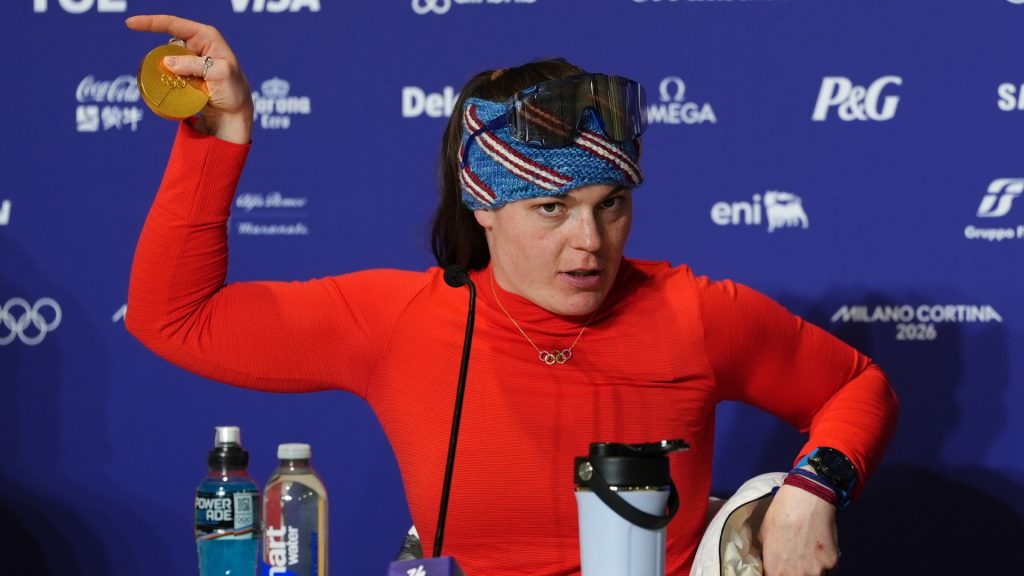
American skier Breezy Johnson won Olympic gold in the women’s downhill early Sunday morning and had her medal draped around her neck before she stepped off the slopes. Within 15 minutes, her gold medal had already broken.
“Well, I was jumping up and down in excitement, and it fell off,” Johnson said after the ribbon split from the disc and connector. “Don’t jump in them.”
-

Gold medallist USA’s Breezy Johnson shows her broken medal to the media following the Women’s Alpine Downhill Skiing at the Tofane Alpine Skiing Centre, Cortina d’Ampezzo, on day two of the Milano Cortina 2026 Winter Olympics. Picture date: Sunday February 8, 2026. (Photo by Andrew Milligan/PA Images via Getty Images) -

Gold medallist USA’s Breezy Johnson shows her broken medal to the media following the Women’s Alpine Downhill Skiing at the Tofane Alpine Skiing Centre, Cortina d’Ampezzo, on day two of the Milano Cortina 2026 Winter Olympics. Picture date: Sunday February 8, 2026. (Photo by Andrew Milligan/PA Images via Getty Images) -

Gold medallist USA’s Breezy Johnson shows her broken medal to the media following the Women’s Alpine Downhill Skiing at the Tofane Alpine Skiing Centre, Cortina d’Ampezzo, on day two of the Milano Cortina 2026 Winter Olympics. Picture date: Sunday February 8, 2026. (Photo by Andrew Milligan/PA Images via Getty Images)
But Johnson’s gold was just the first medal to break. Figure skater Alysa Liu posted on social media Sunday night after the U.S. also took home a gold medal in the team event.
“My medal don’t need the ribbon,” Liu wrote. The 20-year-old later said she was also jumping when it separated.
German biathlete Justus Strelow’s bronze medal fell off the ribbon while he was celebrating a relay win with his team. The moment, and Strelow’s attempt to put it back together, was caught on video.
Swedish cross country skier Ebba Andersson also said her silver medal “fell in the snow and broke in two” while she was celebrating.
What do the organizers say?
The problem was becoming prevalent enough by Sunday night that the 2026 Milan Cortina organizing committee held a press conference on Monday.
“We are aware of the situation,” 2026 Milan Cortina Chief Games Operations Officer Andrea Francisi said. “We have seen the images. Obviously we are trying to understand in detail if there is a problem.”
“We are paying maximum attention to this matter, as the medal is the dream of the athletes,” Francisi added, “so we want that obviously in the moment they are given it that everything is absolutely perfect, because we really consider it to be the most important moment.”
Unbiased. Straight Facts.TM
Organizers expect to award 1,146 Olympic medals during the 2026 Milan Cortina Games – 735 during the Olympics and 411 during the Paralympics.

There are typically a number of spare medals produced in case of ties or mishaps with engraving. Organizers did not comment on their plan to repair or replace medals for athletes with broken medals, or if they would be modifying medals going forward.
“Now I hope the organisers have a ‘Plan B’ for broken medals,” Andersson told Swedish broadcaster SVT.
Johnson and Liu said they received replacement gold medals, but were not able to keep the broken medals given to them on the podium. Johnson told NBC she was given a blank replacement and would have to get it re-engraved. She was also given a cardboard box to keep it safe, she said.
Why is this happening?
According to a source who spoke to Reuters, the problem may be related to the medals’ cord. There is a breakaway mechanism within it, required by law, that automatically releases if pulled with force so the medal’s wearer can’t be choked with it.
The extra piece that some athletes, including Johnson and Stretlow, have reported breaking off, is the piece that holds the ribbon to the medal.
Each gold and silver medal weighs about 500 grams, or just over a pound. Bronze medals are about 80 grams lighter. They’re not the heaviest Olympic medals produced – that title belongs to the 2018 Pyeongchang medals, which came in at just under 600 grams.
Ongoing problem
While the medals are more valuable than ever thanks, in part, to the fast-rising cost of gold, quality issues are not new.
After the 2024 Paris Games, dozens of athletes reported their medals began to tarnish, taking on a scaly appearance. As of February 2025, 220 requests to replace medals won in Paris had been made because of wear-and-tear. That’s about 4% of the medals awarded across Olympic and Paralympic events.
The post The most expensive Olympic medals ever produced are already falling apart appeared first on Straight Arrow News.
Ella Rae Greene, Editor In Chief