Why plain gold can cost more than diamonds this Valentine’s Day
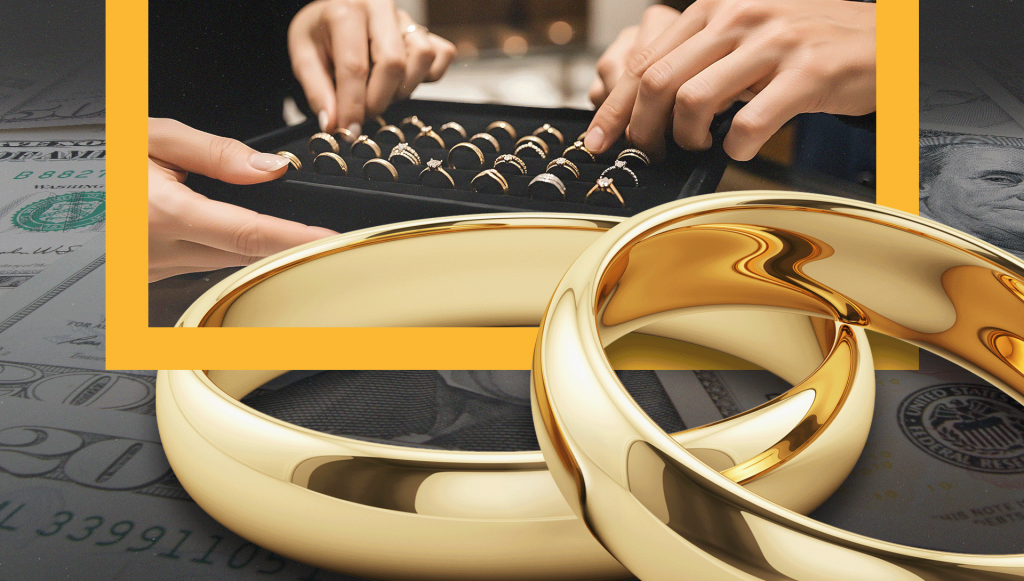
This Valentine’s Day, Americans will shower their sweethearts with the usual romantic staples: flowers, chocolate and pricey dinners. But the biggest spend won’t be on roses or reservations. It will be on jewelry – roughly $7 billion worth, according to the National Retail Federation.
That sparkle comes at a striking moment. Gold prices recently hit an all-time high, briefly surpassing $5,000 an ounce — up 66% from a year ago and 300% over the past decade. Diamonds, meanwhile, have gone in the opposite direction, with prices slipping as lab-grown stones flood the market.
The jewelry industry is being reshaped by the same forces rattling the broader economy: geopolitical uncertainty, a widening income and wealth gap in the U.S. and shifting tariff policies.
But what hasn’t changed is Americans’ enduring love of bling and holiday gifts that make an impact.

Jewelry sales rise despite soaring gold prices
The surging price of gold hasn’t dulled its appeal. Overall, U.S. jewelry sales rose 7.5% year over year in 2025, according to Tenoris, a data analytics firm that tracks the jewelry and gemstones markets.
American consumers are buying fewer pieces, but paying significantly more per item, said Edahn Golan, managing partner at Tenoris. Shoppers have felt the pain of surging prices, but still spent more on fine jewelry in 2025 than in previous years, Golan told Straight Arrow News.
Jewelers, for their part, are adapting. Many are designing lighter-weight or hollow pieces, blending gold with lower-cost alloys, swapping gold for platinum or silver or shifting the emphasis toward gemstones.
Wedding sets and tennis bracelets were standout performers in 2025, Golan said — suggesting that for milestone moments, American consumers still go all in.
Gold prices are notoriously volatile, but expectations remain bullish. Investors flock to the metal as a financial safe haven during periods of economic and political uncertainty. A weaker dollar, high interest rates, geopolitical tensions and tariff concerns all helped fuel the latest gold rush, analysts said.
How lab-grown diamonds are disrupting the market
While gold is glittering, diamonds have lost some luster — at least in price. Lab-grown diamonds have the same chemistry, crystal structure, hardness and sparkle as mined stones but sell for far less. Their growing supply and popularity have pushed prices down across the diamond market.
In 2025, prices for high-quality smaller diamonds between 0.3 and 0.5 carats fell 20% to 26%, according to Rapaport, which publishes widely followed pricing indexes for polished diamonds. Prices for larger stones, weighing one to three carats, also declined, though less sharply. The average American engagement ring is between 1 and 2 carats, according to The Knot.
With lab-created diamonds offering more bling for the buck, “we have seen the major U.S. retail chains shifting” to embrace them, said Joshua Freedman, a senior analyst at Rapaport. More than half of engagement rings now sold in the U.S. feature a lab-grown center stone, he told SAN.
For jewelry makers, the relative costs of gold and diamonds have upended their pricing model. Elena Kriegner, a New York City-based designer, said a plain gold band can now be priced higher than a similar band encrusted with diamonds, since small chips of gold get drilled away when setting gemstones. At today’s prices, “any amount of gold is basically cash.”

How the jewelry market reflects America’s affordability divide
Today’s jewelry market also mirrors the widening spending gap between higher- and lower-income Americans.
Sales of jewelry priced below $1,500 are down, while purchases at higher price points—above $2,500—are rising, according to Golan.
“We have generally seen the high end hold up well,” echoed Freedman. Top luxury brands like Tiffany & Co., Cartier and Bulgari have reported solid sales growth.
Federal Reserve Chairman Jerome Powell recently acknowledged the spending imbalance. While many American families struggle to afford basic necessities, wealthier Americans continue to spend on luxuries.
“Higher-income households tend to own real estate and tend to own stocks and securities, and those assets have been going up in value,” Powell said. “Increases in wealth do support spending over time.”
Data from the Federal Reserve Bank of New York shows that since 2023, inflation-adjusted consumption has risen for high-income households, remained flat for middle-income families and dropped for lower-income households.
For many Americans, expensive gifts like fine jewelry are out of reach. With costs climbing, “gold has become more of a luxury good than in the past,” Kriegner said. “It’s a new status symbol, a sign of wealth, like wearing a Rolex watch or carrying an [Hermès] Birken bag.”
How tariffs are disrupting the jewelry market
The fine jewelry industry, which relies heavily on global trade, has also been roiled by shifting U.S. tariff policies, experts said.
For example, roughly 90% of the world’s diamonds are cut and polished in India, a country facing trade uncertainty with the United States. This exposure leaves sellers highly vulnerable to policy swings.
“Right now it’s an all hands on deck situation in dealing with the tariffs, which have strained and caused major disruptions to the global supply chain,” said David J. Bonaparte, president and CEO of the trade association Jewelers of America, in a recent press release. “The majority of retailers and manufacturers in the U.S. are dependent on diamonds and gemstones that cannot be sourced in the U.S.”
Jewelry remains a popular splurge
Despite the upheaval, jewelry maintains its sheen. The U.S. jewelry market has grown steadily over recent years, reaching an estimated value of $79 billion in 2025.
For some, fine jewelry is not just for wearing, but is also viewed as an investment, given its resale value and the option to melt down gold for cash. Kriegner suspects that logic doubles as justification. “It’s something women can tell themselves as another excuse to splurge” — which is OK, she said.
Whether it’s gifted by a Valentine, a friend or oneself, jewelry gives you positive energy, Kreigner said. “When you wear it, you feel dressed. You feel appreciated.”
The post Why plain gold can cost more than diamonds this Valentine’s Day appeared first on Straight Arrow News.
Ella Rae Greene, Editor In Chief