How two big changes make Venezuelan oil more open to US investors
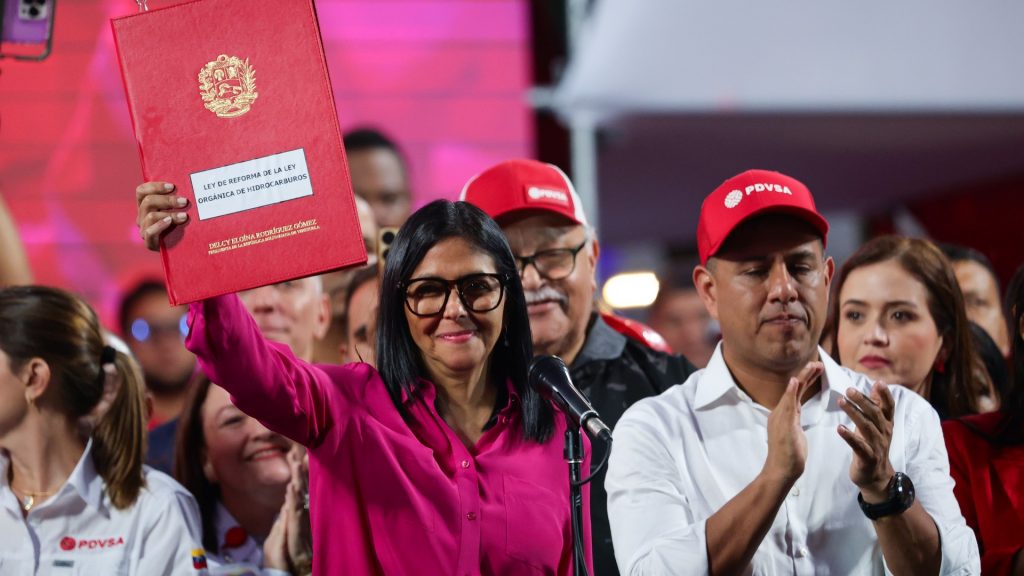
Less than a month after the capture of Nicolás Maduro, legal changes are making Venezuela’s oil patch more favorable to United States investment. On Thursday, Venezuela’s National Assembly voted to lower royalties and offer more control to foreign companies, and the Trump administration eased sanctions that prevented most U.S. companies from transacting with Venezuela.
Opening Venezuela’s estimated 300-billion-barrel oil reserves is a top priority for the Trump administration. Foreign oil companies were effectively kicked out of Venezuela decades ago in a second wave of nationalization in which former President Hugo Chavez’s government seized assets previously owned by American companies. Earlier this month, U.S. President Donald Trump gathered oil industry CEOs at the White House in an attempt to urge American companies to invest in the South American nation once more.
“American companies will have the opportunity to rebuild Venezuela’s rotting oil industry,” Trump said on Jan. 9. At the time, Trump said he wanted U.S. companies to invest $100 billion, but the main news from the meeting was ExxonMobil CEO Darren Woods’ comments that without significant changes, Venezuela is “uninvestable.”
Recent actions by the Venezuelan government and the U.S. Treasury Department may change that calculation.
What has changed for Venezuelan oil policy?
Legislation recently approved in Venezuela will restructure the country’s oil sector. The new law gives private companies control over oil production and sales, ending the monopoly previously held by Petróleos de Venezuela (PDVSA), the state-run oil company. However, the government will still control access to oil reserves.
The law maintains a maximum royalty rate of 30% — the same rate that was previously standard — but now allows Venezuela’s executive branch to set lower percentages for individual projects. The legislation also allows disputes to be settled through independent international arbitration rather than Venezuela’s courts.
The same day acting Venezuelan President Delcy Rodríguez signed the bill, the U.S. Treasury Department Office of Foreign Asset Control (OFAC) eased sanctions that had restricted American companies from Venezuelan oil transactions.
The license authorizes U.S. entities to export, refine, store, transport and purchase Venezuelan oil. Previously, Chevron had a license exempting the company from sanctions. Now all American oil companies will be allowed access to Venezuela’s oil market.
The license requires contracts to be governed by U.S. law with disputes resolved in U.S. courts. Companies must also make payments through government-approved accounts to allow the treasury oversight of where money for Venezuelan oil is flowing. The authorization prohibits transactions with entities from Russia, Iran, North Korea, Cuba or Chinese-controlled companies.
Does this mean US companies will come back?
The changes offer more flexibility for U.S. companies, but may not be enough to bring back major American investment.
Chevron already stated during the White House meeting that it could increase its production in Venezuela by 50% over the next 18 to 24 months.
However, ExxonMobil CEO Darren Woods maintained his stance that Venezuela needs political reform before his company will invest.
“Those priorities start with: One, stabilizing the country,” Woods told CNBC on Friday. “Second is to kickstart the economy and try to recover some of the damage that’s been done over the decades of abuse that the dictators brought in, and then ultimately to transition into representative government.”
ExxonMobil exited Venezuela in 2007 after the Chavez government seized its assets. ConocoPhillips also exited; Chevron was the only company that stayed under the Chavez regime’s policies.
The post How two big changes make Venezuelan oil more open to US investors appeared first on Straight Arrow News.
Ella Rae Greene, Editor In Chief