Minneapolis under surveillance during ICE surge
MINNEAPOLIS — The screen on the black handheld device began firing off a string of alphanumeric characters. The text seemed indecipherable, but in fact was the serial number for an external battery that powered a nearby camera that records the license plates of passing cars.
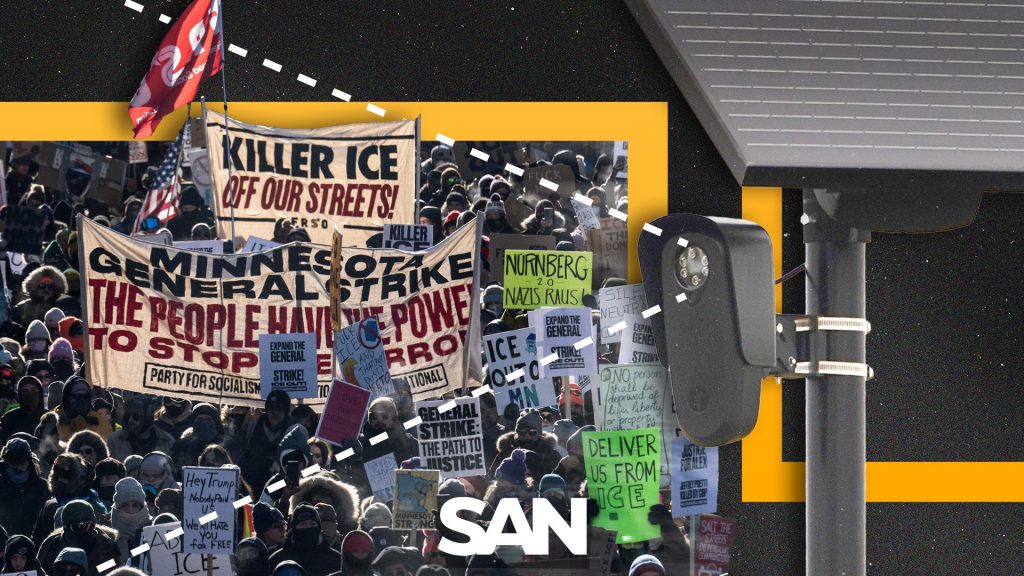
The camera, built by Flock Safety, is just one of 19 placed strategically around two adjacent shopping centers that Straight Arrow News visited in a suburb of Minneapolis last week. Those 19 are part of more than 300 known to be operating in the Twin Cities metro area, placed both by public and private entities.
The cameras are contributing to widespread unease amid an aggressive crackdown on illegal immigration in Minnesota. Tensions were high after the deployment of some 3,000 federal agents to the state, and the killings of two U.S. citizens by immigration officers inflamed the atmosphere.
With authorities saying they will investigate protesters’ activities, it remains unclear whether — or how — Immigration and Customs Enforcement is using the data collected by Flock cameras and other surveillance equipment. Could agents use the information to track immigrants in the community? Or could they turn Flock into a tool to locate citizens who are protesting and monitoring the activity of federal agents?
“Given the national security language coming from the White House, it is plausible that federal access occurs under secretive national security frameworks,” a representative of Have I Been Flocked, an online service that allows users to search for license tags captured by Flock cameras, told Straight Arrow News. “Because state and local agencies cannot audit a private corporation, the only safe assumption is that ICE has access.”
Neither ICE nor its parent agency, the Department of Homeland Security, responded to SAN’s requests for comment.
Data sharing
ICE does not have a formal contract with Flock. However, the technology news site 404 Media reported last May that local police departments around the country were giving ICE agents side-door access to their license plate data. The discovery came after audit logs obtained through public records requests showed thousands of immigration-related searches had been conducted for ICE by police departments with Flock contracts.
The Minneapolis Police Department did not respond to questions from SAN about whether it shares license plate data with ICE. Under Minneapolis’ sanctuary city policy, public safety officials are barred from assisting with federal immigration operations.”
Private property owners also sometimes share data from Flock cameras with law enforcement agencies, including ICE.
SAN searched for Flock cameras at the Southdale Shopping Center and the Galleria Shopping Center in the city of Edina, about 10 miles southwest of downtown Minneapolis. A reporter used a device called an ESP32 Marauder. The Marauder, used for digital security testing, is designed to interact with WiFi and Bluetooth signals and comes equipped with a program known as Flock Sniff. The program detects the Bluetooth signal given off by an external battery used by some models of Flock cameras.
Southdale is owned by Simon Property Group, the largest operator of shopping centers in the United States. SAN spoke with a representative for the company, who would not say whether it had shared license plate data with ICE. However, emails obtained by Forbes showed that the company has quietly given police departments across the country access to its data since at least 2023.
A representative for the Galleria Shopping Center told SAN that it “retains full control of all collected data and shares it only with the Edina Police Department.”
The home improvement chain Home Depot is also a Flock customer. SAN located license plate reader cameras outside one of the company’s stores in Minneapolis, where residents said ICE had been repeatedly spotted.
In a statement to SAN, Home Depot spokeswoman Sarah McDonald said the company does “not grant access to our license plate readers to federal law enforcement.”
“The Home Depot is not involved in immigration enforcement operations, and we do not coordinate with Immigration and Customs Enforcement (ICE), Customs and Border Protection (CBP) or other federal agencies regarding them,” the statement said.
However, the company says on its website that it discloses data, including demographic information about customers, to “law enforcement, public and government authorities” when it is “reasonably necessary to comply with law, support investigations, and protect the rights and property.”
ICE’s activity in Minneapolis has spurred some of Home Depot’s investors to question the company’s partnership with Flock.
Zevin Asset Management, which owns more than $7 million in Home Depot stock, has called for an “assessment of privacy and civil rights risks” associated with Flock, “including discrimination or wrongful detention from misuse of customer data.”
“Such practices may expose the Company to financial and legal risks, including potential data breaches and enforcement of evolving state privacy laws,” the shareholders said. “The Company already faces reputational risks stemming from frequent immigration enforcement raids occurring near its stores and heightened public concerns regarding data privacy.”
SAN also monitored protest sites in Minneapolis, primarily outside the federal building, for evidence of cell phone surveillance. In Portland last fall, SAN detected evidence that a fake cell phone tower, commonly referred to as a Stingray or IMSI-catcher, was used during protests at the city’s ICE facility.
IMSI-catchers, however, appear to be used much more sparingly than other surveillance tools given their localized scope and warrant requirements. Data captured by Flock cameras on the other hand can be readily accessed by law enforcement and include information on vehicles and persons from across the country.
How Flock works
Flock cameras use artificial intelligence to continuously record not just license plates but vehicle brands and colors that enter their view. Flock provides its customers with a search tool known as FlockOS that allows them to process the collected data. Law enforcement agencies can search through data gathered not only by their own cameras but also those from other law enforcement agencies around the nation to track the movements of people suspected of committing crimes or others who are under surveillance.
Another Flock tool known as Nova permits law enforcement to link license plate data to individual people by integrating information from sources such as data brokers and data breaches. Flock’s tools can also issue alerts when any flagged vehicles are recorded by one of the more than 80,000 Flock cameras deployed in the U.S.
Questions surrounding Flock cameras in the Twin Cities come as the company faces growing backlash across the country. Cities in states such as Virginia, Washington, California, Illinois and Massachusetts, among others, have canceled contracts with Flock in response to concerns from the public over dragnet surveillance. The discovery by researchers of numerous security vulnerabilities, including one that saw live feeds from more than 60 Flock cameras exposed to the internet, has also fueled the backlash.
The post Minneapolis under surveillance during ICE surge appeared first on Straight Arrow News.
Ella Rae Greene, Editor In Chief