WATCH: NTSB says $400 GPS device could have prevented D.C. midair crash
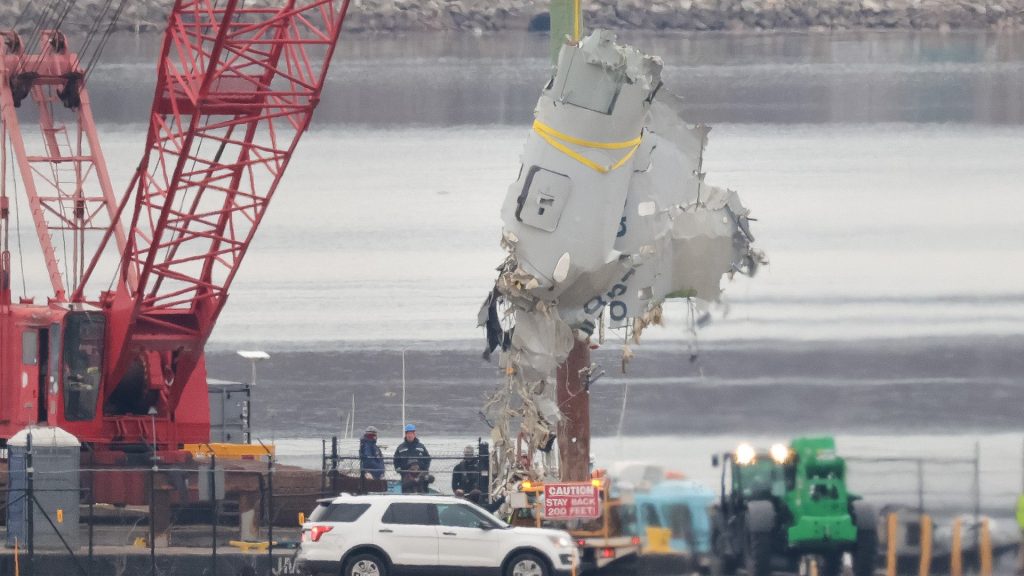
The National Transportation Safety Board concluded Tuesday that systemic failures across multiple federal agencies caused the midair collision near Reagan National Airport that killed 67 people last year. Investigators said known risks were left unaddressed despite years of warnings and available safety tools.
The findings were presented at a daylong NTSB hearing, held two days before the one-year anniversary of the crash between an American Airlines regional jet and an Army Black Hawk helicopter over the Potomac River.
Razor-thin separation went unaddressed
NTSB Chair Jennifer Homendy said the Federal Aviation Administration failed to identify or correct a dangerous airspace design that allowed helicopters and commercial aircraft to operate with minimal vertical separation
By the board’s analysis, the helicopter route involved in the crash placed military aircraft within roughly 75 feet of planes landing on a secondary runway at Reagan National. Homendy said that level of separation should never have existed.
“How is it that no one, absolutely no one, in the FAA did the work to figure out there was only 75 feet, at best, 75 feet of vertical separation between a helicopter on Route 4 and an airplane landing on Runway 33?” Homendy said during the hearing.

Investigators said the helicopter route had not been meaningfully reviewed for years, despite repeated internal concerns and more than 15,000 recorded close-proximity events involving helicopters and commercial aircraft near the airport between 2021 and 2024.
Controller overload and missed alerts
The NTSB said air traffic control staffing and workload were also contributing factors. On the night of the crash, a single controller was handling both helicopter traffic and fixed-wing aircraft, a configuration typically reserved for lower-volume periods.
Investigators said the controller became overwhelmed as traffic increased, reducing situational awareness. A conflict alert activated roughly 26 seconds before impact, but no safety alert was issued to Flight 5342 warning of the nearby helicopter.

The board said the controller relied on visual separation after the helicopter crew reported having the plane “in sight,” even though investigators now believe the crew may not have correctly identified the aircraft.
Homendy also questioned whether staffing levels have meaningfully improved since the crash.
“So by my calculations, you actually have a lower number of personnel today that are operational in the tower than existed on January 29th,” Homendy said.

This story is featured in today’s Unbiased Updates. Watch the full episode here.
Technology available but not required
Homendy emphasized that a relatively inexpensive cockpit technology could have provided earlier warning to both crews.
A $400 GPS-based system known as ADS-B In would have alerted the airplane crew nearly a minute before the collision and the helicopter crew roughly 48 seconds beforehand, according to NTSB simulations. The board has recommended requiring the technology at least 17 times since 2006, but the FAA has not mandated it for commercial aircraft like the CRJ-700 involved in the crash.
The Army has since installed the system on its helicopters.

“This was preventable,” Homendy told reporters. “This was 100% preventable.”
Recovery efforts extended long after crash
Diving teams from the D.C. Metropolitan Police Department returned to the Potomac River for months after the crash, searching for wreckage and personal items to return to families.
Lieutenant Andrew Horos, who leads the department’s harbor patrol, said responders quickly realized the aircraft carried children and focused on recovering victims with care.
“We realized there was a lot of children on that airplane,” Horos said. “The number one goal was dignity and the quick recovery of the victims.”
Diver Robert Varga said personal effects recovered from the river, including a wedding ring and ice skates, were treated as critical pieces of closure for families.
“Each one felt like a treasure,” Varga said.
Next steps and unresolved questions
The NTSB will vote on the crash’s probable cause and safety recommendations, with a final report expected in the coming weeks. The board has no enforcement authority, and its recommendations are not binding.
Homendy said she remains concerned that key safety changes may again go unimplemented, noting that hundreds of aviation safety recommendations remain outstanding years after being issued.
The FAA has permanently closed the helicopter route involved in the crash, reduced aircraft arrival rates at Reagan National, and required additional tracking broadcasts in the area. The Justice Department has acknowledged federal liability in the incident.
The post WATCH: NTSB says $400 GPS device could have prevented D.C. midair crash appeared first on Straight Arrow News.
Ella Rae Greene, Editor In Chief