Should lab-grown meat need labels like cigarettes? More states think so
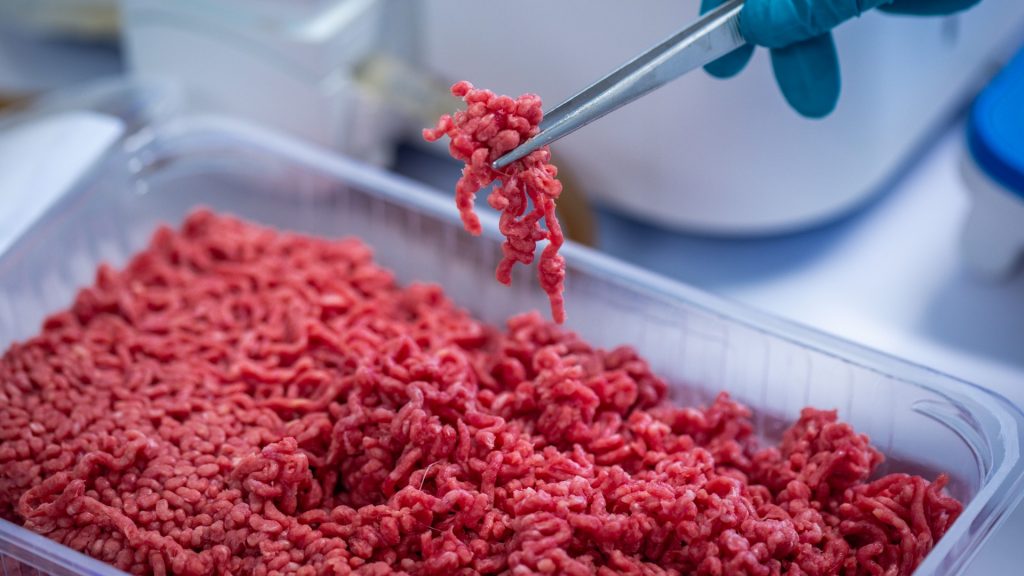
Wisconsin could become the latest state to require labels on lab-grown meat when, or if you can, find it. Several other states have passed similar measures, while some others have banned lab-grown meat altogether.
Wisconsin labeling
The Wisconsin Assembly recently approved a bill requiring lab-grown meat to be clearly labeled.
“I’ve been working on this legislation all of my terms,” Rep. Clint Moses, R- Menomonie, who is one of the co-authors of the bill, told Straight Arrow News. “I’m in my third term now.”
That legislation says nobody can sell lab-grown meat in the state unless it is labeled as such.
“I think people need to clearly know on labeling what it is they’re eating,” Moses said. “If they’re eating beef, chicken, poultry, fish that is raised on a farm or something that’s raised in a laboratory, they need to know the difference.”
The bill now heads to the state Senate for a hearing before it would potentially end up on the desk of Democratic Gov. Tony Evers.
“I’ve had a lot of Democrats come out and say that they do support it,” Moses said. “So, if we got them on board, it’s much, much more likely that it gets signed by the governor.”
Other state labeling
Several other states have already passed measures that require labeling lab-grown meat. That includes South Carolina, Tennessee, Oklahoma, Colorado and others.
“I think labeling makes sense,” Jerold Mande, CEO of Nourish Science, a nonprofit focused on food nutrition and children’s health, told Straight Arrow News. “Certainly, consumers should know what is in the product they’re buying. It shouldn’t be hard to figure it out. It should be clear and obvious.”
Mande believes the companies making lab-grown meat should embrace labeling.
“The labeling should be seen as a plus, not a minus by companies that do that,” Mande, who’s also an adjunct professor of nutrition at the Harvard T.H. Chan School of Public Health, said.

This is an issue that’s been going on for nearly a decade. Missouri became the first state to require lab-grown meat labels in 2018.
“Hopefully today, companies have learned, if you’re going to come up with a product like a lab-grown meat, that’s the selling point,” Mande said. “You want to present it to consumers, as this is better than alternatives.”
Banning lab-grown meat
Some state legislatures have taken things further with an outright ban on lab-grown meats. That includes Florida, Alabama, Missouri and more.
While Moses is a cattle rancher who would benefit from a ban, he thinks customers shouldn’t have choices taken away by the government.
“The consumer should be able to make that decision for themselves, and not necessarily a government thing where we outright ban it,” Moses said.
Moses is also attempting to work with the Evers to pass legislation that isn’t just for show and actually has a chance to get through.
“I want him to actually look at it and hopefully sign the bill, so it comes into law,” he said.
Meanwhile, Mande believes any bans on lab-grown meat are based on politics rather than health or anything else.
“Almost 1/3 of U.S. children have a food-caused chronic disease,” he said. “It’s become difficult as a parent to get your child to 18 without at least the markers of a food-caused chronic disease and that’s because of how powerful the food industry is, how they’ve completely changed our food.”
Recent numbers from the CDC show nearly 33% of young people in this country aged 12-17 have prediabetes.
Pros and cons of lab-grown meat
Mande described what he calls the North Star of food design.
“For consumers, the four points on the star are taste, cost, convenience and health,” he said. “They expect those four things from the food.”
He said the American food industry has kept regulatory agencies at bay and has replaced health in that star with profits.
“It really is outrageous,” Mande said. “We could be designing; we could be doing the research. We could be putting more money in the investment of our food to make sure that, in addition to taste, costs and convenience, it makes us healthy. But they’re not doing that.”
Lab-grown meat is not widely available to most Americans at this point, even if there are some benefits to it. Some of those include animal welfare, less contamination and more sustainable production.
“We’re looking at countries that maybe don’t have as much access to meat products like we do, and [a] growing world population,” Moses said. “I think that’s the argument for it.”
Mande mentioned climate change as possibly the biggest argument for lab-grown meat. Data shows that meat, especially beef, contributes heavily to climate change.

“It’s an alternative to that, where you can have meat and it can taste just like the meat you like, and it doesn’t have that climate effect, ideally, as it scales,” he said.
Those who are opposed to lab-grown meat have their reasons as well. In Texas, it was about protecting industry.
“It’s plain cowboy logic that we must safeguard our real, authentic meat industry from synthetic alternatives,” Sid Miller, Texas agriculture commissioner, said in a statement at the time his state banned lab-grown meat.
“Cowboy logic” aside, Moses also acknowledged the need to protect farmers.
“As a small beef producer, yeah, I’d like to hope that people find our products better than lab-grown meat when they go to the marketplace,” he said.
Other concerns over lab-grown meat often focus on whether it has the same nutrients as natural meat.
“Is it the same quality?” Moses said. “Are you getting the same nutrients? Is it like when GMO corn, for instance, first came out? Is that different? Is that impacting our DNA and what we’re putting in our bodies versus stuff that’s raised, maybe it’s organic, or maybe it’s just conventional, raised beef on a farm.”
Mande also acknowledged health benefits need to be a bigger priority for lab-grown meat producers.
“They put emphasis more on the climate benefits of it, but not making it nutritionally better,” he said. “But they could, and I’m hopeful that they would.”
Possibly the biggest issue with lab-grown meat, and a reason why many people haven’t tried it, is that it’s not cheap. Currently, it’s very costly to produce, and that cost gets passed on to consumers who want to try it.
Estimates show lab-grown meat typically costs $17-$29 per pound. Bureau of Labor Statistics data from December lists beef at $6.69 per pound.
“I think what people don’t always appreciate with lab-grown meat is it’s still a way off in terms of getting it to a price point where it can be there,” Mande said.
What comes next?
Regardless of any pros or cons, this issue isn’t going anywhere. Much like artificial intelligence, food technology will only continue to advance and infiltrate our lives.
“The rapid growth of technology and advancements and innovation, the [agricultural] industry is not immune to that,” Moses said.
Moses added that it’s important legislation keeps up with advances in food technology.
“One thing I do have ready to introduce and hoping to come out with this session is also a bill that covers milk, because another evolving technology that’s out there is lab-grown milk of all things,” he said.
Mande also said the addition of lab-grown foods to our diets is necessary to keep our species alive for thousands of years.
“I think people need to understand that if you’re going to look out — maybe not in today’s lifespan — but if humanity is going to be here in 1,000 years with a changing climate, if we’re going to want to live on other planets, at some point we have to be able to make food from the molecule.”
He referenced the classic cartoon “The Jetsons,” which featured a family that was able to print food in the show, and it has become somewhat of a reality.

“We’ll have to be able to do that at some point,” Mande said.
The post Should lab-grown meat need labels like cigarettes? More states think so appeared first on Straight Arrow News.
Ella Rae Greene, Editor In Chief