US-NATO relationship is in jeopardy. So is NATO’s future
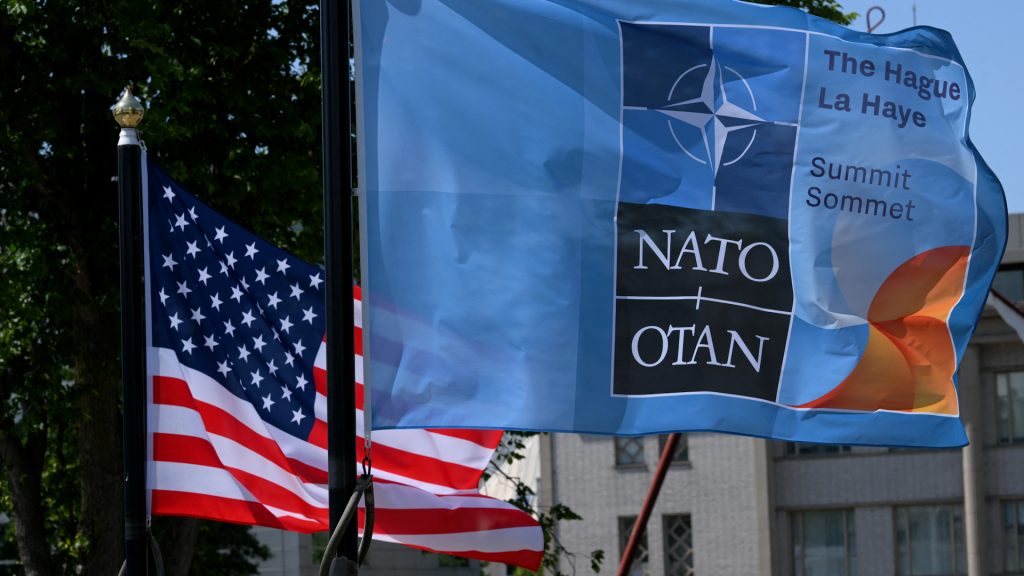
After days of escalating tension and a flurry of one-on-one diplomacy with NATO Secretary General Mark Rutte, President Donald Trump is backing away from threats of a global trade war and taking Greenland by force.
But the episode raised questions about whether the U.S. has damaged its relationships with other NATO member nations, as well as about the future of the alliance itself. Does the U.S. need NATO? Does NATO need the U.S.? And could NATO exist without the U.S.?
The immediate crisis eased Wednesday when Trump said he and Rutte had reached a “framework” for a deal involving Greenland. Few details have been announced, and whatever agreement Trump struck with the NATO leader did not have input from Greenland or Denmark.
In a speech at the World Economic Forum in Davos, Switzerland, Trump reversed his threat to impose tariffs on imports from European countries opposing a U.S. takeover of Greenland. And, just as significant, he vowed not to take the semiautonomous Danish territory through military action.
But, as Time reported, when pressed about the Greenland dispute, Trump would not rule out withdrawing the United States from NATO. The dispute between Trump and leaders of some of the nation’s oldest allies remains unresolved.
Why the Greenland fight tests NATO
NATO is a 32-member collective defense alliance founded in 1949; the United States has been a core member since the start. The George W. Bush Institute noted that Article 5 of the NATO treaty, which posits that an attack on one member is an attack on all, has been triggered only once in history: following the Sept. 11 attacks, when the alliance sent surveillance planes to patrol American skies and then joined the war in Afghanistan.
Peter Viggo Jakobsen of the Royal Danish Defence College recently told Straight Arrow News that if the U.S. invaded Greenland, “NATO dies.”
“If the U.S. were to attack an ally and take over part of its territory,” he said, “it would be doing exactly the same thing as Russia did when it attacked Ukraine in 2022.”
Describing the pact as the “gold standard” of international partnership, the Bush Institute highlighted NATO’s role in stabilizing the Balkans, combating terrorism in Afghanistan and advising security forces in Iraq. It also noted that NATO members recently agreed to raise defense spending targets to 5% of GDP by 2035, crediting Trump’s advocacy for the shift.
Why Article 5 alarms were raised
According to CNN, Trump’s push to acquire Greenland, paired with his initial refusal to rule out the use of force and his tariff threats, sparked fears among diplomats and lawmakers of NATO’s worst crisis yet, with some warning of a potential collapse that would benefit Russia and China.
Legal scholars Ilaria Di Gioia and Curtis Bradley told Time that by merely threatening to leave the alliance, Trump damaged its credibility and undermined the mutual trust required for collective defense.
“The very idea of a U.S. exit erodes trust, cohesion, and the credibility of collective defense,” Di Giola said. “Trump’s repeated questioning of the alliance weakens deterrence, shakes European security planning, and emboldens adversaries.”
The 2024 National Defense Authorization Act seeks to bar a president from withdrawing from NATO without either a two-thirds vote in the Senate or an act of Congress.
But Di Gioia told Time that those constraints are “far from solid,” saying Trump could try to invoke his powers as commander in chief to bypass Congress, setting up a constitutional clash.
Bradley cited precedent in President Jimmy Carter’s withdrawal from a defense treaty with Taiwan in 1978. But he called NATO the “most important mutual defense treaty of the post-WWII era,” and said a U.S. exit would be surprising.
What national leaders are saying
Trump has argued Greenland is “very important for the national security” of the United States and that the U.S. “cannot rely on Denmark” to shield the territory from Russia and China. He called anything less than U.S. control “unacceptable.”
Trump threatened new tariffs starting at 10% on “any and all goods” from Denmark and several European allies beginning Feb. 1. The levies were to rise to 25% on June 1, lasting until an agreement is reached.
Danish Foreign Minister Lars Løkke Rasmussen said there is a “fundamental disagreement” with Washington over Greenland’s future.
Danish Defense Minister Troels Lund Poulsen said Denmark is planning a “larger and more permanent” NATO presence to ensure Greenland’s security and argued that Arctic security is a concern “for all of NATO.”
European leaders hardened their tone. French President Emmanuel Macron wrote on X earlier this week that France supports sovereignty and independence, adding, “No intimidation or threat will influence us.”
From Davos threats to a ‘framework’ deal
Trump used his Davos speech on Wednesday to demand “immediate negotiations” over the United States acquiring Greenland, which he described as “our territory.” He also warned that if Denmark and Greenland refused, “we will remember.”
“It’s the United States alone that can protect this giant mass of land,” Trump said during his speech, “this giant piece of ice, develop it and improve it, and make it so that it’s good for Europe, and safe for Europe, and good for us. And that’s the reason I’m seeking immediate negotiations to, once again, discuss the acquisition of Greenland by the United States — just as we have acquired many other territories throughout our history.”
Later Wednesday, Trump announced a “framework” agreement with Rutte, said he would scrap planned tariffs tied to the dispute, and said the deal “gets us everything we needed to get,” while declining to say whether it involved U.S. ownership.
Danish leaders said the day ended better than it started.
“We welcome that POTUS has ruled out taking Greenland by force and paused the trade war,” Rasmussen said on X.
Senior NATO officials in Brussels are considering the possibility of the U.S. gaining sovereignty over limited areas in Greenland used for military bases, modeled on Britain’s sovereign bases in Cyprus. However, officials said they did not know whether that idea was part of Trump’s announced “framework.”
Allison Hart, a spokeswoman for Rutte, said he “did not propose any compromise to sovereignty” during his meeting with Trump in Davos, The New York Times reported.
Aaja Chemnitz, a Greenlandic member of Denmark’s parliament, rejected the idea of any deal negotiated without Greenland, saying “NATO has absolutely no mandate” to negotiate over its territory. She called the situation “total confusion.”
U.S. and European trade relations
Shortly after the speech — and before Trump announced the deal — The Washington Post reported that the European Parliament suspended work on ratifying an EU-U.S. trade deal. Bernd Lange, chair of the body’s legislative trade committee, argued that U.S. threats against the territorial integrity of an EU member state and the use of tariffs as coercion undermined trade stability.
“By threatening the territorial integrity and sovereignty of an E.U. member state and by using tariffs as a coercive instrument,” Lange said in a statement, “the U.S. is undermining the stability and predictability of E.U.-U.S. trade relations.”
Legal and political battles ahead for NATO
NATO said negotiations among Denmark, Greenland and the United States will move forward “aimed at ensuring that Russia and China never gain a foothold — economically or militarily — in Greenland.”
CNN reported that Sens. Rand Paul, R-Ky., and Tim Kaine, D-Va., said they are discussing a war powers resolution on Greenland, as well as plans to challenge Trump’s tariffs and steps to highlight the law requiring congressional approval for any NATO withdrawal.
Time reported that legal experts expect continued tensions between the U.S. and NATO, but not an immediate U.S. exit. The Bush Institute argued that maintaining NATO’s unity and America’s reputation as a reliable, values-based partner remains central to U.S. security — and that rivals would “relish” the alliance’s collapse.
The post US-NATO relationship is in jeopardy. So is NATO’s future appeared first on Straight Arrow News.
Ella Rae Greene, Editor In Chief