At the ‘Board of Peace,’ power belongs to Trump
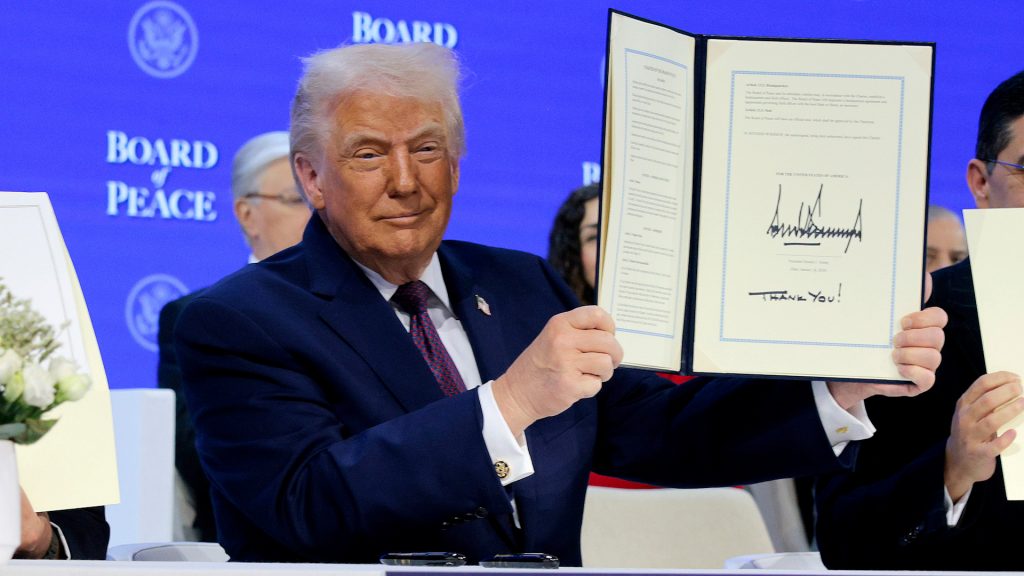
President Donald Trump’s new international “Board of Peace” is built on a charter that gives him extensive powers as inaugural chairman, including the ability to veto decisions, set the agenda, invite members, dissolve the body and name his own successor, according to a draft charter described by The New York Times and a leaked version reviewed by NPR.
The board was formally unveiled at the World Economic Forum in Davos, Switzerland, on Wednesday, with 19 world leaders present. Its stated mission now extends well beyond its original United Nations-backed mandate in Gaza.
NewsNation, citing the White House, reports more than two dozen signatories to Trump’s Board of Peace, including Bahrain, Morocco, Argentina, Armenia, Azerbaijan, Bulgaria, Egypt, Hungary, Indonesia, Jordan, Kazakhstan, Kosovo, Mongolia, Pakistan, Paraguay, Qatar, Saudi Arabia, Turkey, Uzbekistan and the U.A.E.
Several European allies declined to join, including France, Norway and Sweden. The United Kingdom declined to be one of the initial signatories because Trump invited Russia to the board, despite its four-year-long invasion of Ukraine.
Israel has agreed to join the Board of Peace, but Prime Minister Benjamin Netanyahu did not attend the signing ceremony in Davos to avoid arrest on an International Criminal Court warrant charging him with war crimes in Gaza.
Why Trump’s peace board challenges the UN
The U.N. Security Council endorsed the creation of a Board of Peace in November as a temporary administration through 2027 to oversee reconstruction and redevelopment in Gaza. The Trump administration has since recast the project as a global peace institution whose mission overlaps with the U.N.’s role in maintaining international peace and security.
Supporters, including former Trump national security aide Fred Fleitz, describe the board as a way to codify a more assertive U.S.-led push to resolve conflicts, while critics warn it could weaken or even supplant multilateral institutions built after World War II.
Cambridge University international law professor Marc Weller called the initiative “a direct assault on the United Nations” and “a takeover of the world order by one individual in his own image,” according to The Times.
Former Irish president Mary Robinson told NPR it is not a peacemaking body at all but “the board of the power of one person.”
What the charter gives Trump and what it asks of members
The proposed charter says the Board of Peace will “secure enduring peace in areas affected or threatened by conflict” and establishes Trump as inaugural chairman with broad authority to shape its work.
Robinson said the leaked charter makes Trump chair “for as long as he likes,” gives him exclusive power over creating or dissolving subsidiary bodies and allows him to choose his successor, who would then select theirs.
“Trump has the exclusive authority to create, modify or dissolve subsidiary bodies,” Robinson said. “Trump is chairman for as long as he likes, and then he chooses his successor, and the successor will choose his — their successor.”
According to reports, countries would be expected to pledge $1 billion to secure a permanent seat, with standard membership limited to three-year terms. A U.S. official told The Times that contributions would be subject to “the highest financial controls and oversight mechanisms” and held only in approved accounts at reputable banks.
The same official confirmed Trump could retain a central role after leaving office, saying he can hold the chairmanship “until he resigns it,” while a future U.S. president could designate the U.S. representative to the board.
Trump has said he “wished the United Nations could do more” and suggested the Board of Peace “might” replace the U.N. He also said the world body should continue because its potential is “so great,” according to The Times. Secretary of State Marco Rubio described the new body as “not just a board of peace” but “a board of action.”
Who is joining the board and who is pushing back
The 19 leaders gathered onstage at Davos for the signing ceremony included only two European representatives — from Hungary and Bulgaria. The ceremony highlighted both Trump’s ambition to reshape the global order and European resistance to his desires..
Hungarian Prime Minister Viktor Orban wrote on Facebook, “If Trump, then peace,” and accepted the invitation, while Saudi Arabia, Egypt, Israel, Belarus and Pakistan also signaled they would join ahead of the signing ceremony.
France, Norway, Sweden, Denmark and Slovenia have declined to participate under the board’s initial charter. In response to France’s snub, Trump threatened a punitive 200% tariff on French wine, including Champagne.
Some governments — including Canada, Russia and China — have said they need more time to study the proposal, while Belgium’s foreign minister publicly contradicted a White House list that claimed his country had signed on.
Russia and China were invited as part of an effort to make the board “broad-based” and reduce the chances that other powers would try to sabotage it, former Trump national security aide Fred Fleitz told The Times.
Russian President Vladimir Putin has not formally accepted the offer and instead suggested contributing $1 billion from Russian assets frozen in the West, if allowed. Ukrainian President Volodymyr Zelensky said it was “very difficult” to imagine Ukraine and Russia serving together on the same council, while Polish officials voiced similar concerns.
How Gaza, other conflicts and the UN fit into the plan
Under the Security Council resolution, the Board of Peace is authorized as a transitional administration to coordinate reconstruction in Gaza through 2027, even though Gaza is not mentioned in the new body’s leaked charter.
The White House has also tasked Trump’s peace team — including Rubio, special envoy Steve Witkoff, the president’s son-in-law Jared Kushner and former British Prime Minister Tony Blair — with using the board to address other flash points such as the Russia-Ukraine war and disputes over Greenland.
Canada’s government has accepted membership “on principle” but conditioned its participation on the resumption of a “full flow” of humanitarian aid to Gaza, while its finance minister has ruled out paying $1 billion for a permanent seat.
According to Robinson, the former Irish president, the initiative is “trying to replace the United Nations and, in particular, the Security Council.” She urged other countries to defend and reform the existing rules-based system rather than invest in what she called “one Trump imperial idea.”
The post At the ‘Board of Peace,’ power belongs to Trump appeared first on Straight Arrow News.
Ella Rae Greene, Editor In Chief