America’s measles elimination status is under review. Here’s what that means
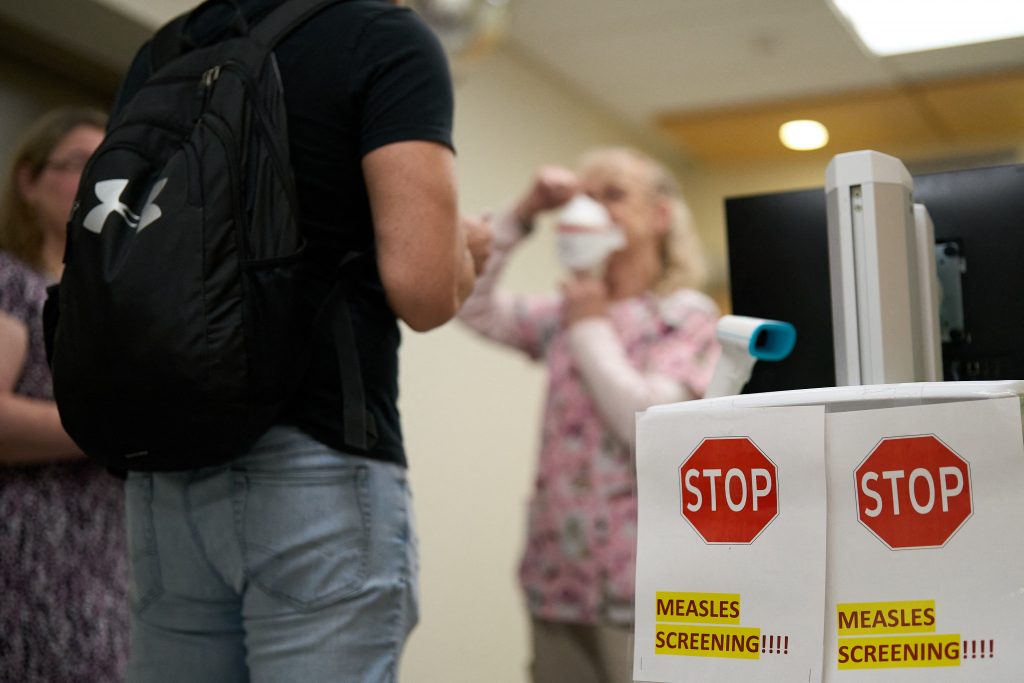
The Pan American Health Organization (PAHO) set an April 13 date to review data on the ongoing measles outbreaks in the U.S. and to determine if the country will lose its measles-elimination status, a largely symbolic badge first bestowed upon the U.S. in 2000.
Measles has resurged across the country and around the world in recent years. In November 2025, PAHO revoked Canada’s measles-elimination status.
So far in 2026, the Centers for Disease Control and Prevention (CDC) documented 171 cases across nine states. Utah recorded six new measles cases this week; Arizona reported eight last week. The South Carolina Department of Public Health announced 88 new cases over a five-day stretch that included last weekend.
There have been no deaths reported.
Last year, the U.S. recorded 43 measles outbreaks, a total of 2,242 confirmed cases — and three deaths — across 45 states, the highest number of cases recorded since 1991 when there were almost 10,000 cases.
The U.S. losing its measles-elimination status carries no immediate implications for Americans. Public health researchers and clinicians say it demonstrates the backsliding of public health gains.
“Losing that distinction is an embarrassment for the United States,” John Swartzberg, a professor at the University of California Berkeley, told the L.A. Times. “It’s another nail in the coffin for the credibility of this country.”
Ralph Abraham, the CDC’s principal deputy director since mid-December, said earlier this week that he was not concerned about losing elimination status because new federal guidelines have given Americans more choice regarding vaccination.
“It’s just the cost of doing business,” he said, suggesting that international travel spreads measles. But the CDC has recorded zero measles cases among international visitors so far this year. In 2025, there were 25 cases among foreigners in the U.S., about 1% of all cases.
“We have these communities that choose to be unvaccinated,” Abraham said. “That’s their personal freedom.”
What is measles-elimination status?
PAHO is a regional body of the World Health Organization that covers North, Central and South America. PAHO’s Regional Monitoring and Re-Verification Commission for Measles, Rubella and Congenital Rubella Syndrome oversees the measles-elimination status program.
In the U.S., local and state health departments work with the CDC to collect and analyze data on measles cases across the country. That data is then presented to PAHO.
“As part of the established process, the CDC will present its findings to the National Sustainability Committee, an external panel of national experts, which in turn submits to the Regional Verification Committee, an expert panel convened by the Pan American Health Organization,” Emily Hilliard, the Department of Health and Human Services press secretary, told Straight Arrow News.
The committee will use that data to determine if measles can still be considered eliminated from the U.S. or if it has once again become endemic. PAHO specifically considers measles to be endemic when the same strain of the virus spreads within a country, without interruption for at least 12 months.
Although the U.S. has recorded at least one measles case per week since January 2025, it has yet to be determined whether the same strain caused all those cases. The CDC is analyzing genetic sequences of measles viruses from across the country to determine whether recent cases stem from the same ongoing chain of transmission or from separate, newly introduced infections. This distinction would determine whether the U.S. retains its elimination status.
“The available data must be fully analyzed to assess whether any chain of transmission meets that threshold, a process that can take months,” Hilliard said. At this time, that threshold has not been met, she said.
“Until that process is complete, any claims about elimination status are speculative and not supported by an official determination.”
The post America’s measles elimination status is under review. Here’s what that means appeared first on Straight Arrow News.
Ella Rae Greene, Editor In Chief