Minneapolis protesters think someone’s watching. They may be right
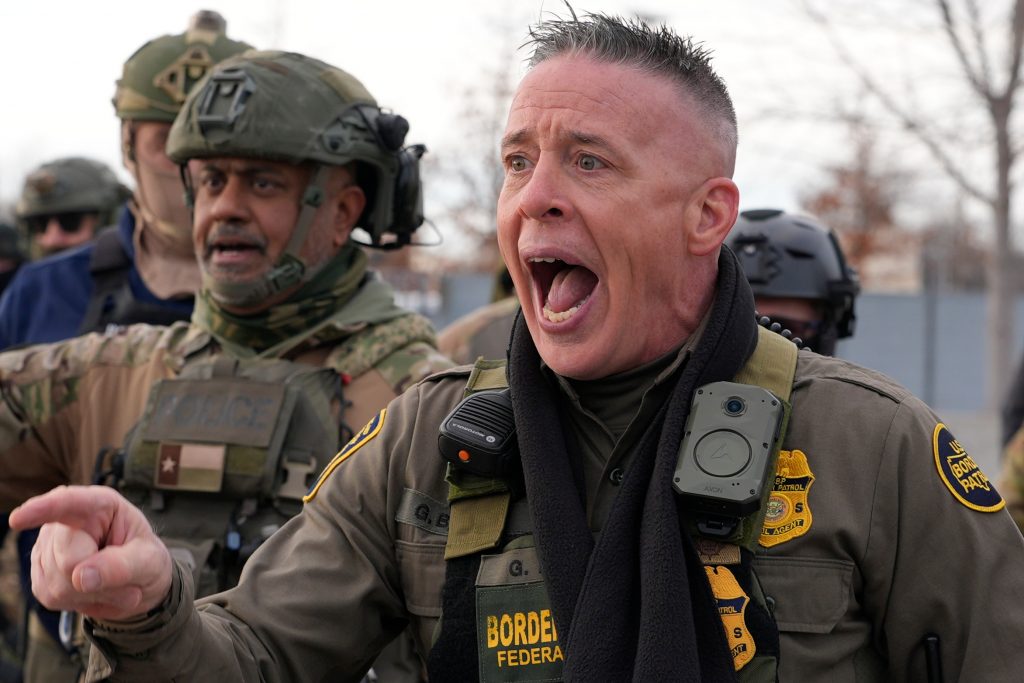
MINNEAPOLIS — As Border Patrol Commander Greg Bovino defended the tactics of immigration officers during a press conference at the local CBS affiliate on Tuesday, protesters gathered outside. One of them wanted to know how Bovino knew her name.
The 20-something woman, who identified herself only by her first name, Hannah, said it was her fifth day in a row protesting Bovino. She has spotted Bovino, known for his trademark trenchcoat, throughout the Twin Cities of Minneapolis and St. Paul since immigration agents launched Operation Metro Surge in December. During one of those encounters, Hannah said, Bovino made it a point to address both her and her sister — by their first and last names.
Hannah told Straight Arrow News that neither she nor her sister had ever been introduced to Bovino.
The episode, and Hannah’s suspicions about it, underscore the anxiety that many in Minneapolis feel about the presence of more than 2,000 federal agents, especially after the death of 37-year-old Renee Good, who was shot and killed by an Immigration and Customs Enforcement officer.
Hannah wondered whether a viral TikTok video she’d recently made about Bovino had alerted federal authorities to her identity. She also questioned whether the cellphone app Mobile Fortify, used by immigration officers to identify individuals through facial recognition, had been deployed against her during her second encounter with Bovino.
Regardless, Hannah felt Bovino’s remarks had one purpose: intimidation.
Two-way surveillance
The expanded surveillance capabilities of ICE and Customs and Border Protection have left many Minneapolis-area residents wondering just how much of a role technology is playing on the ground as protesters confront federal agents carrying out immigration operations.
Last week it was revealed that the data integration company Palantir has been developing a tool for ICE that, according to 404Media, “populates a map with potential deportation targets, brings up a dossier on each person, and provides a ‘confidence score’ on the person’s current address.”
The tool, known as ELITE, is just one of many surveillance programs that have come to light in recent weeks.
Following his press conference on Tuesday, Bovino would not answer questions from SAN about potential digital surveillance by federal immigration agencies.
In response to those agencies’ surge in Minneapolis, however, residents are conducting surveillance of their own.
The website ICEout.org, for example, allows locals to report sightings of immigration officers by uploading photos and descriptions of ICE activity to a map of the city. Groups on the encrypted messaging app Signal, many with more than 1,000 members, are also used for providing real-time updates on sightings.
Despite single-digit temperatures in Minneapolis this week, residents could be seen standing along East Lake Street, equipped with their phones and whistles. It’s a neighborhood where many immigrant-owned businesses operate.
Outside the Bishop Henry Whipple Federal Building near the Minneapolis airport, the site of repeated anti-ICE protests, locals take photos of license plates linked to suspected ICE vehicles. The photos can then be shared among community activists or uploaded to websites like Stop ICE Plate Tracker.
ICE has attempted to counter the action by replacing and switching out license plates, a move that the director of Minnesota’s Driver and Vehicle Services says violates state law.
The situation has led to a paranoid environment, where any vehicles with out-of-state plates, including those used by journalists, are viewed with suspicion.
Surveillance remains apparent even at the vigil for Good, the American citizen who was fatally shot by an ICE agent on Jan. 7. The vigil, located near the intersection of Portland Avenue and East 34th Street, was being watched on Tuesday by two police vehicles and a mobile surveillance camera trailer.
And with Vice President JD Vance expected to visit Minneapolis on Thursday, the surveillance, fear and defiance are unlikely to let up anytime soon.
The post Minneapolis protesters think someone’s watching. They may be right appeared first on Straight Arrow News.
Ella Rae Greene, Editor In Chief