Trump says he had ‘the greatest first year in history.’ Not everyone agrees
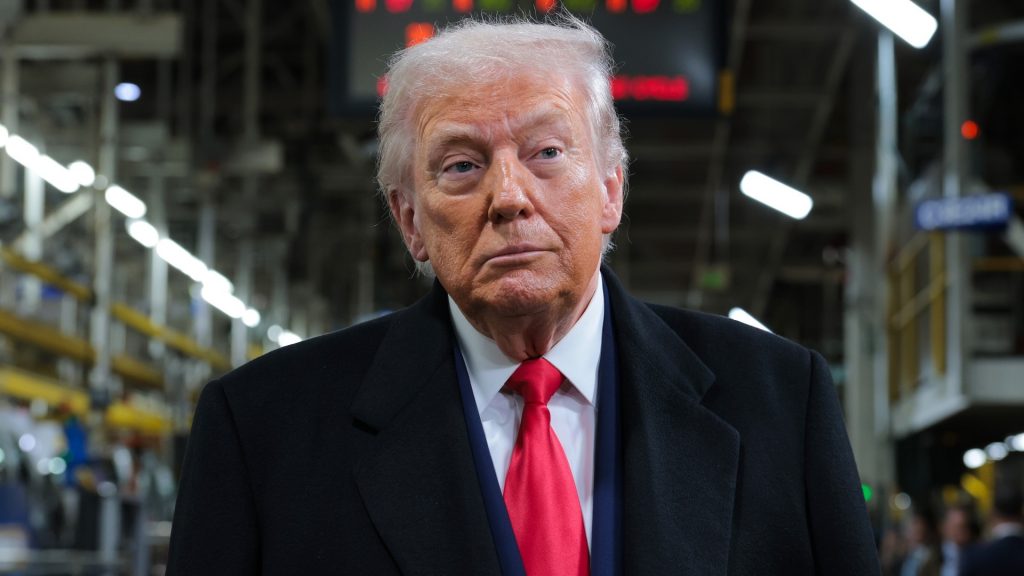
Tuesday marks the first anniversary of President Donald Trump taking his second oath of office and concludes a year in which he has made fundamental changes to policy, politics and even the landscape of Washington, D.C. From immigration to tariffs to fighting “wokeness,” the last 365 days have been busy for Trump and his administration.
The president dubbed his first year “the greatest first year in history” during a Michigan rally last week.
Polls suggest most Americans do not agree. An Associated Press-NORC poll taken in early January 2026 showed that only about 40% of respondents approve of Trump’s job performance. About half say he’s focusing on the wrong priorities, while 37% approve of his handling of the economy, 38% agree with his approach to immigration and 37% support his foreign policy initiatives.
Popular or not, these were some of the major moves of Trump’s first year back in office:
Immigration
In his first term, Trump intensely focused on immigration in the U.S. That did not change when he returned to the White House last year. One of his first acts as president was to block asylum access for those entering the U.S. without proper documentation.
He also ramped up efforts to prevent illegal crossings and urged Mexico to do more to deter migrants. All of Trump’s efforts to secure the border have led to a decrease in illegal crossings by 90%, as Straight Arrow News previously reported.
The most prominent efforts, however, were his National Guard troop deployments and surges of immigration and border agents across various states.
Through enhanced enforcement, the administration deported roughly 500,000 immigrants, according to The New York Times. But that number is well shy of the 1 million Trump and his administration sought.
The administration sent many of those deported to war-torn and faraway nations they are not from in an effort to encourage immigrants still in the U.S. to return to their home country voluntarily.
The efforts have not gone unnoticed. In fact, many immigration efforts have sparked protests and lawsuits, many of which are still pending. The administration also slashed the number of refugees allowed to enter the U.S., reserving slots mostly for white Afrikaners from South Africa, and made it harder for immigrants to get green cards.
Unbiased. Straight Facts.TM
President Donald Trump has signed 227 executive orders since returning to office last year — seven more than in his entire first term.

Federal workforce
Prior to his second term, Trump promised to “demolish the deep state.” Since taking office, he has significantly downsized the federal workforce, including dismissing prosecutors and FBI agents involved in criminal cases against him.
The president sought to dismantle the U.S. Agency for International Development and the Department of Education, which are now undergoing major restructuring.
In November, the Office of Personnel Management estimated that 317,000 employees had left the federal government. Tens of thousands of those were fired, while the rest resigned or retired. Meanwhile, the administration hired about 68,000 individuals.
Justice Department chases political foes
Trump returned to the White House promising “retribution” for his political enemies, and over the past year, the Justice Department has targeted several of the president’s political foes.
Prosecutors brought charges against former FBI director James Comey and New York Attorney General Letitia James shortly after Trump publicly pressured Attorney General Pam Bondi to seek their indictments. Both indictments were dismissed in November.
Former national security adviser John Bolton, an outspoken Trump critic, also faces criminal charges, and federal authorities are investigating other Trump enemies, such as Sen. Adam Schiff, D-Calif.; Lisa Cook, a member of the Federal Reserve Board of Governors; and lawmakers who appeared in a video reminding military service members they are obligated to refuse unlawful orders.
The Justice Department has also recently come under fire over Trump-appointed prosecutors who are serving unlawfully. They include the prosecutor who brought forth charges against Comey and James, as well as Trump’s former personal attorney, Alina Habba, and Trump-appointed U.S. Attorney John Sarcone.
Illegal drugs
This year’s news cycle has often been dominated by the Trump administration’s war on drugs. The president ramped up the military’s presence in the Caribbean and off the coast of Venezuela.
He designated drug cartels and criminal gangs as terrorists and ordered the military to strike boats believed to be smuggling drugs out of Venezuela. Since September, at least 115 people have been killed in a reported 35 boat strikes. Trump said the strikes were necessary to stem the flow of drugs into the U.S.
Trump also authorized a military action that captured Venezuelan President Nicolás Maduro on Jan. 3. Maduro and his wife were taken to New York to face federal drug trafficking charges.
Wars
Although he authorized military strikes on Venezuela and Iran, Trump has credited himself with ending seven wars around the world since returning to office.
These conflicts were between were Cambodia and Thailand, Kosovo and Serbia, Congo and Rwanda, Pakistan and India, Israel and Iran, Egypt and Ethiopia, and Armenia and Azerbaijan.
“It’s a shame I’ve had to do these things instead of the United Nations doing them,” Trump told the UN General Assembly in September.
He also helped broker a peace deal between Israel and Hamas, while criticizing Russian President Vladimir Putin for not negotiating a deal to end the war with Ukraine. He also falsely blamed Ukrainian President Volodmyr Zelenskyy for starting the war. Special envoys continue to work with both sides to try to reach an agreement.
Other key moments
During his first year back in office, Trump also sought to rebalance global trade and focus more on American manufacturing. He imposed steep tariffs on imports from Canada, Mexico, China and dozens of other trading partners.
The president also moved to cut billions of dollars from schools and universities with diversity and equity programs. He said schools should not have “racially charged” orientation programs or scholarships specifically for minorities.
Some of his biggest headlines, however, related to the White House ballroom that he announced last year. Trump ordered the East Wing of the White House demolished to make way for the new space, which has grown in size and cost since the initial announcement.
The other major move that made headlines? The Epstein Files. After much debate and back-and-forth, Trump signed the Epstein Files Transparency Act, requiring the Justice Department to release all files related to convicted sex offender Jeffrey Epstein.
While the deadline for release has passed, all of the Epstein files have yet to be made public. The Justice Department said that due to the sheer volume of files, it will take a while to comb through them and release them to the public.
The post Trump says he had ‘the greatest first year in history.’ Not everyone agrees appeared first on Straight Arrow News.
Ella Rae Greene, Editor In Chief