Robots are the future of manufacturing. What happens to human workers?
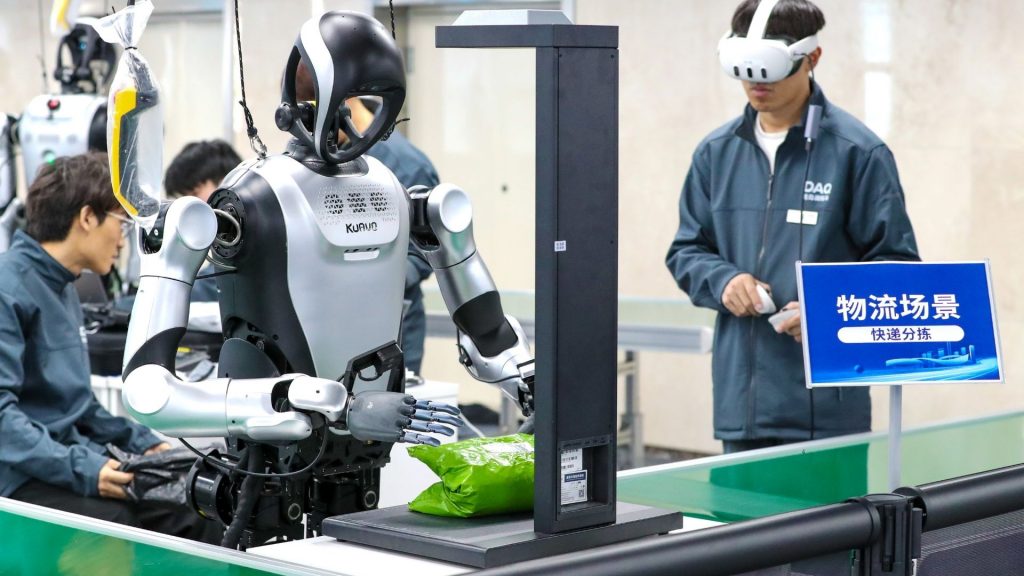
Companies from around the world traveled to the Consumer Electronics Show in Las Vegas this month to show off their latest tech. But one category always catches everyone’s eye: robots.
Ever since Karel Čapek introduced the word “robot” in his 1920 play “R.U.R.,” or Rossum’s Universal Robots, people have fantasized about a world run by robot labor, where humans reap the benefits. The term “robot” actually comes from the Czech word for “forced labor.”
Now, one country is placing big bets on advanced humanoid robotic technology: China. Just last year, the country invested nearly $140 million into the technology.
China is looking to humanoid robots to increase its manufacturing output and address bottlenecks hindering the industry. While the technology would be a major boon for China’s manufacturing supremacy, it could have dire consequences for its people.
The technology carries a number of potential risks not only to China but to the world. Major concerns — like a fully robotic workforce permanently wiping out jobs, high unemployment gutting government programs like Social Security and just a few companies potentially controlling the entire workforce — continue to keep some futurists up at night.
Why is China focusing on humanoid robots?
Unbiased. Straight Facts.TM
Some estimates suggest robotics and AI could replace about 58% of manufacturing jobs globally.

The Chinese government believes advanced humanoid robots are the future for its manufacturing sector. The technology also fits with the country’s “whole-of-nation” industrial plan. The strategy focuses on key sectors, like artificial intelligence and robotics, to overcome bottlenecks and become a tech superpower.
While China, like much of the West, is focusing on AI, trade restrictions and manufacturing limitations make it harder for the country to keep up.
“China is not necessarily focusing on robotics to the exclusion of any other aspect of AI,” said Adam Dorr, the director of research at RethinkX, a U.S.-based research nonprofit focusing on technology-driven disruptions. “But China’s companies and government clearly understand the importance that humanoid robots will play in the future.”
The country excels at manufacturing and remains the world’s biggest producer. In 2025, China’s trade surplus hit record highs, surging to nearly $1.2 trillion. China understands humanoid robots would benefit every country and being the first country to perfect the tech would give the country massive leverage over others.
“It’s not just a race to build humanoid robots to boost the host country’s domestic productivity,” Dorr told Straight Arrow News, “but also a race to deploy these into other nations’ markets across the globe. Chinese companies and the Chinese government certainly want to be the ones supplying humanoid robots to all of Africa and Asia.”
The country faces a significant challenge with its manufacturing dominance. Following decades of its One-Child Policy, China faces population decline. The problem is exacerbated with more Chinese people being less eager to work low-paying manual labor jobs.
Robots could eliminate that issue for China, creating an entire labor force using its massive manufacturing infrastructure.
How advanced are China’s humanoid robots?
While many consumers are amazed by the capabilities of modern-day humanoid robots, even the most advanced are still too primitive to replace human workers. Most analysts say they’re visually impressive but still not ready to perform truly autonomous labor. But they are quickly improving.
Chinese company EngineAI unveiled its latest version of its humanoid robot, the T800, at this year’s CES. The robot can stand upright without any support, move around about as well as a fairly athletic person and can perform some impressive acrobatics. The company had previously promoted the robot in a video showing it kicking the company’s CEO, who wore protective padding.
Still, most companies are waiting for more adept robots they could use to cut labor costs. Dorr said those robots may be available sooner than later.
“It would be a big mistake to presume they will be bumbling clankers for a long time,” he said. “They will go from meh to good to amazing very quickly. Expect near-human-level capability by 2030.”
One of the biggest holdups is the difficulty of building advanced robots. Dorr said companies are working to fix this, with some American companies focusing on making the machines easier to mass produce.
“The clear leader here is Tesla,” Dorr told SAN. “But China has a strong track record of building out manufacturing capacity for new, technically demanding industries to large scale in a big hurry.”
Designers have difficulty recreating complex parts of the human anatomy, such as the hand. However, some companies are getting close. The Shadow Robot Company, based in England, offers some of the most advanced robotic hands available.
Humanoid robots also require expensive materials, such as high-capacity batteries, a technology China is focusing heavily on.
How could these robots help China’s labor problem?
China’s working-age population is shrinking, its society is rapidly aging, and policymakers see robotics as a way to maintain high manufacturing output even as the labor force shrinks.
Every industrialized country already uses robotics in production, but humanoid robots are more general-purpose and can do whatever human workers can. They could also use tools the company already has, meaning it wouldn’t have to invest in specific devices.
These advanced machines could also branch out into other fields. For example, retail, culinary and elder care services could see advanced humanoid robots replace humans.
These advanced machines could significantly help with China’s labor issue. That’s because labor is the most significant limiting factor on most goods and services, according to Dorr.
While China is good at mass production, manufacturing requires labor, and labor is complicated. A country needs to provide enough care and stability so its population can have children. The government then needs to educate those children for roles in the economy and have companies that pay them to work.
But humanoid robots need only to be built and powered.
“Up until now, it didn’t go the other way: more electricity couldn’t give you more human workers,” Dorr said. “That all changes with artificial labor — labor from robots. You really can just use energy to build more robots.”
What could happen to laborers?
Machines replacing the majority of human workers would have dramatic ramifications for the global economy. Many experts agree that the change would shock the economy and lead to mass firings, something that is already happening with non-humanoid robots.
This would drive down prices because labor costs are significantly lower. But most people, now without jobs, would have no money to spend. China is examining how a scenario of robot-caused mass unemployment could impact its social security system, according to Reuters.
During the 2025 National People’s Congress, social security expert Zheng Gongcheng raised concerns that humanoid robots and AI could affect 70% of China’s manufacturers. The mass joblessness could lead to a steep decline in social security contributions.
At that event, the chairman of Chinese AI firm iFlytek suggested AI unemployment insurance. He proposed the country provide six to 12 months of coverage for those replaced by machines.
However, some robotics companies say they aren’t out to get people’s jobs. The chief technology officer of Beijing Innovation Centre for Human Robotics, a company backed by the Chinese government, said the company is only targeting jobs people don’t like doing or dangerous jobs.
How could this technology impact the global economy?
This possible future has led many futurists to theorize about new types of economies. One of the most popular ideas for a potential future robot labor economy is a universal basic income. Everyone would receive a set amount of money every year, which they could spend however they liked. Many call this the post-work economy.
This concept raises a major concern: Whoever controlled the robot workforce would control the world. Everyone else would become dependent on money from the government or corporations, which could be cut off unexpectedly.
But other analysts, including Dorr, see a robot workforce as a generally positive development, especially in its impact on scarcity.
Advanced humanoid robots would be able to manufacture anything in large quantities, minimizing production costs to historic lows. Material costs would also decrease since labor costs to obtain those resources would decrease.
“Every good and service made by any factory or office can be made in an arbitrarily larger amount,” Dorr said. “Scarcity ends, which means prices plummet toward zero.”
Dorr said any shortage of materials would be “steamrolled” by simply building more robots to produce or obtain those products. He believes that this technology would create a “rich lifestyle” for everyone and eventually, no one would need to work.
“Robots are the ultimate unlock for civilization,” Dorr said. “The 64-trillion-dollar question is, ‘How do we make the paradigm shift to a Stellar world of superabundance without total mayhem and carnage destroying our societies along the way?’”
The post Robots are the future of manufacturing. What happens to human workers? appeared first on Straight Arrow News.
Ella Rae Greene, Editor In Chief