Wary of ‘uninvestable’ Venezuela, ExxonMobil leans into nearby Guyana’s oil boom
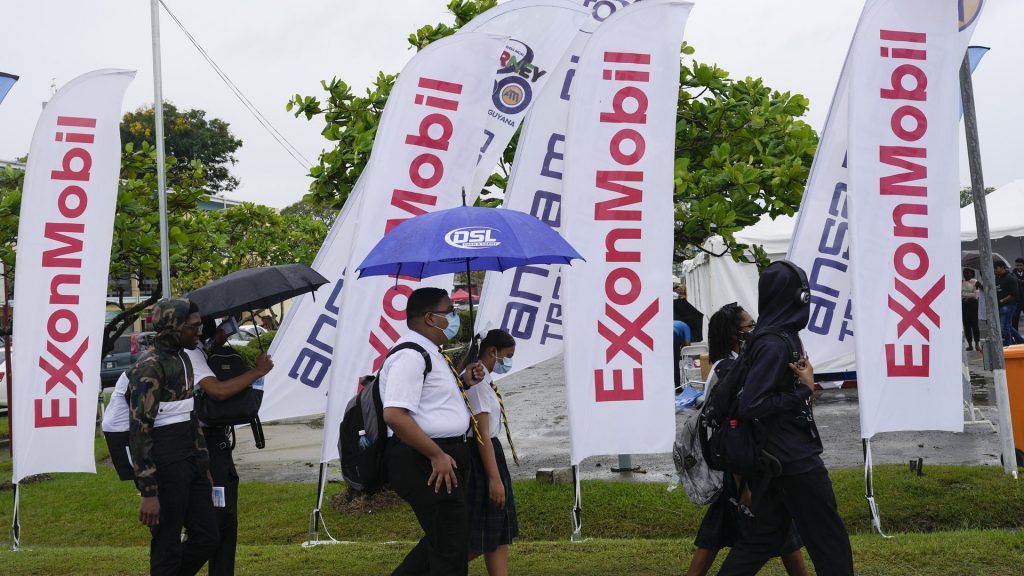
As President Donald Trump attempts to convince the oil industry to invest in Venezuela, ExxonMobil has shown hesitance to take the offer. But the company may have already benefited substantially from the U.S. intervention because of its stake in neighboring Guyana.
Venezuela’s neighbor to the east has turned into a fast-growing oil producer, but its oil reserves are located largely underwater along territory long disputed by the two countries. ExxonMobil is the largest oil investor in Guyana’s oil industry.
At a Friday meeting between the Trump administration and executives from over a dozen oil companies, ExxonMobil CEO Darren Woods said “significant changes have to be made” in Venezuela for the company to reenter, but “today it’s uninvestable.”
Speaking to reporters on Sunday, Trump said he didn’t like Woods’ response, and he will “probably be inclined to keep Exxon out” of Venezuela. Regardless of whether ExxonMobil invests in Venezuela, experts say the company’s position in Guyana is more secure following the U.S. capture of President Nicolas Maduro.
With the U.S. ostensibly calling the shots in Caracas, “the border dispute will recede in importance,” said Jay Mandle, a professor emeritus in economics at Colgate University.
Mandle, who has spent his career studying Guyana and other countries in the Caribbean, told Straight Arrow News that “the Trump administration would not encourage Venezuela’s pursuit of that claim,” and therefore, “this all benefits Guyana’s petroleum sector.”
What’s the Essequibo region?
With the internationally recognized border of Venezuela on the west and the Essequibo River on the east, the Essequibo region is rich in biodiversity and natural resources. The disputed region covers roughly two-thirds of Guyana.
The origins of the territorial dispute date back to the colonial period when Spain controlled Venezuela, and the area that became Guyana traded hands between French, British and Dutch control. Venezuela declared independence from Spain in 1811, and Guyana became independent from the United Kingdom in 1966.
While an 1899 international tribunal awarded the territory to Guyana, then a British colony, Venezuela has repeatedly pursued its claim to the area — most recently after oil was discovered in 2015.
Guyana’s oil deposit
Unbiased. Straight Facts.TM
After discovering oil in 2015, ExxonMobil now produces 900,000 barrels of oil per day from Guyana.

ExxonMobil held an exploration license to search for offshore oil as far back as the 1990s. After oil was discovered offshore of Guyana in 2015, ExxonMobil built offshore drill rigs. ExxonMobil had exited Venezuela a few years earlier, when President Hugo Chavez ordered that the state-run oil company control a majority share of all oil extraction projects.
The 2015 discovery found an 11 billion barrel reserve. That’s far short of Venezuela’s reserves, estimated at 300 billion barrels of oil. But Guyana welcomed the industry, and the country’s oil exports now rival its western neighbor.
Oil production grew at a rapid pace: In 2019, 15,000 barrels a day were produced in Guyana; by the end of 2025, ExxonMobil alone was producing 900,000 barrels per day out of Guyana. The country is expected to reach 1.3 million barrels per day by 2027, exceeding Venezuela’s current daily production of just under 1 million barrels.
Maduro’s renewed claims on Essequibo
Following the announcement of ExxonMobil’s 2015 discovery, Maduro renewed Venezuela’s claim over the Essequibo region and the oil-rich waters off its shore, at times sending the navy to patrol disputed waters.
In 2023, Maduro’s government placed a referendum on the ballot to annex the Essequibo territory. The official results showed an overwhelming victory for Maduro in favor of incorporating the territory into Venezuela, but remarkably low voter turnout raised questions over the legitimacy of the results. Residents of Essequibo were not part of the electorate.
Maduro then released a new map showing the region as part of Venezuela and said he would authorize the state oil company PDVSA to begin operations in the territory. The U.S. government stood with Guyana and condemned Venezuela’s attempt.
“Guyana’s government is relying heavily on the U.S. for security against Venezuela’s claim,” said Thomas Singh, head of the economics department at the University of Guyana.
The U.S. had already participated in joint maritime patrols alongside Guyana to monitor oil operations beginning in 2020. In March of 2025, Venezuelan patrol ships entered one of ExxonMobil’s offshore lease areas. The Organization of American States urged Venezuela to cease “aggressive maneuvers that could escalate tensions in the region.”
With Maduro out, the unease over Essequibo has subsided — for now. But Singh told SAN that he believes the Venezuelan people’s outlook hasn’t changed when it comes to the disputed territory.
The claim is “visceral among Venezuelans,” he said, with a majority of the country believing it is legitimate.
Editor’s note: This story has been updated since initial publication to correct Guyana’s oil reserve size.
The post Wary of ‘uninvestable’ Venezuela, ExxonMobil leans into nearby Guyana’s oil boom appeared first on Straight Arrow News.
Ella Rae Greene, Editor In Chief