‘Democracy in action’: Cities react to privacy concerns by canceling Flock surveillance contracts
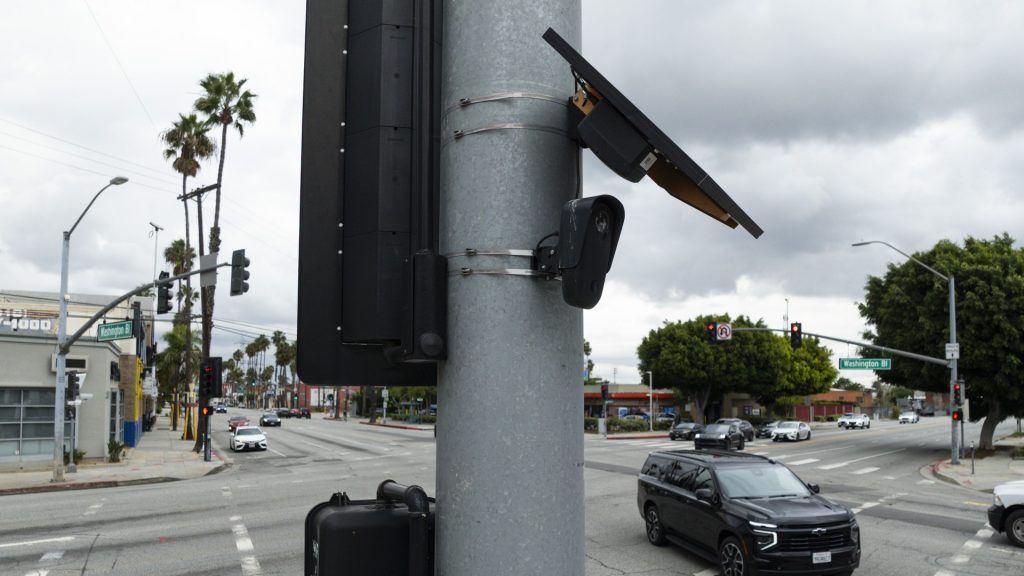
After residents of a Virginia town complained about AI-powered license plate reading cameras in their community, the head of the company that provided them to the local police department pushed back. His message was defiant.
“Let’s call this what it is: Flock, and the law enforcement agencies we partner with, are under coordinated attack,” Garrett Langley, chief executive of Flock Safety, wrote in an unsolicited email to Staunton Police Chief Jim Williams. “The attacks aren’t new. You’ve been dealing with this forever, and we’ve been dealing with this since our founding, from the same activist groups who want to defund the police, weaken public safety, and normalize lawlessness.”
Langley’s defiance backfired.
Last month, Staunton joined the growing list of cities that are canceling contracts with Flock, amid a growing public backlash over the surveillance technology’s expansion.
City council meetings from Washington state to Massachusetts have been filled with concerned residents, many of whom accuse their local officials of entering into contracts that allow unwarranted spying without their input or knowledge.
Williams, the longtime chief in Staunton, a town of about 25,000 in the Shenandoah Valley where Flock installed six license plate reading cameras in 2024, rejected Langley’s assertion that law enforcement is under attack.
“What we are seeing here is a group of local citizens who are raising concerns that we could be potentially surveilling private citizens, residents and visitors and using the data for nefarious purposes,” Williams wrote to Langley. “These citizens have been exercising their rights to receive answers from me, my staff, and city officials, to include our elected leaders.
“In short,” he said, “it is democracy in action.”
Video spurs scrutiny
More than 80,000 Flock cameras are said to be in use throughout the U.S. Flock’s customers include an estimated 5,000 law enforcement agencies and 1,000 corporations.
Scrutiny of the company has intensified since a YouTube video revealed how live feeds from more than 60 cameras were exposed to the open internet.
The video has been viewed more than 953,000 times. Its producer, technologist Benn Jordan, told Straight Arrow News that he sent an email thanking Williams for what he saw as a rational response to Flock’s CEO.
Jordan also expressed concern over Langley’s email, which he believes may have been sent out en masse.
“I realized that Garrett Langley’s original email was unsolicited and impersonal, coming from a ‘no_reply’ address, which suggests that this kind of message is going out to large amounts of law enforcement agencies around the country,” Jordan said. “Intentionally misleading law enforcement and trying to get them to ‘join the fight’ against people critical of your company is incredibly reckless and dangerous.”
“I’ve already had police show up to my house after taking video footage of Flock Safety cameras,” Jordan continued. “How will they approach my house if they have reason to believe that I’m part of a ‘lawless coordinated attack’ on them?”
SAN reached out to Flock with specific questions about Langley’s email and the contract cancellation in Staunton. The company replied only with a link to a page on its website outlining its privacy and ethics guidelines.
A clash of values
In Staunton, Williams said the Flock cameras had helped officers locate missing and wanted persons, recover stolen vehicles and identify suspects in crimes.
However, the damage from Langley’s email could not be undone. After Williams met with the city manager and city council to discuss Langley’s remarks, they decided to end the contract with Flock.
In a statement, the city said that Langley’s “narrative does not reflect” Staunton’s values.
“The Staunton Police Department reported numerous successes utilizing this technology,” the statement said. “Unfortunately, the city does not agree with the assessment as detailed by the CEO of Flock Safety.”
The city says it is currently coordinating with Flock to finalize the contract’s termination and to turn off and remove all license plate reading cameras.
‘A new era’
The situation in Staunton is similar to a growing number of others, including in Flagstaff, Arizona, which terminated its contract with Flock in December after a month of pushback from local residents. Despite efforts by police to ease concerns by outlining policy guardrails, the Flagstaff City Council ultimately voted unanimously to end the partnership.
Jan Carlile, a local resident who supported terminating the contract, said during public comment that the potential privacy ramifications were too much to bear.
“I admire and respect the efforts of our police department to try to do the very best they can to protect our safety, and until the advancement of AI and frankly the troubling efforts by our current national administration, both of those can potentially very seriously undercut our privacy as citizens,” Carlile said. “I would not likely have been concerned about the use of cameras as a tool for public safety [in the past], but we are in a new era.”
Cambridge, Massachusetts, initially paused the use of 16 cameras in October. But city officials canceled their contract entirely after it was revealed that Flock had installed two additional cameras without the city’s knowledge.
“Concerns about Flock were substantiated,” said city spokesperson Jeremy Warnick. “Due to this material breach of our trust and the agreement, the city terminated its contract with Flock Safety.”
In Evanston, Illinois, a similar series of events unfolded. After the city terminated its contract in late August and deactivated 19 cameras, Flock began reinstalling cameras across the city, seemingly unbeknownst to local officials and residents. The city responded in September by issuing a cease-and-desist order against Flock, which said that it would uninstall the cameras.
The controversy came around the same time that an audit by the Illinois Secretary of State found that Flock had violated state law by allowing U.S. Customs and Border Protection access to data collected by its license plate-reading cameras. Flock refuted the charge.
Washington state has also been a hotbed for backlash against Flock. The cities of Redmond and Lynwood deactivated their cameras in November while reevaluating their contracts after complaints from residents. The City Council in Mountlake Terrace unanimously canceled its contract in November, while the capital city of Olympia uninstalled 15 cameras and canceled its pilot program with Flock in December.
The post ‘Democracy in action’: Cities react to privacy concerns by canceling Flock surveillance contracts appeared first on Straight Arrow News.
Ella Rae Greene, Editor In Chief