Supreme Court expected to release major tariff ruling Friday
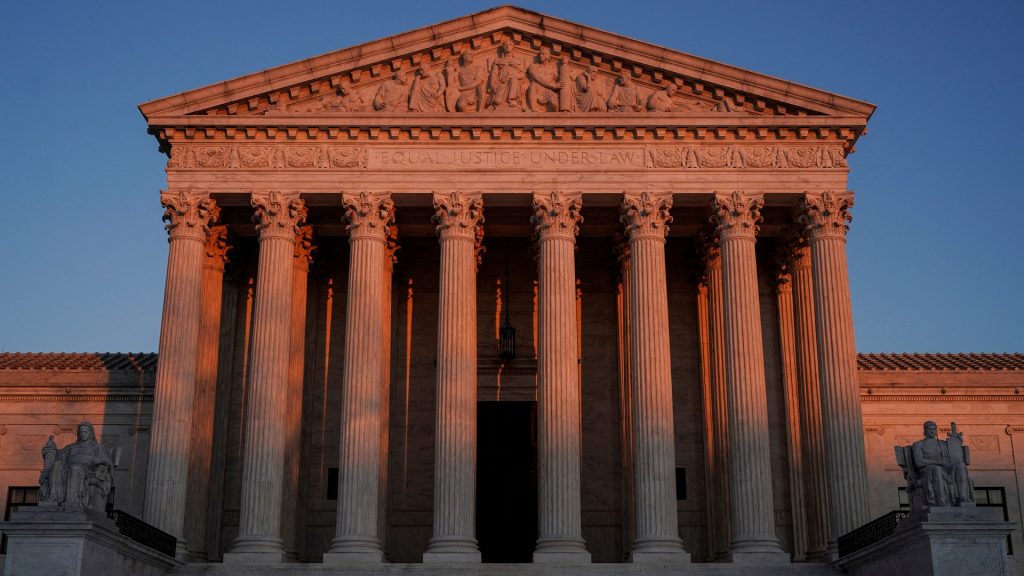
The Supreme Court is expected to provide an expedited ruling Friday on the legality of many of the tariffs President Donald Trump has imposed on imports from other countries. The decision could undermine much of Trump’s economic agenda for his second term.
The court heard arguments on the case in November, and typically releases opinions on major cases such as this near the end of its term in June. But the court’s promised fast turnaround reflects the gravity of the decision.
In April 2025, Trump claimed authority under a 1977 law, the International Emergency Economic Powers Act, to impose high tariffs on nations across the world.
Trump has said the case is one of the most important in the nation’s history.
“If a President is not allowed to use Tariffs, we will be at a major disadvantage against all other Countries throughout the World,” Trump wrote on Truth Social on Nov. 2, shortly before oral arguments at the Supreme Court.
The court will decide not only whether the president may use emergency powers to impose tariffs in amounts of his choosing on the nation’s trading partners. It is also likely to have massive effects on American consumers, businesses and the global economy, as well as future presidencies.
Three lower courts — including the Court of International Trade and two U.S. Courts of Appeals — found the tariffs to be illegal. The Trump administration appealed those rulings, and the final word on the president’s tariffs will belong to the nation’s highest court.
The nine justices of the Supreme Court heard the arguments in this seismic case in November, focusing on whether Trump’s application of the 1977 tariff law was, in fact, legal.
The Supreme Court has never interpreted the 1977 law, Hans von Spakovsky, a senior legal fellow at The Heritage Foundation, a conservative think tank, told Straight Arrow News last year.
“This is going to be a very important case,” he said, “because it will define not only what President Trump can do, but what future presidents can do.”
So far, the court’s conservative majority has sided with Trump on many polarizing legal issues, at times using what is known informally as “the shadow docket,” a fast-track, yet less transparent way to expedite decisions.
Ruling in Trump’s favor could lead to an infinite increase in presidential power, some legal experts say.
“I worry that if the court accepts the government’s position here — that it’s deferential to the president in international affairs and national security — it would have future ramifications that even conservatives would not be happy with,” legal fellow Brent Skorup at the Cato Institute, a libertarian think tank that filed an amicus brief in this case, told SAN in 2025. “Future presidents could enact climate change policies because it has some impact on national security or regulate guns because they have impact on national security. The stakes, from my perspective, are larger than just tariffs.”
What is the International Emergency Economic Powers Act?
The 1977 economic powers law, known as the IEEPA, grants presidents broad authority to declare a state of emergency in cases of “unusual or extraordinary” threats to the U.S. and to regulate economic transactions and international trade.
“How far does the [president’s] power extend when trying to impose tariffs, as part of national security concerns or concerns about the economic condition of the country?” von Spakovsky said. “Legally and constitutionally, does the president have the power to do this? That’s really what the Supreme Court will be deciding. There’s a lot of debate out there whether or not tariffs are a good idea or not economically. The Supreme Court is not going to be looking at that.”
The law derives from a World War I-era statute called the Trading with the Enemy Act.
“[It] has been substantially amended over time, particularly during the Great Depression and World War II,” Skorup said. “During the Great Depression, Congress extended it not just during wartime but to any national emergency. “After the Japanese bombed Pearl Harbor, Congress amended the act within days to allow the president to regulate importation. This is the core of the fight in the president’s tariff case.”
In the decades that followed, Congress wanted to curtail the powers the president was granted through the Trading with the Enemy Act.
“In 1977, Congress passed IEEPA, which uses much of the same language of the Enemy Act,” Skorup said. “It gives the president broad powers during the emergency, but it also gives Congress the power to cancel the declared emergency. IEEPA says the president can regulate importation. The fight about the tariffs today is: when Congress allows the president to regulate importation during an emergency, does that include the president being able to set whatever tariff rates he wants?”
Over time, presidents have called upon this federal law in times of crisis. During the 1979 Iran hostage crisis, President Jimmy Carter blocked Iranian assets. President George W. Bush took a similar action against funders of terrorist groups after the Sept. 11, 2001, attacks.
“The statute that’s at issue here has very specific language,” Spakovsy said. “It has to be an ‘unusual and extraordinary’ threat. The president has said fentanyl is a threat, and that the trade deficit has gotten so large, that it’s an extraordinary event. Did the president under the Constitution and, specifically, under this statute, have the power to impose these kinds of tariffs? That’s what [the Supreme Court] is going to be looking at.”
The controversy
This is a high-stakes case focused on the separation of powers between two branches of the U.S. government — the executive and the legislative.
“The stakes of this case reach far beyond trade policy,” wrote Elizabeth Goitein, senior director of liberty and national security at the left-leaning Brennan Center. “The Court’s decision could shape whether the use of emergency powers to bypass Congress becomes a tool of routine governance, with profound implications for the constitutional separation of powers and limits on presidential authority.”
Stanford University law professor and constitutional law expert Michael McConnell said the United States has not seen so profound a separation-of-powers controversy in more than 70 years.
“The tariff litigation is shaping up as the biggest separation-of-powers controversy since the steel seizure case in 1952,” McConnell, a former judge on the 10th U.S. Circuit Court of Appeals, wrote in a New York Times op-ed. “Understandably, most of the commentary has focused on the practical ramifications for the president’s trade negotiations and the American economy. But the case may be even more important for the future of a fundamental component of the Constitution’s architecture: the separation of powers, intended by the founders to prevent any of the government’s three branches from becoming all powerful.”
Trump also sees the case as consequential, for different reasons.
“It will be, in my opinion, one of the most important and consequential Decisions ever made by the United States Supreme Court,” he wrote on Truth Social in November. “If we win, we will be the Richest, Most Secure Country anywhere in the World, BY FAR. If we lose, our Country could be reduced to almost Third World status — Pray to God that that doesn’t happen!”
The post Supreme Court expected to release major tariff ruling Friday appeared first on Straight Arrow News.
Ella Rae Greene, Editor In Chief