Trump wants US oil companies back in Venezuela. Here’s why they left
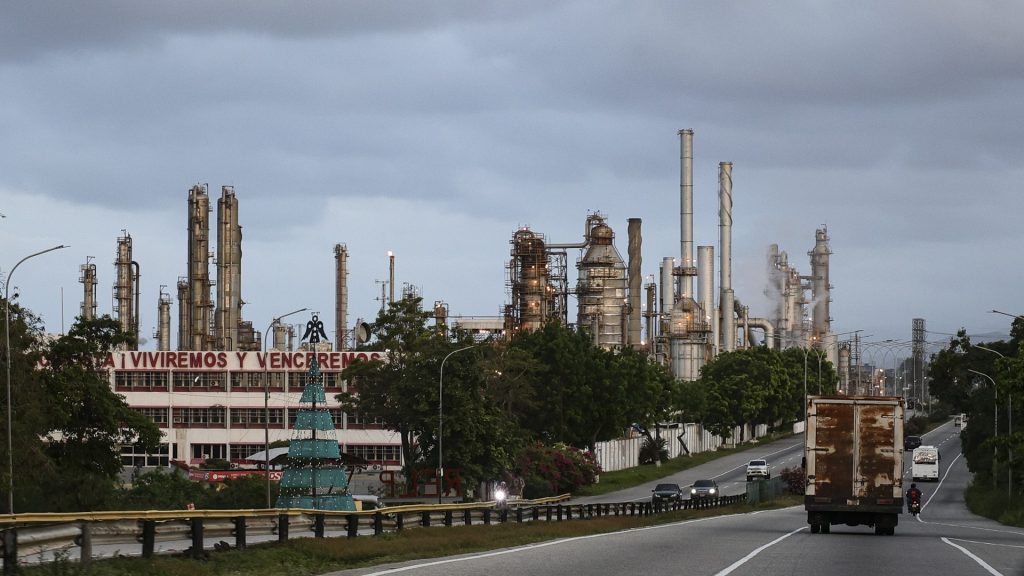
Wall Street reacted to the military operation that brought Venezuelan President Nicolás Maduro to U.S. custody with a rally that bolstered major oil and gas stocks. While maintaining that narco-terrorism was the motive for Maduro’s capture, at a Saturday press conference, President Donald Trump made clear another central aim of U.S. intervention in Venezuela: rebuilding the country’s oil industry.
Trump announced the United States would “run” Venezuela until a proper transition can take place, with American oil companies set to invest billions in the country’s petroleum infrastructure. Venezuela holds the world’s largest proven oil reserves at nearly 304 billion barrels, yet production has fallen from 3.5 million barrels per day in the late 1990s to roughly 1 million today.
Venezuela’s oil reserves hold the potential to reshape global markets. The U.S. intervention appears aimed at ensuring access for American companies, which could generate significant profits as many U.S. refineries were designed to process heavy crude, which Venezuela could provide. But the outcome will depend on how stable the new government is, and whether corporate interests are willing to risk major investments in a country that has already nationalized its infrastructure once.
What did Trump say about Venezuelan oil?
During a Saturday press conference, Trump mentioned oil more than a dozen times — more often than freedom, democracy, or the transition to a new Venezuelan government. Trump’s rhetoric focused on reclaiming what he characterizes as stolen American property, seized when most U.S. companies left the country in the wake of nationalization.
“We built Venezuela’s oil industry with American talent, drive and skill, and the socialist regime stole it from us during those previous administrations,” Trump said. He announced that “very large United States oil companies, the biggest anywhere in the world” would “go in, spend billions of dollars, fix the badly broken infrastructure.”
What is the history of Venezuela’s oil industry?
When Venezuela nationalized its oil industry in 1976, the government “fully compensated” foreign companies, according to Miguel Tinker Salas, a professor of history at Pomona College who has written multiple books on Venezuela and the country’s oil industry.
The nationalization, however, created a “backdoor” that allowed U.S. companies to continue operating as contractors and consultants, Tinker Salas told Straight Arrow News.
That changed in 2007, when President Hugo Chávez moved to take majority control of oil projects and reduce the role of large multinational corporations. ExxonMobil and ConocoPhillips refused to accept minority stakes and exited, as Venezuela’s state-run oil company PDVSA seized assets the U.S. companies had been in the process of developing.
Through arbitration at the World Bank, Venezuela was ordered to pay ExxonMobil $1.6 billion in 2014, but the company believed it was owed $10 billion. In 2019, the bank determined that Venezuela owed ConocoPhillips $8.7 billion.
Around 60 arbitration proceedings have been filed against Venezuela since the 2000s, with total estimated liabilities between $20 and $30 billion, according to Luisa Palacios, an energy economist at Columbia University.
Chevron remains active in Venezuela thanks to an exemption from U.S. sanction policy. Venezuela currently exports about 120,000 barrels of oil per day to the United States. Before sanctions, the country sent more than 800,000 barrels per day to the U.S. Gulf Coast.
What are the obstacles to revving up oil production?
Extracting Venezuela’s vast oil reserves is “not going to happen overnight,” Tinker Salas said.
When the industry was nationalized, much of the personnel within PDVSA maintained a corporate culture. Tinker Salas said many within the oil company “saw the state as an obstacle,” but Chavez wanted to use its revenues to fund social programs. This dynamic contributed to mismanagement and a loss of technical expertise. On top of that, U.S. sanctions during Trump’s first term restricted the market for Venezuelan oil, creating the conditions for lower production as idling infrastructure was left to rust.
Venezuela’s oil reserves are also a variety of heavy crude. Extracting and processing this dense, sticky oil is more capital-intensive than lighter variations. Some analysts have estimated that the global price of oil — currently around $60 per barrel — would need to reach around $80 to make heavy crude extraction possible.
Oil companies will likely need guarantees before committing tens of billions for rehabilitation.
Returning to peak production would require $80 to $90 billion in investment over six to seven years, according to Daniel Sternoff, a fellow at Columbia University’s Center on Global Energy Policy. However, Palacios estimates Venezuela could boost production by 500,000 to 1 million barrels per day within two years if reforms occur and sanctions are lifted.
What happens next will depend on how Venezuela’s leaders and the Trump administration navigate political challenges ahead. Trump said the U.S. will work with interim President Delcy Rodríguez, who was sworn in Monday. Rodríguez had served as Maduro’s vice president since 2018.
“She’s sitting on a knife’s edge between trying to negotiate the relationship with the base in Venezuela” and Trump’s directives, Tinker Salas said of Rodríguez.
The post Trump wants US oil companies back in Venezuela. Here’s why they left appeared first on Straight Arrow News.
Ella Rae Greene, Editor In Chief