Trump escalates warnings to Hamas and Iran; Bomb cyclone moves east
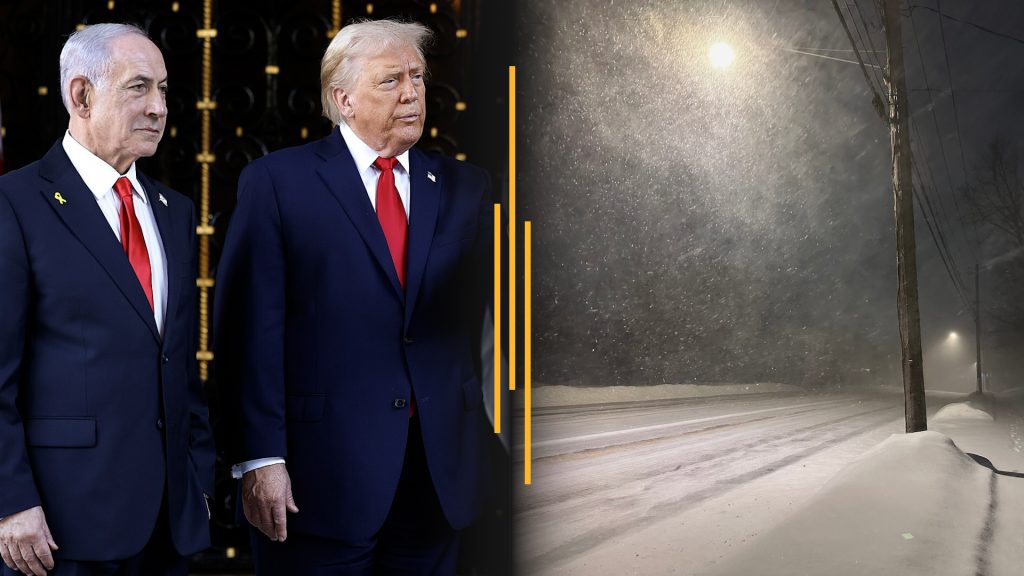
President Donald Trump is drawing a hard line in the Middle East. After meeting with Israel’s prime minister, he’s warning Hamas to disarm, saying there will be “hell to pay” if the deal collapses.
Plus, the U.S. drug war is moving closer to shore. After months of targeting suspected smuggling boats, the U.S. appears to have struck a drug-loading dock inside Venezuela.
And a powerful bomb cyclone that hit the Midwest is now pushing east, bringing snow, ice and dangerous winds. It’s also extending travel disruptions for millions.
These stories and more highlight your Unbiased Updates for Tuesday, Dec. 30, 2025.
Trump says Hamas must disarm or be ‘wiped out’
There are new warnings from President Donald Trump, directed at Hamas and Iran, following his meeting in Florida with Israeli Prime Minister Benjamin Netanyahu.
Trump says he’s pushing to move the Gaza ceasefire into its next phase, and he made clear that it hinges on Hamas disarming quickly.
If it does not, the president warned the terror group could be “wiped out.”
“They’re going to be given a very short period of time to disarm. And we’ll see how that works out,” Trump said. “Steve Witkoff and Jared Kushner will be in charge of that from our side. But if they don’t disarm, as they agreed to do, they agreed it, and then there will be hell to pay for them. And we don’t want that. We’re not looking for that, but … They have to disarm within a fairly short period of time.”
The first phase of the peace plan included an immediate ceasefire, the return of all hostages and remains, and Israel allowing humanitarian aid back into Gaza.
But moving to phase two has stalled, largely because it requires Hamas to give up its weapons.
Trump praised Israel for what he called full compliance with the plan so far, but he acknowledged disagreements with Netanyahu over Israeli settler violence in the West Bank. He said the two are “not on the same page” but will work toward a resolution.

Trump also had a warning for Iran, saying the U.S. could carry out additional military strikes if Tehran attempts to restart its nuclear program.
After American strikes in June, Trump had claimed Iran’s nuclear capabilities were “completely obliterated.” But on Monday, he walked that back slightly, suggesting Iran may be trying to rebuild elsewhere.
“I hope they’re not trying to build up again, because if they are, we’re going to have no choice but very quickly to eradicate that buildup,” Trump said. “So I hope Iran is not trying to build up, as I’ve been reading, that they’re building up weapons and other things. And if they are, they’re not using the sites that we obliterated, but they’re using possibly different sites.”
Iran quickly responded. An adviser to the country’s supreme leader warned that any U.S. aggression would trigger what he calls a “strong, immediate” response.
Trump claims US struck Venezuelan drug dock
President Trump says the United States has carried out what appears to be its first known strike on land inside Venezuela, targeting a dock he described as being used for drug trafficking.
Speaking Monday at Mar-a-Lago alongside Israeli Prime Minister Benjamin Netanyahu, Trump said the U.S. hit boats suspected of carrying drugs and then went further.
“There was a major explosion in the dock area where they load the boats up with drugs,” Trump said. “So we hit all the boats, and now we hit the area. It’s an implementation area, that’s where they implement. And that is no longer around.”
Trump didn’t say how the strike was carried out or by whom, but CNN is now reporting exclusively the attack was a CIA-led drone strike earlier this month on a remote Venezuelan port facility.
According to sources familiar with the operation, the target was a dock the U.S. believed was being used by a Venezuelan criminal group to store drugs and load them onto boats. CNN reports that no one was at the site at the time and that there were no casualties.
The strike marks a major escalation in the administration’s pressure campaign against Venezuelan President Nicolas Maduro.
The United States has already increased its military posture in the region, with about 15,000 American troops and multiple warships deployed in the Caribbean.
And it has been conducting strikes on boats suspected of carrying drugs since September, another of which it launched just Monday
Earlier this month, Trump also ordered what he called a “complete blockade” of sanctioned oil tankers moving in and out of Venezuela, cutting off a key source of revenue for Maduro’s government. He suggested it would be “smart” for Maduro to step down.
Venezuela has not publicly acknowledged the strike, and the CIA has declined to comment. However, CNN reports the operation destroyed the facility and the boats stored there.
Bomb cyclone pushes east, flight delays mount
A powerful winter storm is still leaving its mark on Tuesday, as crews across the Midwest and Northeast dig out from blizzard conditions and travelers face another tough day on the road.
In southern Minnesota, we’re starting to see the damage from the whiteout conditions with jackknifed semis, wrecked cars, and long recovery efforts that simply couldn’t happen when the storm was at its worst.
State officials say dangerous winds and near-zero visibility made travel nearly impossible in some areas.
Farther east, snow and ice continue to grip parts of Maine, where crews are salting roads, clearing lots, and urging drivers to take it slow as temperatures plunge and precipitation refreezes.

At major airports, including Minneapolis-St. Paul, snow-covered taxiways, long check-in lines, and rolling delays are adding to the frustration.
Nationwide, thousands of flights were delayed or canceled Monday as airlines scrambled to recover during one of the busiest travel weeks of the year.
Meteorologists say this storm rapidly intensified into what’s known as a bomb cyclone, driven by a sharp clash between frigid Canadian air and lingering warmth to the south.
The system is now pushing east, bringing a mix of snow, ice, and high winds to the northeast. Officials warn that hazardous travel and scattered power outages could continue into today.
Search for MH370 resumes with new deep-sea expedition targeting different ocean zone
The search for one of aviation’s greatest mysteries has resumed. More than a decade after Malaysia Airlines Flight MH370 vanished without a trace, a new deep-sea search is underway in the southern Indian Ocean, renewing hope for answers long denied to families worldwide.
The Boeing 777 disappeared on March 8th, 2014, just 39 minutes after taking off from Kuala Lumpur en route to Beijing, carrying 239 people.

The last radio transmission, “Good night, Malaysian three seven zero,” was the final human contact before the plane fell silent.
This latest effort is being led by Ocean Infinity, a U.S.-based marine robotics firm operating under a no-find, no-fee agreement with the Malaysian government. The company will be paid up to $70 million only if the wreckage is found.
Search vessels are now scanning a newly targeted 15,000-square-kilometer stretch of the ocean floor, believed to offer the best chance yet of locating the aircraft. The mission is expected to run for up to 55 days, weather permitting.

Investigators believe the plane was deliberately diverted after its transponder was shut off and then flew for hours before running out of fuel somewhere in the remote Indian Ocean. But what happened inside the cockpit and why remain unanswered.
For families, this moment holds both hope and heartbreak. Many have waited more than 11 years — not necessarily for blame, but for certainty. The new mission doesn’t offer clear answers, but it does reopen a door that many have felt has been closed for too long.
Judge backs data sharing, says government can share Medicaid info with ICE
A court victory for the Trump administration as it proceeds with its immigration crackdown, this time in California. A federal judge has ruled that the government may share limited Medicaid data with U.S. Immigration and Customs Enforcement.
Twenty states, led by California, sued to block the practice. A lower court initially agreed and issued a preliminary injunction.
But on Monday, a U.S. District Court judge ruled that the federal government may share basic information with ICE — including biographical details, location data and contact information.
The Centers for Medicare & Medicaid Services (CMS) said it will provide only the minimum required data, such as a person’s immigration status and phone number.
Medical records are not included.
CMS has long maintained a policy of not sharing Medicaid recipient data with immigration authorities. During the case, the judge learned that the agency began sharing information in June, and in July, CMS and ICE entered into a formal data-sharing agreement.
Migrants living in the U.S. illegally are generally not eligible for full Medicaid coverage. But federal law requires all states to provide Medicaid coverage for life-saving emergency care, including emergency room visits, regardless of immigration status.
First 3D interior image of Mexico’s Popocatépetl created
After five years of risky fieldwork, during which they trekked over 17,000 feet up the mountain, researchers have produced the first-ever 3D image of the interior of Mexico’s Popocatépetl volcano.
Using artificial intelligence, the team analyzed seismic data from deep inside the volcano, tracking how rocks, magma, gas and underground water move and interact beneath the surface.

The result is a detailed 3D model that gives scientists an unprecedented view of how the volcano behaves — and, crucially, how it might erupt.
Researchers said the breakthrough will not only improve scientific understanding but also help authorities respond more quickly and accurately when Popocatépetl shows signs of danger.
That matters because roughly 25 million people live within about 60 miles of the volcano. Until now, it was one of the few major active volcanoes threatening lives without a detailed map of what’s happening inside.
More from Straight Arrow News:

Privacy in 2026: Will AI further supercharge surveillance?
The tug of war between widespread data collection and data privacy has only intensified, with disruptive technologies like artificial intelligence supercharging both. Going into 2026, experts say that trends in privacy are at once reassuring and alarming.
The increase in data collection, often in the form of domestic surveillance, has sparked debate across the country. But the level of pushback doesn’t seem to have outpaced the current surveillance rollout.
Experts feel that many of the privacy trends witnessed in 2025 will expand in the coming year. Jake Laperruque, deputy director of the Security and Surveillance Project at the Center For Democracy & Technology, believes the hasty adoption of AI by law enforcement agencies will prove even more controversial in 2026.
“The ramp of immigration surveillance in a variety of ways has been alarming, with the government vacuuming up data from a huge range of sources and pushing for more reckless deployment of surveillance technologies in the field,” Laperruque told Straight Arrow News. “The rapid integration of AI into surveillance and policing is also a big concern — lots of AI technologies have not proven their efficacy or at best only work under very precise and controlled scenarios, yet unvetted and unregulated technologies are being built into surveillance and policing in ways that could lead to errors with extremely serious consequences for individuals.” Read the full story now>
The post Trump escalates warnings to Hamas and Iran; Bomb cyclone moves east appeared first on Straight Arrow News.
Ella Rae Greene, Editor In Chief