Filming ICE agents is a First Amendment right. So why might it land you in jail?
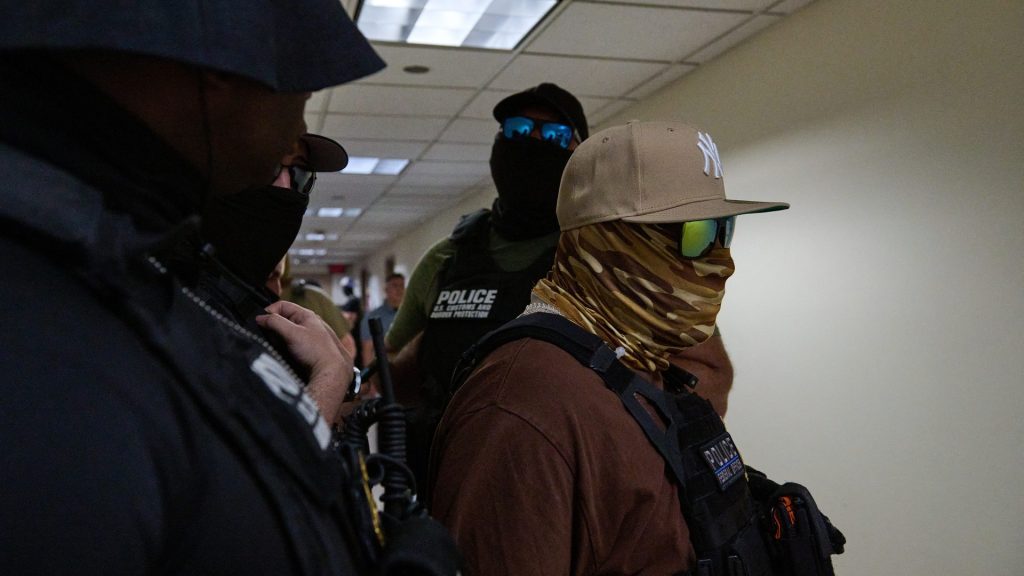
Masked and armed Immigration and Customs Enforcement agents are arresting people for filming their activities in public spaces. Though multiple courts said these arrests violate the First Amendment, the Department of Homeland Security begs to differ.
While an official count of these arrests is not available, ProPublica tracked at least 130 Americans — including at least 12 elected officials — who’ve been arrested for allegedly interfering with and filming agents.
In the ongoing legal battles about whether or not people can legally film ICE activity in public, at least seven federal courts have ruled that it is a First Amendment right to record law enforcement agents in public.
“If you obstruct or assault our law enforcement, we will hunt you down and you will be prosecuted to the fullest extent of the law,” an unnamed DHS spokesperson told Reason. The publication asked the department if it considers recording or following a law enforcement officer in a public place to be obstruction of justice.
“That sure sounds like obstruction of justice,” the DHS spokesperson said. “Our brave ICE law enforcement face a more than 1,150% increase in assaults against them.”
Straight Arrow News contacted DHS to try to clarify the agency’s legal argument, but did not receive a response.
In July, DHS Secretary Kristi Noem declared “violence” as being “anything that threatens [DHS agents] and their safety. It is doxing them. It is videotaping them where they’re at,” she said.
First Amendment right, courts say
Federal courts, including the 1st, 3rd, 5th, 7th, 9th, 10th and 11th circuits, have ruled that the First Amendment protects the rights of people to record law enforcement agents performing their duties in the public sphere.
Adam Rose, the deputy director of advocacy for Freedom of the Press Foundation, said he’s sat in on courtrooms where the DHS’ attorneys try to argue their point.
“This DHS comment is pro-secret police and anti-American,” Rose told Straight Arrow News. “Using an unnamed spokesperson puts it on the same level as an online troll, so let’s not pretend this has any merit. Filming in public is a fundamental American right, as confirmed by federal appeals courts for decades.”
The department’s email responses to Reason seem to defy federal courts saying that the First Amendment protects the right to record police activity in public spaces.
“It’s one of the most direct public statements yet from DHS articulating a policy that treats following, recording, and revealing the identities of federal immigration officers as illegal activity,” C.J. Ciaramella wrote for Reason.“There have been months of news reports and viral showing federal immigration officers threatening, brandishing weapons, and violently detaining people for following and recording them in public.”
But most of ICE’s citizen arrests for allegedly interfering with or assaulting agents have been dropped, ProPublica reported.
“There’s a reason DHS and its counterparts keep getting humiliated in court when they pretend to be victims,” Rose told SAN. “They’re losing in front of juries, judges are calling them not credible. It’s important not to normalize this absurd language from DHS — their ‘sounds like’ doesn’t mask their intent.”
Powerful player
ICE is positioned to receive more money than any other federal law enforcement agency.
This year, Congress earmarked $170 billion for immigration enforcement and border security initiatives, including a $45 billion allocation for immigration detention. Officials plan to increase its detention capacity from a daily average of 41,500 people to at least 100,000, according to Reuters.
Tricia McLaughlin, DHS’ assistant secretary for public affairs, said, “videotaping ICE law enforcement and posting photos and videos of them online is doxing our agents… We will prosecute those who illegally harass ICE agents to the fullest extent of the law.”
But many courts, organizations and people say that videotaping the agents in public is a First Amendment right.
“There is no doubt that DHS is deliberately threatening people who observe and record their activities,” David J. Bier, the director of immigration studies at Cato Institute, told SAN. “This is an attack on their First Amendment rights as well as accountability when agents violate people’s rights in other ways.”
Cato Institute, a libertarian organization, is among the vocal critics of ICE’s arrests of people for filming law enforcement agents. Cato, alongside groups like the ACLU, says that these arrests are unconstitutional, and that ICE has a “systematic” approach to detaining people who film agents’ arrests.
“[I]t is crucial to understand that ICE and the Department of Homeland Security (DHS) consider people who follow DHS and ICE agents to observe, record, or protest their operations as engaging in ‘impeding,’” Bier wrote in an article for Cato. “DHS has a systematic policy of threatening people who follow ICE or DHS agents to record their activities with detentions, arrests, and violence, and agents have already chased, detained, arrested, charged, struck, and shot at people who follow them.”
The ACLU is another group that is an active opponent of these ICE arrests. Scarlet Kim, a senior staff attorney with the ACLU’s Speech, Privacy, and Technology Project, told SAN that it is a core First Amendment right to record publicly visible law enforcement activity.
“It creates an independent record of what officers are doing, and it is no accident that some of the most high-profile cases of misconduct have involved video recordings,” Kim said. “The burning question is why ICE officers feel the need to hide who they are and what they do from the public — masking their faces, lacking visible ID, driving unmarked vehicles, and now attacking those who document their activities.”
The post Filming ICE agents is a First Amendment right. So why might it land you in jail? appeared first on Straight Arrow News.
Ella Rae Greene, Editor In Chief