After 70 years of tracking Santa, the US military says he’s a ‘very special aviator’
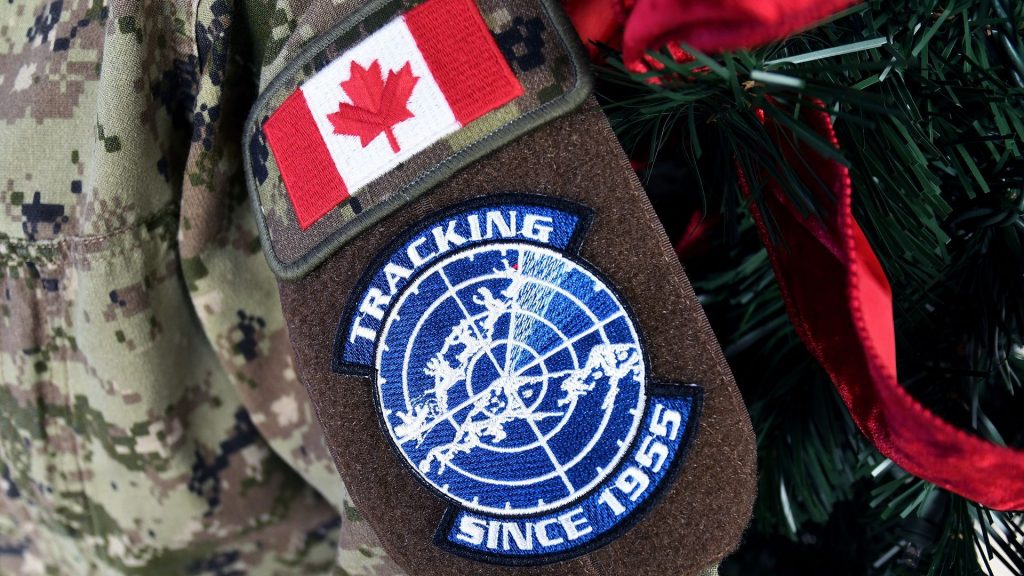
In the winter of 1955, Air Force Col. Harry Shoup was working in the combat operations center of the Continental Air Defense Command, fulfilling the mission set out by President Harry Truman a year earlier: track North America’s skies as an early warning against Soviet nuclear strikes.
This made Shoup a central piece of the United States’ nuclear response strategy. Shoup had a secure phone — red, of course — to be used only to respond to the threat of Armageddon. On this day, the phone rang.
“The red phone ringing is either the Pentagon calling or the four-star general, General [Earle] Partridge calling, so I picked it up, and I said, ‘Yes, sir,’” Shoup recalled in interviews before his death in 2009. Not receiving a response, he repeated himself.
And that’s when the little voice on the other end asked him if he was really Santa Claus.
Tracking a critical aviator
In the intervening years, CONAD became North American Aerospace Defense Command (NORAD), the Cold War ended, and that phone call turned into the 70-year-old tradition now known as NORAD Tracks Santa.
Every year, NORAD receives thousands of phone calls from children around the world, all hoping to get updates on Santa’s whereabouts. In addition to the 1-877-HI-NORAD hotline, the program also includes a browser-based tracker, a mobile app, and web-based calling (to help kids around the world save on international rates). As many as 1,000 volunteers operate the phones in Christmas Eve shifts at NORAD’s headquarters near Colorado Springs.
According to NORAD public affairs officer John Tingle, tracking such a critical aviator through U.S. airspace requires the full use of NORAD’s capabilities.
“Last year we received around 380,000 phone calls on Christmas Eve alone,” Tingle told Straight Arrow News. “We open up the phone lines at 4 a.m. Historically, that’s when our data shows Santa takes off from the North Pole, and we start tracking him with our ground-based radars from the North Warning System, a network of roughly 49 radars.”
“Then we go over to fighter jets, who continue tracking Santa through our airspace and always give him a wave with their wings,” Tingle continued. “Our radars can only go so far, so that’s when our infrared sensors on satellites 22,000 miles above the globe start tracking — Rudolph, mainly, who has a very bright nose on the sensors. It’s kind of like a missile engine, in a sense.”
(In keeping with Straight Arrow News’ commitment to unbiased news coverage, we must pause to note that there are people who say Santa Claus is a myth. But if we may take a rare moment to editorialize: Those people are grinches.)

When the legend becomes fact, print the legend
One persistent question about NORAD Tracks Santa: How did a child dial a secure military telephone at the height of the Cold War? Did it even happen?
Writing in The New York Times in 2015, the historian Michael Beschloss explained that given Shoup was experienced with the media, there’s long been skepticism that it was just a stroke of PR genius:
Had the director Frank Capra made a film about a communications line intended for nuclear war being remade into a children’s conduit to Santa Claus, moviegoers might have thought the story contrived — especially since the colonel who happened to get the accidental call was such a media pro.
Compare that to how Beschloss describes the “grim” mission of CONAD, and you can understand why the command would have enjoyed some lighthearted press:
Combining assets from the Air Force, Army and Navy, it was intended to give the Strategic Air Command of Gen. Curtis E. LeMay early warning of a surprise attack on America — most urgently, from nuclear-armed Soviet bombers roaring over the North Pole and approaching the United States from Canada. After such an alert, the president would have to decide whether to launch a deadly counterattack against the Soviet Union, resulting in a nuclear war that could kill tens of millions of people. President Eisenhower called this the “awful arithmetic” of atomic destruction.
Shoup was asked about the phone call throughout his life, and maintained it was a genuine story, not a publicity stunt. The most common explanation throughout the historical record is that the fateful phone number, ME 2-6681, was printed in The Denver Gazette as part of a Sears Roebuck newspaper ad advertising a hotline for children to speak with Santa. The Gazette has faithfully reprinted the ad in much of its historical coverage, lending credence to the origin story.
“That’s one of the big debates each year,” Tingle told SAN. “Some will say it was a misprint, some will say it was printed correctly but the child called the wrong number. What we do know is the phone was the Continental Air Defense Command.”
But over the years, various details have been inconsistent throughout the historical and journalistic record: the original phone call has been placed on various December dates, sources conflict on whether a girl or boy called, and if a misprinted ad did inspire a flurry of calls from children, as you might expect, it hasn’t been definitively reported. (Santa’s ground speed has also been reported inconsistently. The Associated Press wrote in 1955 that Santa flew at around 45 knots, while Tingle told SAN that Santa travels at the speed of light. Presumably, this can be chalked up to 70 years of propulsion innovations.)
The journalist and historian Matt Novak, in researching the media’s historical coverage of the Sears ad, found a Dec. 1, 1955, article in the Pasadena Independent that says a call to Shoup happened on Nov. 30 of that year. This was the earliest record Novak could find, proving the call at least happened before Christmas Eve. While Novak remained skeptical of the Sears ad, he concluded, “Yes, Colonel Shoup got a call at CONAD that turned out to be a wrong number.”
In any case, NORAD Tracks Santa is now one of the longest-running public initiatives from the U.S. military. The tonality has shifted since the Cold War; the 1955 Associated Press story stated that “CONAD, Army, Navy and Marine Air Forces will continue to track and guard Santa and his sleigh on his trip to and from the U.S. against possible attack from those who do not believe in Christmas,” which is a big contrast to the fun tradition the Santa tracker has become. But it’s still a mission that NORAD takes very seriously.
“This is a regular, everyday mission for us,” Tingle said. “We do this 365 days a year. It’s just this one day that we have a very special aviator going around the globe.”
The post After 70 years of tracking Santa, the US military says he’s a ‘very special aviator’ appeared first on Straight Arrow News.
Ella Rae Greene, Editor In Chief