Trump administration halts offshore wind construction, citing national security risk
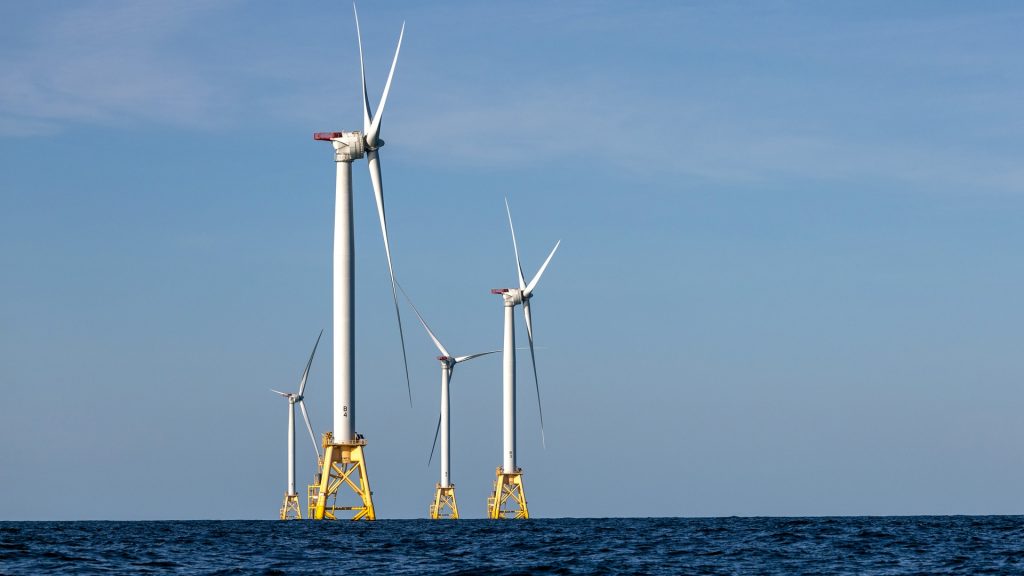
The Trump administration dealt a serious blow to the offshore wind industry by halting construction of existing wind farms Monday. Citing national security concerns that offshore wind interferes with critical radar, the Department of the Interior announced a pause to all offshore wind leases and ordered construction to stop on five ongoing projects.
In a press release, the Interior Department announced “recently completed classified reports” identified “security risks” posed by offshore wind turbines. Previous studies have identified that the size and speed of offshore wind turbines can generate false targets on military radar, and the Interior Department said adapting the radar to avoid false targets could cause it to miss real targets.
The pause on leasing is the latest Trump administration action hampering the offshore wind industry. After narrow stop-work orders on individual projects were lifted or blocked by the courts earlier this year, the across-the-board suspension of active leases marks an escalation against offshore wind. While the Interior Department indicated that the pause will be temporary, it heightens the spectre of uncertainty facing the offshore wind industry.
What is offshore wind clutter?
The announcement cites “clutter” appearing in radar due to wind turbines.
“The clutter caused by offshore wind projects obscures legitimate moving targets and generates false targets in the vicinity of the wind projects,” according to the Interior Department.
The turbine towers are large and reflect on the water, and their blades spin at high speeds. These can show up as false targets on military radar, according to Department of Energy research. The radar’s threshold for detecting targets can be raised to avoid false alarms, but the Interior Department said that also increases the risk of missing a real attack.
Despite these challenges, wind farms have been approved in the past because federal agencies determined the impacts were minimal enough to manage. Since at least 2011, federal agencies have been researching how to mitigate offshore wind’s impact on radar. Wind farms can be designed to lower any interference, and radar software upgrades can yield up to an 86% reduction in radar interference, according to the Department of Energy.
What has been the response?
The leasing pause specifically named five projects currently under construction: Vineyard Wind in Massachusetts; Revolution Wind in Rhode Island and Connecticut; Coastal Virginia Offshore Wind in Virginia; and Sunrise Wind and Empire Wind, both in New York.
The reactions varied along predictable political lines, with Democrats criticizing the Trump administration while Republicans largely stood by the move.
Senate Minority Leader Chuck Schumer, D-N.Y., said halting construction will “kill thousands of good-paying union jobs and raise your electricity bill,” in a social media post.
Dominion Energy, the company behind the 2.6 gigawatt Virginia offshore wind project, said any work stoppage “will threaten grid reliability for some of the nation’s most important war fighting, AI, and civilian assets.”
Dominon’s statement indicated that the Interior Department had ordered construction stopped for 90 days. However, the Interior Department did not provide a specific timeline.
The pause will provide “time to work with leaseholders and state partners to assess the possibility of mitigating the national security risks posed by these projects,” the Interior Department said.
The post Trump administration halts offshore wind construction, citing national security risk appeared first on Straight Arrow News.
Ella Rae Greene, Editor In Chief