Coast Guard under fire after new manual labels swastikas and nooses ‘potentially divisive’
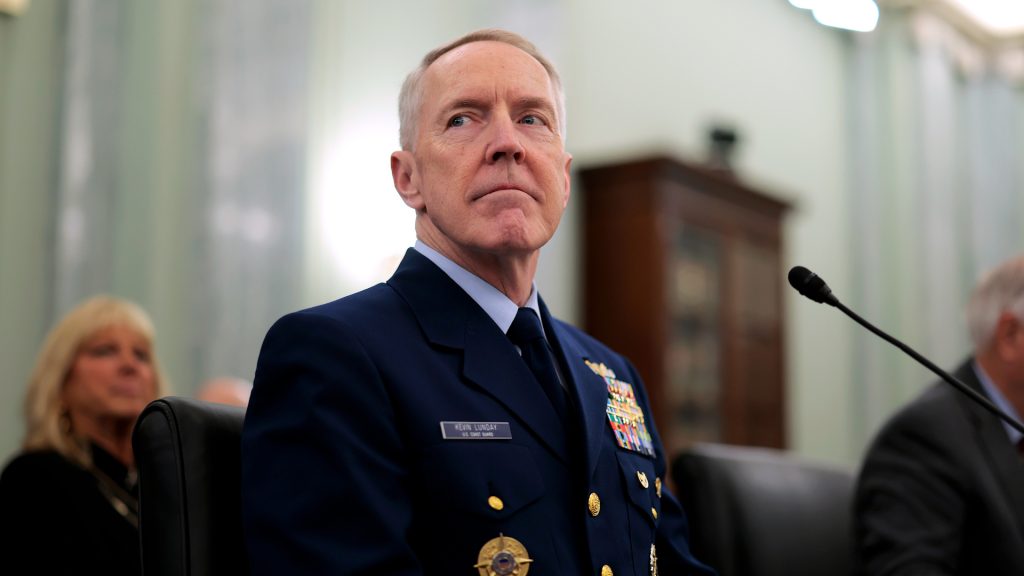
The Coast Guard is engulfed in controversy over a new policy that designates swastikas and nooses as “potentially divisive” rather than forbidden symbols of hate. The uproar led two U.S. senators to place a hold Wednesday on the nomination of a new commandant for the service.
Sens. Tammy Duckworth, D-Ill., and Jacky Rosen, D-Nev., acted after the Coast Guard let a revised anti-harassment policy take effect Monday that seemingly gave commanders the leeway to let symbols like swastikas be displayed by service members.
The new policy created confusion because Adm. Kevin Lunday, the Coast Guard’s acting commandant, separately issued an order in November prohibiting those items, according to The Washington Post.
Now Lunday’s nomination to lead the service is on hold, as Democratic lawmakers question whether the new policy blurs the line between what is allowed and not allowed in Coast Guard spaces.
Why the new language is drawing scrutiny
The new anti-harassment policy shifts away from treating certain imagery as falling within a distinct “hate incident” category. Instead, the policy says conduct previously handled as a potential hate incident, including incidents involving symbols widely identified with oppression or hatred, is now processed as a harassment report when there is an identified aggrieved individual, or handled under a separate “public display” framework.
The instruction says the term “hate incident” is no longer used in policy.
The instruction also adds a reporting timeline. Except for sexual-harassment allegations, reports generally must be made within 45 calendar days of an incident (or the most recent incident in a series). However, the policy gives commanders discretion to accept reports beyond that window.
The new policy
Chapter 11 in the updated policy defines a “public display” as one in which viewing is unavoidable in Coast Guard workplaces, common-access or public areas, or operating facilities. That includes clothing, bumper stickers and readily visible displays in barracks or quarters. Nooses and swastikas are listed among “potentially divisive symbols and flags.” They join other symbols co-opted by hate-based groups as representations of supremacy, intolerance or other bias.
Under the policy, the Confederate battle flag is prohibited as a public display and “shall be removed.” For other potentially divisive symbols, commanders and supervisors must inquire into the display. Then, after consulting Coast Guard lawyers, they may order their removal if the display harms good order, cohesion, morale or mission effectiveness.
The acting commandant’s ‘lawful order’
In a Nov. 20 memo titled as a “lawful order,” Lunday said the Coast Guard “does not tolerate” divisive or hate symbols and flags. He explicitly included a noose and a swastika as examples.
Unlike the new policy’s discretionary standard for many symbols, Lunday’s memo says the display of any divisive or hate symbol is prohibited and “shall be removed” from Coast Guard workplaces, facilities and assets.
The memo also says it supersedes other policies, an assertion echoed this week by Rear Admiral David Barata during a congressional hearing this week. But since the new anti-harassment policy was issued weeks after Lunday’s memo, it remains unclear which standard of behavior applies.
‘Absolutely an anathema’
Members of Congress and others have strongly criticized the new anti-harassment policy.
In a letter to Homeland Security Secretary Kristi Noem, whose agency oversees the Coast Guard during peacetime, Sen. Richard Blumenthal, D-Conn., argued that labeling swastikas and nooses as merely “potentially divisive” lends them legitimacy.
“Granting hate symbols like swastikas and nooses even an ounce of respectability is absolutely an anathema,” Blumenthal wrote. “This edit besmirches the Coast Guard’s honor, and DHS should be ashamed. At a time when antisemitic and racist violence are at unconscionable levels, it is absolutely appalling that DHS is doubling down on such a hateful, destructive policy.”
Historian Deborah Lipstadt, who was a special envoy to monitor and combat antisemitism under President Joe Biden, called the Coast Guard’s instruction “terrifying.”
“What’s really disturbing is, at this moment, when there is a whitewashing of Nazis amongst some on the far right, and Churchill is painted as the devil incarnate when it comes to World War II, to take the swastika and call it ‘potentially divisive’ is hard to fathom,” Lipstadt told The Post. “Most importantly, the swastika was the symbol hundreds of thousands of Americans fought and gave their lives to defeat. It is not ‘potentially divisive,’ it’s a hate symbol.”
The post Coast Guard under fire after new manual labels swastikas and nooses ‘potentially divisive’ appeared first on Straight Arrow News.
Ella Rae Greene, Editor In Chief