Immigration and maritime trade law come together in latest ICE enforcement
The Trump administration is invoking a decades-old trade law with roots in the second Continental Congress amid its immigration push. Meant to protect the country’s merchant marines, immigration officials say it’s the law behind some recent enforcement operations.
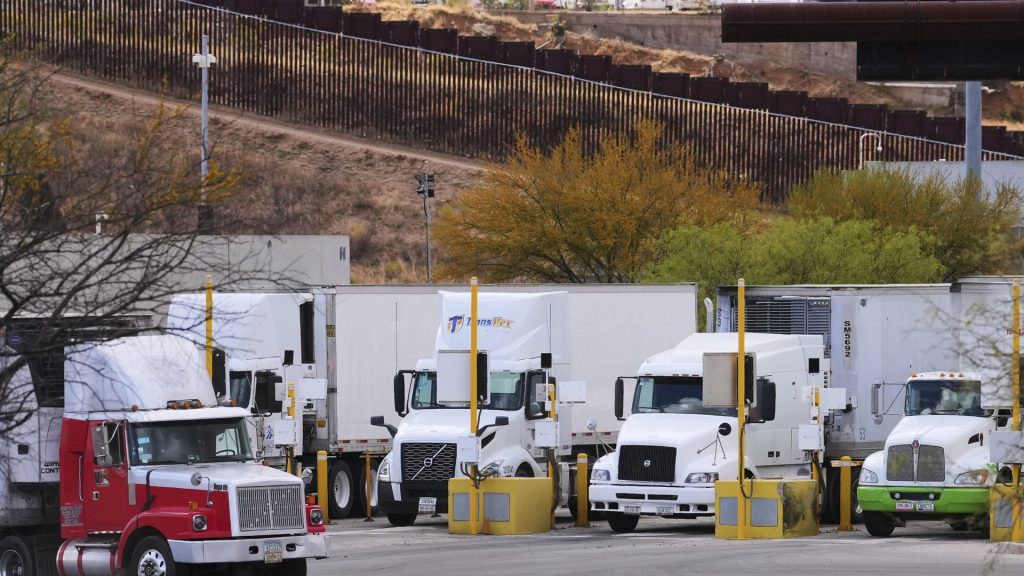
U.S. Customs and Border Protection and the Department of Homeland Security have turned to enforcing cabotage law on trucking companies as part of its enforcement strategy.
What is cabotage?
Cabotage is defined as “the right to operate sea, air, or other transport services within a particular territory.”
“Cabotage is a French word, and it refers to the reservation of domestic trade to the citizens of that country,” Charlie Papavizas, maritime lawyer and partner at Winston & Strawn LLP, told Straight Arrow News.
In essence, cabotage laws make it so foreign transportation companies can’t transport things from two places inside the U.S.
“If a foreign vessel comes to the United States and drops off goods in New York and picks up some goods in New York and then goes to Baltimore and does the same, it can do that,” Papavizas said. “It can go between New York and Baltimore, but it can’t pick up something in New York and drop it off in Baltimore.”
Those vessels could pick up goods in New York, Baltimore or Miami and take them abroad but cannot take them to another location inside the U.S.
“Once in the United States, it can’t take something from one place in the United States to another place in the United States,” Papavizas said. “That’s reserved for U.S. citizen drivers, U.S. citizen-owned trucks.”
It’s unclear how long immigration officials have used cabotage law as part of immigration enforcement. They said these latest stops were about protecting U.S. transporters.
“The enforcement of cabotage laws is vital to protecting the U.S. economy and ensuring fair competition within the domestic transportation industry,” U.S. Customs and Border Protection wrote. “By enforcing these laws, Border Patrol agents help preserve opportunities for U.S. truck drivers and transportation companies, ensuring that American workers remain competitive in the marketplace.”
Papavizas said this enforcement is more focused on immigration than cabotage.
“Are we enforcing the capital laws, or are we enforcing immigration laws, by other capitalized laws,” Papavizas said. “My suspicion was we were probably doing the latter.”
Border Patrol said they are enforcing both immigration and cabotage law as a way to protect U.S. jobs, which is in line with how cabotage law began in the first place.
History of cabotage law
Cabotage law in America dates back to just after the ratification of the Constitution. The second Continental Congress passed the Registry Act in 1793.
“The concept was, we’ll make the foreigners pay more in terms of tonnage taxes,” Papavizas said. “We’ll let the Americans off at one rate, and when the foreigners will pay a much higher rate. So in other words, it wasn’t an outright prohibition for foreign ships carrying goods within the United States, but it was much more expensive.”
That legislation established a federal system to register ships as American, regulate access to U.S. trade and strengthen early American merchant marines by reserving key shipping privileges for U.S.-owned and operated ships.
“It’s entwined with the concept of sovereignty, because if a country is going to have sovereignty over physical territory, it’s going to have a border,” Papavizas said. “Well, what does it mean to have a border unless that country reserves its internal trade to its own people? If it let foreigners do all its internal trade, doesn’t sound like it has much of a border.”
That did turn into an outright prohibition several years later when U.S. lawmakers and former President James Monroe enacted the Navigation Act of 1817. That act formally stated that all cargo moving between American ports must be carried by ships owned by citizens or belonging to West Indian merchants.
All of this built the foundation for the 1920 Merchant Marine Act with the biggest piece of that being the Jones Act.
“The rest of the law deals with the U.S. flag fleet and international trade and how to sell the ships that we had acquired in World War One, and on and on,” Papavizas said.
But the Jones Act required any cargo being shipped between U.S. ports to be in the hands of American-owned and American-built ships. Those ships also needed to be crewed by Americans.
“In common parlance, it’s synonymous with cabotage and the Jones Act,” Papavizas said.
The U.S. then expanded that law to air transportation with the Civil Aeronautics Act of 1938.
When it comes to trucks, the North American Free Trade Agreement, or NAFTA, enacted those same rules on truckers in 1994.
“A Mexico domiciled motor carrier may not provide point-to-point transportation services, including express delivery services, within the United States for goods other than international cargo,” the law read.
Cabotage law enforcement history
Unless you’re in the field, there’s a pretty good chance you’ve never even heard of cabotage law.
“There’s no reason to be,” Papavizas said.
Cabotage law isn’t enforced very often.
“It’s not common, but there have been some pretty high-profile incidents,” he said.
One of those incidents came as recently as 2022 when a federal court in Alaska ruled American Seafoods Company violated the Jones Act with a “Canadian Railway” transportation arrangement.
Basically, foreign ships were bringing cargo up through the Panama Canal to New Brunswick, Canada, where it was offloaded. That cargo was then loaded onto truck trailers and driven onto a two-car, one-track train.
There’s a provision in the Jones Act that exempts shipment routes that are “in part over Canadian rail lines.”
“They rigged up a one-mile Canadian rail, silly thing, that maybe wasn’t even a mile, was 100 yards, and they pretended to go under this exemption,” Papavizas said. “Customs and Border Protection decided that this was a sham, and they penalized everybody. They penalized the truckers, they penalized the warehouses, they penalized the ocean carriers.”
Current enforcement
While these laws were intended to protect merchant marines, it’s now being used for immigration enforcement under the Trump administration.
Earlier this month, dozens of agents with DHS raided a trucking company in Arizona.
“ICE Homeland Security Investigations special agents are executing a federal search warrant near Flowing Wells and Miracle Mile related to cabotage violations and unlawful labor practices,” Yasmeen Pitts O’Keefe, a DHS spokeswoman, said to the Tucson Sentinel. “This is an ongoing investigation.”
Border Patrol agents also made two stops at an immigration checkpoint on I-19 in Nogales, AZ.
In both cases, they said the Mexican nationals driving the trucks violated cabotage laws and other laws.
“Not everybody’s careful about getting legal advice and doing it the right way,” Papavizas said. “So sure, it’s quite possible that people are trying to slide by.”
The post Immigration and maritime trade law come together in latest ICE enforcement appeared first on Straight Arrow News.
Ella Rae Greene, Editor In Chief