Supreme Court weighs free speech rights of anti-abortion ‘crisis pregnancy center’
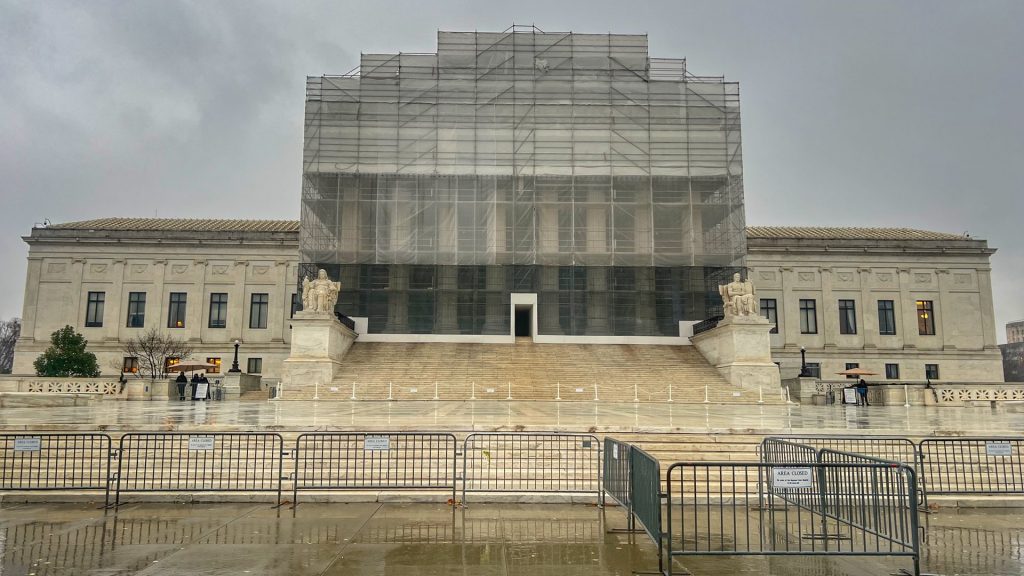
WASHINGTON — The Supreme Court heard arguments Tuesday in a New Jersey case that could influence the ability of states to regulate private organizations that promote controversial viewpoints. During an hour and a half of oral arguments, several justices seemed sympathetic to claims by a chain of “crisis pregnancy centers” that a New Jersey investigation seeking information on their donors violated the First Amendment.
The case hinges on whether First Choice Women’s Resource Centers has met a legal standard to challenge the New Jersey attorney general’s subpoena in federal court, rather than in state.
But the arguments — and questions from justices — centered on the organization’s First Amendment rights.
First Choice sued the state after the attorney general sought to obtain donor lists and other internal records as part of an investigation into allegedly deceptive practices at the organization’s five centers in New Jersey. The goal, attorney Sundeep Iyer representing the state told the court on Tuesday, was to warn donors that the nonprofit may have been masquerading as abortion clinics to deceive women into not having abortions. Similar centers have proliferated around the country since 2022, when the Supreme Court overturned the landmark Roe v. Wade decision that guaranteed the right to an abortion.
First Choice, however, contends the investigation could have a chilling effect on donors. The Department of Justice (DOJ) supported First Choice’s case. Assistant to the Solicitor General of the DOJ, Vivek Suri, gave a ten-minute argument.
Though the case hinged on whether or not legal procedure allows a First Amendment lawsuit to go straight to federal court, circumventing state courts, the justices’ questions wandered into free speech territory.
First Choice’s lawyer, Erin Hawley, began by criticizing a subpoena the New Jersey attorney general issued to obtain information on donors and other internal documents.
“There’s no question that First Choice’s First Amendment interests are arguably burdened by the subpoena,” said Hawley, who’s known for her conservative political work with Alliance Defending Freedom and her marriage to Missouri Sen. Josh Hawley, a Republican.
Justice Clarence Thomas posed the first question.
“Your argument seems to be based on the mere reception of the subpoena, so what did that cause you to do?” Thomas asked.
“It imposes a litigation hold, your honor,” Hawley responded. “And it also chilled First Choice and its donors’ First Amendment rights.”
She later added: “If you fail to obey the subpoena, you could be subject to contempt, you could lose your business license. Those are the death knell for nonprofits like First Choice.”
“I’m sympathetic,“ Justice Amy Coney Barrett told Hawley. She asked whether a letter from the attorney general would have sufficed, rather than a subpoena. Yes, Hawley answered.
Hawley’s oral argument finished in the allotted 20 minutes. Iyer’s argument stretched for 45 minutes, as he fielded questions from justices — some skeptical, mainly from the three of the court’s conservative justices: Barrett, Samuel Alito, and Neil Gorsuch.
The court honed in on whether New Jersey’s subpoena was self-executing — that is, whether it took effect right away and immediately caused a chill to First Amendment rights. Iyer argued it was not self-executing.
Iyer also argued that if the court allowed First Choice to challenge the subpoena in federal court, it could open the floodgates for an overwhelming number of subpoena challenges.
“This would represent a pretty dramatic sea change in historical practice,” Iyer said, adding that 50,000 subpoenas were issued nationwide last year. “So this would be a pretty extraordinary change. And I think the risk would be that federal courts would potentially be inundated by these subpoena cases.”
The court is not likely to rule in the case until next year. But the questions posed during oral arguments suggested a majority of justices may side with First Choice. The ACLU is among the organizations that have filed briefs siding with First Choice.
“Two things suggest that First Choice will win,” Thomas Jipping, a senior legal fellow at the conservative think tank Heritage Foundation, told Straight Arrow News. “[L]iberal groups, such as the ACLU, filed briefs on their side, and both conservative and liberal justices asked similar kinds of questions.”
“That suggests they are agreed on the basic underlying issue that the New Jersey AG went too far,” Jipping said, “and any differences will be on technical issues that will affect how broad or narrow the opinion will be.”
The post Supreme Court weighs free speech rights of anti-abortion ‘crisis pregnancy center’ appeared first on Straight Arrow News.
Ella Rae Greene, Editor In Chief