Is the Beechcraft M-346N the next evolution in Navy flight training?
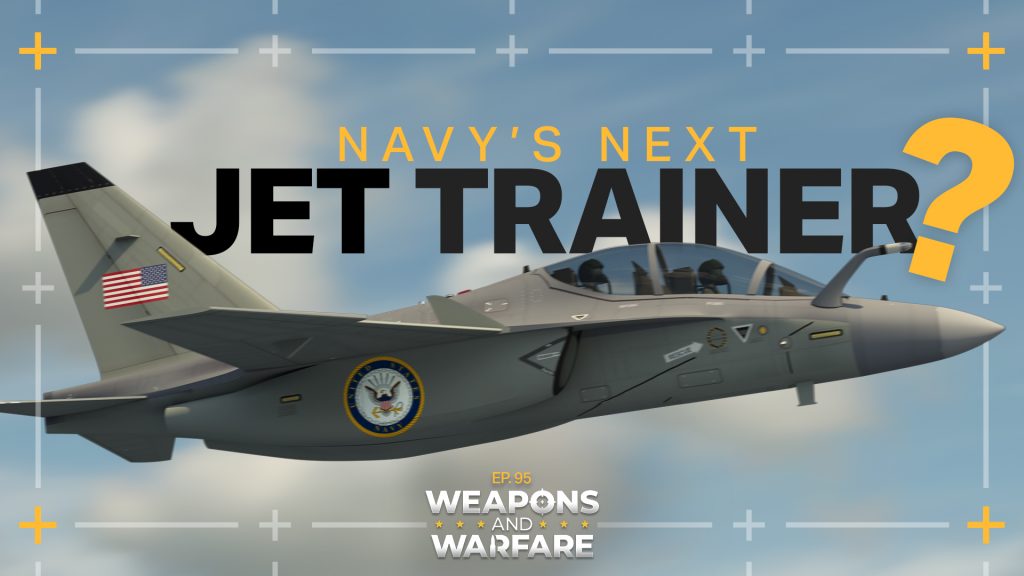
This week on Weapons and Warfare, host Ryan Robertson explores the groundbreaking partnership between Textron and Leonardo to develop the Beechcraft M-346N as a potential next-generation training jet for naval aviators. Ryan hits the tarmac to get an up-close look at the innovative design features that set the M-346N apart, hear insights about the collaboration’s significance and discover how this advanced training aircraft is poised to enhance naval pilot readiness for modern combat challenges.
For our Weapon of the Week, we take a look at AimLock’s innovative modular counter-unmanned aerial systems (CUAS), designed to enhance aerial defense capabilities. With a focus on adaptability and efficiency, these cutting-edge systems provide military and security forces with the tools needed to detect, track and neutralize rogue drones across diverse operational environments.
Textron Aviation Defense and Italy’s Leonardo presented the Beechcraft M-346N as a contender to replace the U.S. Navy’s aging fleet of T-45 training aircraft. The companies said the jet offered advanced technology, proven performance and features designed to prepare student pilots for the next stage of flight training.
The M-346N was a variant of the M-346, originally designed by Leonardo, but modified for U.S. Navy requirements. Matt Hall, director of North America sales, training and services for Textron Aviation Defense, said the aircraft represented the next chapter in the company’s long partnership with naval aviation.
“We have a long history in naval aviation training, stemming all the way back to World War II,” Hall said. “Aircraft like the T-34, the T-6, the T-44, the T-54 and now we hope will be the M-346N, that the Navy will move forward with for purchase for the undergraduate jet training system.”
Textron and Leonardo emphasized the jet’s fully digital flight controls, fly-by-wire technology and advanced training system, which included a carrier-landing simulator. Hall said the aircraft’s data link set it apart by allowing students to train in complex scenarios that combined live aircraft, simulators and constructive forces monitored in real time.
“You could have aircraft flying with other aircraft, aircraft flying with simulators, and you could have those constructive forces showing up on an air-to-air radar so a student can do an intercept,” Hall said. “An instructor could inject new threats into the scenario the student may not have expected. Even with one aircraft airborne at a time, you could get a very complex training scenario and make the most efficient training possible.”
The M-346 platform had already logged more than 150,000 flight hours over the past decade and was flown by more than half a dozen countries. Hall said the aircraft had gone through multiple updates and improvements, giving the Navy a proven system rather than an untested design.
Another feature highlighted by Textron was the elevated rear cockpit, which gave instructors a clear view over the student pilot’s head. Hall said the visibility made it feel as though he was flying from the front seat during a recent flight.
“One of the main reasons for that would be in the landing pattern,” Hall said. “The visibility over the top of the student’s head in the front cockpit has great capability for that.”
As for when the M-346N might start appearing in the skies, the Navy is set to hand out the contract for the Undergraduate Jet Training System program in January 2027.
Weapon of the Week: AimLock develops autonomous counter-drone system
Cheap, off-the-shelf drones have become one of the most persistent threats on modern battlefields, drawing comparisons to improvised explosive devices for their ability to strike quickly, evade detection and cause widespread damage.
AimLock, a Colorado-based defense company, has positioned itself as a solution to that growing danger. The firm developed autonomous counter-unmanned aerial systems designed to detect, track and neutralize drones with speed and precision.
Bryan Bockman, AimLock’s president and chief executive officer, said the company’s Keystone targeting module accelerated target acquisition and calculated advanced fire controls.
“Most of the time, that is deployed onto a remote weapons turret,” Bockman said. “When we integrate into larger systems, that same module integrates radar sensors, camera sensors and any other kind of effector like missiles and rockets as we need them.”

Bockman said the U.S. military already had a wide arsenal of kinetic weapons, including machine guns, grenades and rockets, but those systems risked becoming obsolete if they could not be deployed at the right time.
“We focus on building safe and secure autonomy to control these weapons so that the war fighter can focus on getting their job done,” he said.
AimLock designed its systems to be modular, allowing components to be swapped out as technology advanced.
“As soon as one piece becomes obsolete, you can replace just that one piece, and the rest of the system keeps marching forward,” Bockman said.
The company operates in a global market regulated by the U.S. State Department. NATO allies and Indo-Pacific partner nations are verified recipients of export licenses. AimLock ensures that electronics, software and manufacturing partners are properly licensed before transferring equipment abroad, which is then followed by training and sustainment operations.
Looking ahead, AimLock has partnered with Overland, AI MVP Robotics and Teledyne to deliver experiments scheduled for next year. Bockman said war fighters have already begun receiving new systems to test and develop ways to bring AimLock technology into combat.
The post Is the Beechcraft M-346N the next evolution in Navy flight training? appeared first on Straight Arrow News.
Ella Rae Greene, Editor In Chief